Service Guide
Landscaping
in California
Drought-tolerant, water-smart gardens that thrive in the California climate. From California natives to Mediterranean gardens, your complete guide.
$15-$50
Per sq ft installed
50-75%
Water savings
$5/sqft
LADWP rebate
365 Days
Year-round bloom
Understanding California Landscaping
Why California Landscaping Has Evolved
Landscaping in California has undergone a profound transformation. The traditional green grass lawn has given way to water-smart design that is not only more sustainable but often more beautiful and more uniquely suited to the Southern California lifestyle.
The California basin sits in USDA Hardiness Zone 10a to 11a, with a Mediterranean climate shared by only five regions on Earth. The plants that evolved in these regions represent some of the most beautiful and diverse flora on the planet, and they grow spectacularly in California with a fraction of the water a traditional lawn requires.
Did You Know?
Drought-tolerant landscaping uses 50-75% less water than traditional grass lawns while supporting native pollinators, birds, and butterflies that are vital to California's ecosystem.
How Much Does Professional Landscaping Cost in California?
Professional landscaping in California costs $15 to $50 per square foot for design and installation. A full front yard transformation of 500 to 1,000 square feet typically runs $7,500 to $50,000. A complete property renovation of 2,000+ square feet ranges from $30,000 to $100,000+. LADWP offers a $5 per square foot turf replacement rebate (up to $25,000) for homeowners replacing grass with drought-tolerant landscaping.
Drought-Tolerant Design & Native California Plants
Drought-tolerant landscaping in California is not about replacing your lawn with rocks and gravel. Done well, it is a design-forward approach that produces gardens far more visually interesting than a traditional grass lawn while using 50 to 75% less water. The key is understanding xeriscaping principles and selecting the right combination of native California plants and climate-adapted Mediterranean species.
Xeriscaping principles form the foundation of water-smart landscape design. The approach centers on seven strategies: planning and design for water efficiency, grouping plants by water needs (hydrozoning), reducing or eliminating turf grass, improving soil with compost and amendments, applying 3 inches of mulch to reduce evaporation, using efficient drip irrigation, and selecting climate-appropriate plants. A well-designed xeriscape does not look like a desert; it looks like a curated garden that belongs in the California landscape.
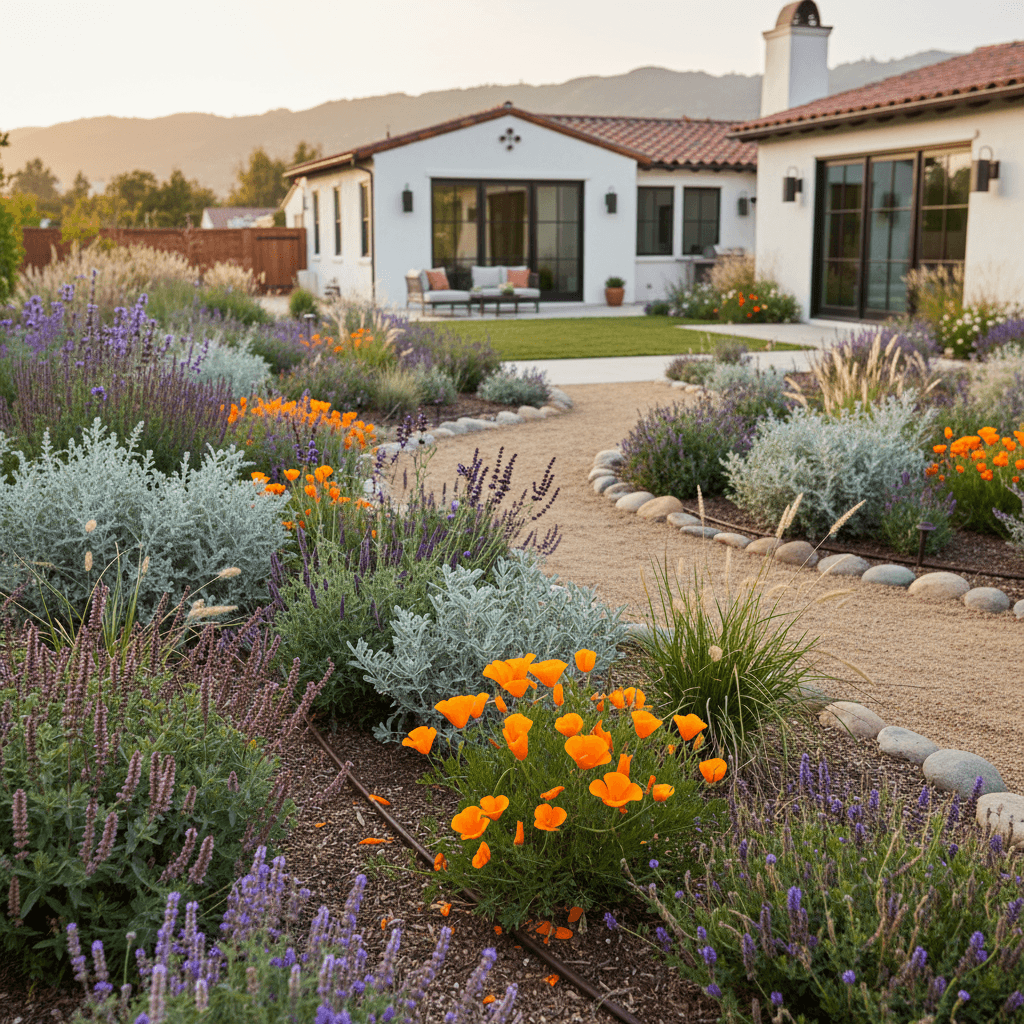
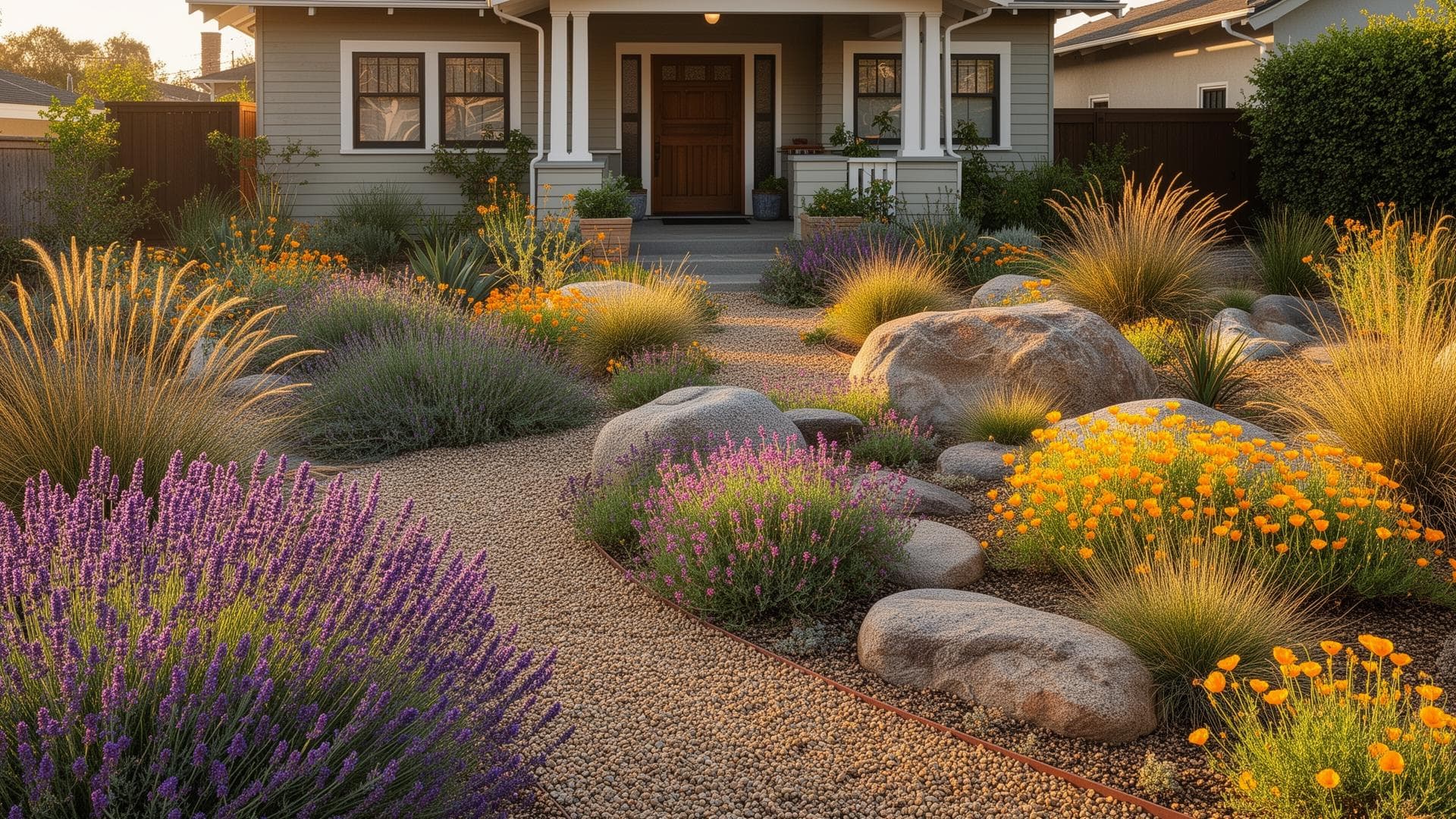
Native California plants are the backbone of drought-tolerant landscaping because they evolved in the state's Mediterranean climate and thrive on natural rainfall once established. Top performers include California poppy (Eschscholzia californica), the state flower that produces brilliant orange blooms from February through September. Manzanita (Arctostaphylos) offers year-round sculptural form with smooth red bark and produces berries that attract birds. Ceanothus (California lilac) delivers spectacular blue-purple flower clusters in spring and grows as ground cover, shrub, or small tree depending on the variety. White sage (Salvia apiana) and black sage (Salvia mellifera) are fragrant, pollinator-attracting shrubs that require almost no supplemental water. California buckwheat (Eriogonum fasciculatum) is one of the most important native pollinator plants and thrives on neglect. Deer grass (Muhlenbergia rigens) provides graceful ornamental grass texture and grows to 4 feet tall.
Mediterranean species that originate from similar climates around the world also perform exceptionally in California. Lavender (Lavandula) is a workhorse plant that offers fragrance, pollinator value, and beautiful purple flower spikes on minimal water. Rosemary (Salvia rosmarinus) serves as a ground cover, hedge, or trailing plant and is virtually indestructible in the California climate. Olive trees (Olea europaea) provide structure and shade with a distinctly Mediterranean aesthetic. Bougainvillea produces months of vibrant color and is one of the most drought-tolerant flowering vines available.
Water Savings by the Numbers
A 1,000 square foot grass lawn in California requires approximately 44,000 gallons of water per year. Replacing that lawn with drought-tolerant landscaping reduces water use to 11,000 to 22,000 gallons annually, saving $200 to $600 per year on water bills depending on local rates. Over 10 years, that is $2,000 to $6,000 in water savings alone, not counting the LADWP turf replacement rebate.
Smart Irrigation & LADWP Rebate Guide
Efficient irrigation is the backbone of every successful drought-tolerant landscape in California. Even the most water-wise plant selection will fail if the irrigation system delivers water inefficiently. Upgrading from traditional spray heads to smart controllers and drip irrigation can reduce outdoor water consumption by 40 to 60% while keeping plants healthier.
Smart irrigation controllers like Rachio 3 and Hunter Hydrawise have transformed residential irrigation management. Priced at $200 to $400 installed, these Wi-Fi-connected controllers automatically adjust watering schedules based on real-time weather data, evapotranspiration rates, soil type, and plant water needs. They reduce water use by 20 to 40% compared to traditional timer-based controllers. Most smart controllers integrate with smartphone apps, allowing homeowners to monitor and adjust irrigation remotely. California law (AB 1668 and SB 606) mandates water budgets for residential properties, and smart controllers help homeowners stay within their allocation.
Drip irrigation versus spray heads is one of the most impactful upgrades a California homeowner can make. Traditional spray heads operate at 50 to 70% efficiency, meaning 30 to 50% of the water is lost to evaporation, wind drift, and runoff. Drip irrigation delivers water directly to the root zone at 90% efficiency or higher. For planted beds, shrubs, and trees, drip irrigation is unequivocally the better system. Micro-spray and rotary nozzles (such as Hunter MP Rotator) are effective middle-ground options for ground covers and areas where drip is impractical, operating at approximately 80% efficiency.
LADWP Turf Replacement Rebate Program
LADWP offers $5 per square foot for residential turf replacement, with a maximum rebate of $25,000 (covering up to 5,000 square feet). The Metropolitan Water District (MWD) adds an additional $2 per square foot where available, bringing the total potential rebate to $7 per square foot. To qualify, homeowners must apply and receive pre-approval before starting work. Requirements include: installation of drip irrigation, a minimum of 3 plants per 100 square feet, at least 3 inches of mulch, stormwater capture features, and no invasive species. The rebate covers living turf removal only (not artificial turf). Processing takes 8 to 12 weeks after final inspection. For a typical 1,000 square foot front yard conversion, the rebate can offset $5,000 to $7,000 of the total project cost.
Additional rebate considerations: Some water agencies offer rebates for smart irrigation controllers ($50 to $200), rain sensors ($25 to $75), and high-efficiency nozzles ($3 to $4 per head). Check with your local water provider for current programs. Rebates can be combined with federal tax incentives for water conservation improvements in some cases. A qualified landscape contractor familiar with California rebate programs can help maximize your savings and ensure all documentation requirements are met.
Why Go Drought-Tolerant
6 Reasons to Transform Your California Landscape
50-75% Water Savings
Drought-tolerant landscapes use a fraction of the water traditional lawns require. Your water bill drops dramatically while your garden thrives on natural rainfall and minimal supplemental irrigation.
LADWP Rebate: Up to $25,000
LADWP pays $5 per square foot when you replace grass with qualifying drought-tolerant landscaping, up to $25,000 per property. Combined with MWD rebates, you can offset a significant portion of project cost.
Year-Round Color & Beauty
Properly designed drought-tolerant gardens bloom in every season. California natives offer spring wildflowers, summer sage, fall berries, and winter evergreen structure.
Supports Wildlife & Pollinators
Native plants attract and sustain butterflies, hummingbirds, bees, and other pollinators essential to California's ecosystem. Your garden becomes a living habitat, not just decoration.
Minimal Maintenance
No mowing, no fertilizing, no pesticides, no weekly watering schedules. Drought-tolerant gardens need only occasional pruning, seasonal cleanup, and minimal irrigation once established.
Increases Property Value
A professionally designed landscape is one of the highest-ROI home improvements. In California's competitive market, a stunning drought-tolerant garden signals sophistication and sustainability.
The Process
How a Landscape Project Works
Consultation & Site Analysis
Day 1A landscape designer visits your property to assess soil type, sun exposure, existing plants, drainage patterns, slope, and microclimates. Aesthetic preferences, lifestyle needs, budget, and LADWP rebate eligibility are discussed.
Custom Landscape Design
Week 1-3A comprehensive landscape plan is created showing plant selections and locations, hardscape elements, irrigation zones, and lighting. A detailed plant palette with photos, mature sizes, water requirements, and bloom seasons is included.
Rebate Application & Material Sourcing
Week 2-4If pursuing LADWP or MWD rebates, the application is submitted with required plans and photos. Pre-approval takes about 2 weeks. Plants are sourced from local nurseries specializing in California natives and Mediterranean species.
Installation
1-4 WeeksExisting lawn and unwanted vegetation are removed, soil amended, irrigation installed (drip lines, smart controller, rain sensor), hardscape placed, plants installed per design, and 3 inches of organic mulch applied.
Establishment & Handover
Completion + 90 daysA garden walkthrough, irrigation system explanation, and plant care guide are provided. During the first 90 days, return visits adjust irrigation and replace any plants that don't establish. LADWP post-project documentation is assisted.
Compare Styles
Landscape Styles for California Homes
| Style | Cost/sqft | Water Use | Maintenance | Year-Round Color | Wildlife | LADWP Rebate | Best For |
|---|---|---|---|---|---|---|---|
| California Native★ BEST for ecology | $15-$35/sqft | Very Low | Very Low | ★★★★ | ★★★★★ | Yes | Eco-focused, hillsides |
| Mediterranean★ MOST POPULAR | $20-$40/sqft | Low | Low | ★★★★★ | ★★★★ | Yes | Traditional homes |
| Succulent/Modern | $18-$35/sqft | Very Low | Very Low | ★★★ | ★★ | Yes | Modern/contemporary |
| Mixed Drought-Tolerant | $15-$45/sqft | Low | Low | ★★★★★ | ★★★★ | Yes | Versatile all-styles |
| Edible Garden | $20-$50/sqft | Moderate | Moderate-High | ★★★ | ★★★ | Yes (with conditions) | Foodies, families |
California Native★ BEST for ecology
Best for: Eco-focused, hillsides
Mediterranean★ MOST POPULAR
Best for: Traditional homes
Succulent/Modern
Best for: Modern/contemporary
Mixed Drought-Tolerant
Best for: Versatile all-styles
Edible Garden
Best for: Foodies, families
Editor's Pick: A mixed approach combining California native foundation plants with Mediterranean accent plants delivers the best combination of water savings, year-round beauty, low maintenance, and wildlife support. This is what experts recommend for most California homes.
California Local Guide
Rebates, Planting Seasons & Neighborhood Guide
LADWP Turf Replacement Rebate
LADWP pays $5/sqft to replace grass with drought-tolerant landscaping, up to $25,000 per property. Min 250 sqft, max 5,000 sqft. Pre-approval required. Requirements: drip irrigation, 3+ plants per 100 sqft, stormwater capture feature, 3" organic mulch, no invasive species. Synthetic turf does not qualify.
MWD Stacking Rebate
Metropolitan Water District offers an additional $2/sqft through SoCal Water$mart, stackable with LADWP. Combined: up to $7/sqft. MWD also offers $100 per tree installed (up to 5 trees). Same program requirements apply.
Smart Irrigation & Water Harvesting
A 1,500 sqft roof can capture approximately 900 gallons from 1 inch of rain. Rain barrels (50-100 gal) and cisterns (500-5,000 gal) store water for dry months. Greywater systems are legal in California. A well-designed system can reduce municipal water use by 70-90%.
Best Planting Season
Fall (October through December) is ideal for California planting. Plants establish root systems using natural winter rainfall, reducing supplemental irrigation during the critical establishment period. Spring (February-April) is second-best but requires more watering through the first summer.
Neighborhood Plant Guide
Hillside
Hollywood Hills, Bel Air, Mt. WashingtonManzanita, ceanothus, California buckwheat. Deep-rooted natives that stabilize slopes and prevent erosion. Fire-resistant species essential in VHFHSZ areas.
Coastal
Santa Monica, Venice, MalibuSalt-tolerant species like coast sunflower, beach evening primrose, and seaside daisy. Australian natives (grevillea, kangaroo paw) thrive here.
Valley
Sherman Oaks, Encino, NorthridgeHeat-tolerant varieties like desert willow, palo verde, and Texas ranger. Shade trees like coast live oak critical for urban cooling.
Urban
Silver Lake, Echo Park, DTLAContainer gardens, vertical plantings, and compact natives for smaller spaces. Edible gardens with citrus, herbs, and vegetables are popular.
Reviews
What California Homeowners Say
"We replaced our water-guzzling front lawn with a stunning California native garden. The LADWP rebate covered nearly a third of the cost, our water bill dropped by $120 per month, and honestly our yard has never looked this beautiful. Neighbors stop to take photos. Hummingbirds visit every day. We went from embarrassed about our dead lawn to proud of the most gorgeous yard on the block."
Susan & Tom B.
Highland Park · Front yard native garden, 800 sq ft
"The Mediterranean garden is like having a Tuscan villa in Pasadena. Absolutely stunning."
Maria C. · Pasadena
"Our water bill went from $280 to $95 a month. The garden pays for itself."
Kevin J. · Northridge
"The installer handled the entire LADWP rebate process. We got $4,000 back."
Andrea L. · Los Feliz
"The smart irrigation system is incredible. It waters perfectly based on weather."
Phil R. · Culver City
"Butterflies and hummingbirds everywhere now. Our garden is alive."
Diana K. · Silver Lake
FAQ
Frequently Asked Questions
Ready to start your landscaping project?
Get matched with 2-3 vetted California contractors. 100% free, no obligation.
Find My ProsKeep Reading
Explore More California Guides
Your Next Step: Getting a Landscaping Quote in California
Browse top-rated landscape designers in California, compare options, and get matched for free.
Find a Trusted ProFree to use · Independent reviews · We respond within 24 hours