Cost Guide · Updated November 2026
Patio Cover Cost
in California
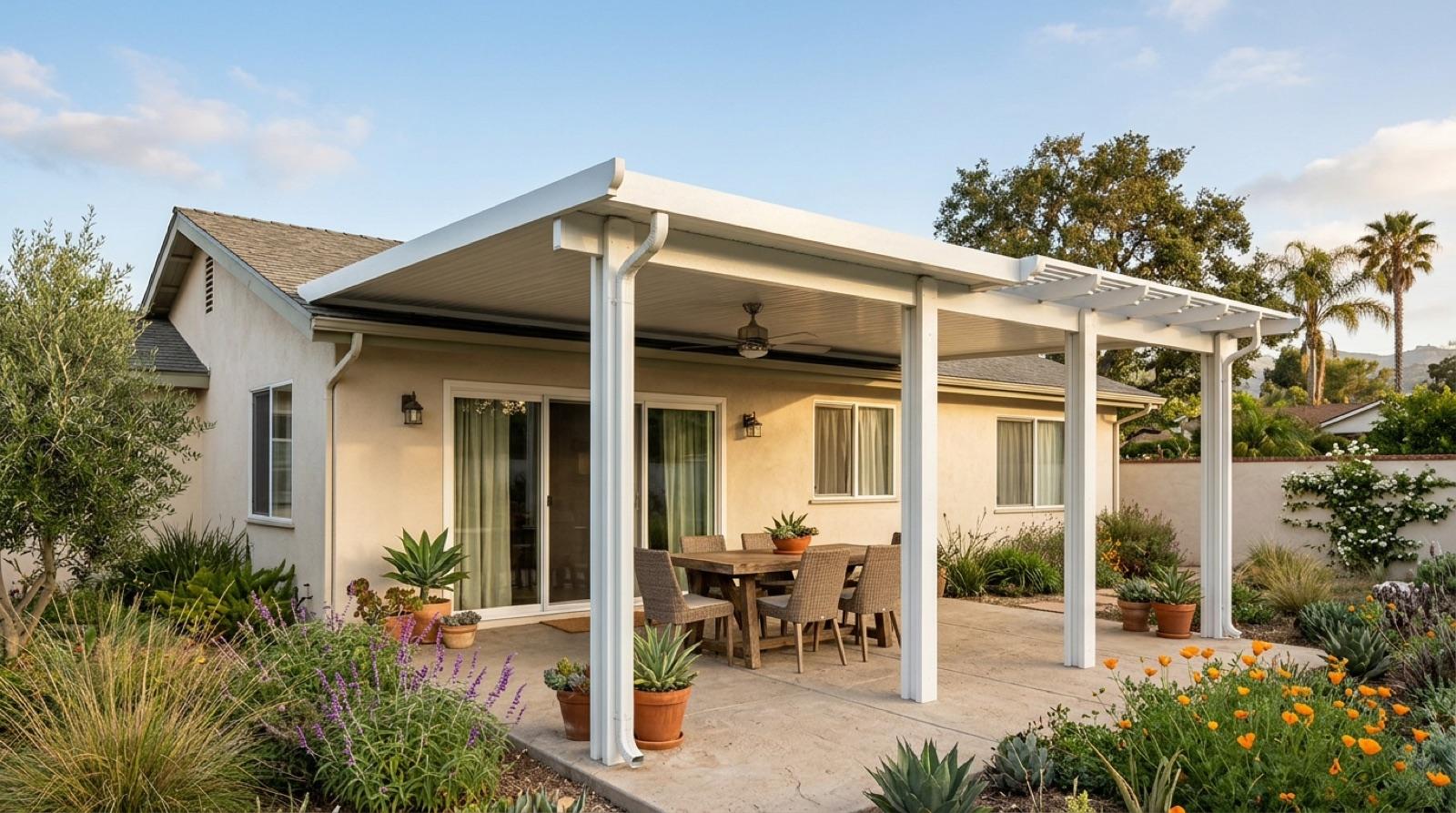
An installed aluminum patio cover costs about $18 to $55 per square foot in California, roughly $5,000 to $14,000 for a typical 12 × 20 ft cover over an existing patio. Insulated roofs run $45 to $75 per square foot and motorized louvered roofs $100 to $200.
$18–$55
Per sq ft, aluminum, installed
$5k–$14k
Typical 12 × 20 ft cover
$100–$200
Per sq ft, motorized louvered
300 sq ft
San Diego permit-free limit
Patio Cover Cost by Type
An attached aluminum patio cover costs $18 to $55 per square foot installed in California, depending on whether the roof is lattice, solid or insulated. Wood costs about the same as insulated aluminum, and motorized louvered roofs cost several times more.
These Los Angeles prices assume an attached, rectangular cover on an existing concrete patio. They exclude permits, engineering, electrical, footings for a freestanding cover and any new concrete.
| Cover type | Installed / sq ft | 12 × 20 ft (240 sq ft) |
|---|---|---|
| Aluminum lattice (open, filtered shade) | $25 – $45 | $6,000 – $10,800 |
| Aluminum solid (full shade) | $30 – $55 | $7,200 – $13,200 |
| Insulated aluminum (foam-core panels) | $45 – $75 | $10,800 – $18,000 |
| Wood (Douglas fir or redwood) | $40 – $80 | $9,600 – $19,200 |
Source: Green Design and Build, patio cover cost in Los Angeles, September 2026. Other LA installers publish lower aluminum prices: NP Line Design lists lattice at $18 to $28 and insulated at $36 to $55 per square foot (April 2026), and Pacific Pavers in Orange County lists Alumawood at $18 to $55 (February 2026).
Louvered roofs
Motorized louvered roofs tilt their blades open for sun and close them for shade or rain. Valley Patios, an Equinox dealer, says pricing starts around $100 per square foot with most projects at $120 to $160. NP Line Design lists StruXure at $150 to $200 per square foot, or $36,000 to $48,000 for 12 × 20 ft.
Sources: Valley Patios, 2025; NP Line Design, April 2026.
What a 12 × 20 Patio Cover Costs
A 12 × 20 ft cover (240 sq ft) is the most common size on a California tract-home patio. Here is what installers who publish prices charge for it.
| What it covers | Price |
|---|---|
| Alumawood lattice, 3 posts, existing slab: kit onlyValley Patios | $2,579 |
| Same cover, installedValley Patios | $4,274 |
| Yellow pine wood lattice, installedValley Patios | $10,132 |
| Southern California medium cover, installedEveryday Patio | $5,200 – $12,800 |
| Los Angeles aluminum, lattice to insulatedGreen Design and Build | $6,000 – $18,000 |
| Los Angeles aluminum cover, size not statedAPLA Construction | $6,000 – $14,000 |
Valley Patios also says the median price in its own sales history is $29.26 per square foot, which works out to about $7,000 for 240 sq ft by our arithmetic. Most homeowners add upgrades: Valley puts a typical Alumawood job with common upgrades at $22.74 to $37.45 per square foot, roughly $5,000 to $12,500.
Doing it yourself: Try-Tech Patios in Oroville sells DIY kits from $3,955 for a 15 × 20 ft lattice cover and $6,795 for a 14 × 20 ft insulated cover, and says installers often charge about twice the kit price. A kit still needs a permit in most cities. See Try-Tech kit prices.
Every California price above comes from a company that sells patio covers. We found no independent California dataset, so use these to judge whether a quote is in the normal band, then compare bids line by line.
What Costs Extra
The base price covers the posts, beams and roof. These are the lines that make two quotes for the same size look nothing alike.
| Item | Typical cost |
|---|---|
| Lights, fan and wiringGreen Design and Build (LA) | $1,000 – $3,500 |
| Freestanding instead of attachedGreen Design and Build | +$1,500 – $4,000 |
| Engineering letter or drawingsGreen Design and Build | $800 – $2,500 |
| New concrete slabGreen Design and Build | $8 – $18 per sq ft |
| Concrete footingsThis Old House | $150 – $500 each |
| Motorized retractable side screensValley Patios | $3,500 – $9,500 |
Valley Patios reports that more than 70% of its projects add lights or fans, with wiring averaging $1,640 before the fan itself. Engineering is usually only needed for wood, steel, freestanding or hillside covers; manufactured aluminum systems come with pre-engineered span tables. Sources: Green Design and Build, Valley Patios, This Old House.
Do You Need a Permit for a Patio Cover?
In most of California, yes. The state residential code's permit exemptions cover one-story detached structures up to 120 sq ft and window awnings that project no more than 54 inches, not patio covers. Some cities carve out exceptions, so check with yours. Source: CRC R105.2 exemption list (2025 code).
No building permit for covers up to 300 sq ft on single-family and duplex lots, unless the lot is coastal, historic or environmentally sensitive, or the cover reaches into a setback. Electrical work may still need its own permit.
When a permit is needed: $1,412.54 plan check plus $529.71 inspection, or $1,501.42 plus $353.13 for a pre-approved design.
San Diego County (unincorporated)
Over-the-counter permit: $405 plan review plus $521 permit.
Covers are valued at $34.50 per sq ft, so a 300 sq ft cover pays $325 for the permit and $137 for plan review before surcharges.
$0.54 per sq ft plan check plus $0.66 per sq ft inspection, about $360 for 300 sq ft.
Permit and plan check typically $400 to $1,500, by one LA installer’s estimate.
The Sacramento and Irvine totals are our arithmetic from each city's published fee table.
What the code requires
Where a city adopts the patio cover appendix of the California Residential Code (Appendix BF in the 2025 code), a patio cover must be one story and no taller than 12 feet, keep the long side and one other side at least 65% open, carry a roof live load of at least 10 pounds per square foot, and never be used as a garage, carport, storage room or living space. Wall it in beyond those limits and it no longer counts as a patio cover under this appendix. Source: 2025 CRC Appendix BF.
Manufactured aluminum covers usually come with an ICC-ES evaluation report that shows their spans and loads. Cities accept those reports in place of custom engineering: San Diego offers Rapid Review for covers built to an evaluation report.
Patio Covers in Fire Hazard Zones
California's 2025 Wildland-Urban Interface Code took effect on January 1, 2026. In a fire hazard zone, a permitted patio cover less than 3 feet from the house must be built of noncombustible or ignition-resistant materials, and the code official can require the same out to 50 feet. Source: California WUI Code §504.11.
Aluminum is noncombustible, but check the paperwork: the California supplement to one major aluminum cover's evaluation report says it was not evaluated for use in a Fire Hazard Severity Zone. Ask the installer how the product meets the fire rules where you live. Source: ICC-ES ESR-4436.
The state is also writing "Zone 0" rules for the first 5 feet around homes in the highest-risk areas. The Board of Forestry adopted emergency rules in August 2026 that reach combustible material under decks and pergolas; check their status before you build a wood cover near the house. Source: Best Best & Krieger, September 2026.
Hiring an Installer, HOAs and Property Tax
License: the CSLB's D-3 Awnings classification covers aluminum, metal, vinyl and canvas patio covers, attached or freestanding. General building (B) and carpentry (C-5) contractors can build them too. An unlicensed handyman can only take jobs under $1,000 that need no permit, which rules out almost every patio cover. Source: CSLB D-3 classification.
Down payment: on a home improvement contract it cannot exceed $1,000 or 10% of the price, whichever is less.
HOA: if you live in an HOA, get architectural approval first. Under Civil Code §4765 the association must decide in writing and in good faith, explain any denial, and offer reconsideration at an open board meeting. Source: Civil Code §4765.
Property tax: a new patio cover is new construction. The Orange County Assessor lists patio covers as taxable: the cover's market value is added to your Proposition 13 base and you get a one-time supplemental bill. Replacing an old cover with one of similar size is not taxed. Source: OC Assessor, Tips for Homeowners.
What to ask every installer
- Which product and roof panel, with the evaluation report number for the permit.
- Whether the price includes the permit, engineering, footings and removal of an old cover.
- Attached or freestanding, how many posts, and the post size.
- Electrical: how many lights and fans, and whether the circuit and permit are included.
- Gutters and where the downspouts drain.
- Fire-zone compliance if your lot is in a hazard zone.
Ready to start your patio cover project?
Get matched with 2-3 vetted California contractors. 100% free, no obligation.
Find My ProsWhere These Prices Come From
We compared prices published by Southern California installers with national cost guides, and checked them on November 8, 2026. National guides price a whole covered patio, not just the cover: Fixr puts a 12 × 18 ft patio with pavers and an attached pergola at $4,000 to $12,000, and This Old House puts a roof over a patio at $14,000 to $31,000, averaging $21,000.
California installers price the cover alone over an existing slab, which is why their numbers look lower. For the patio itself, see our concrete and paver patio cost guide; for open-roof shade, see pergola cost in California.
Related reading
How a Patio Cover Project Works
Decide the shade you want
Choose lattice for filtered shade, a solid or insulated roof for full shade and rain cover, or a louvered roof that does both.
Measure and check the rules
Measure the patio, then ask the city whether a permit is required, whether the lot is in a fire hazard zone, and whether an HOA must approve the design.
Get itemized quotes
Ask two or three licensed installers to price the same size, product, posts, footings, electrical and permit, and to list exclusions.
Permit and install
The installer pulls the permit with the product's engineering, builds the cover, and the city inspects it before final approval.
Common Questions
Patio Cover Cost FAQ
Methodology
How Golden Yards builds ranges
Review how we normalize California costs, site conditions, source limits, and editorial updates.
Read methodologyGlossary
Terms that change bids
Define base prep, drainage, allowances, setbacks, permits, and other outdoor project terms.
Browse termsKeep Reading