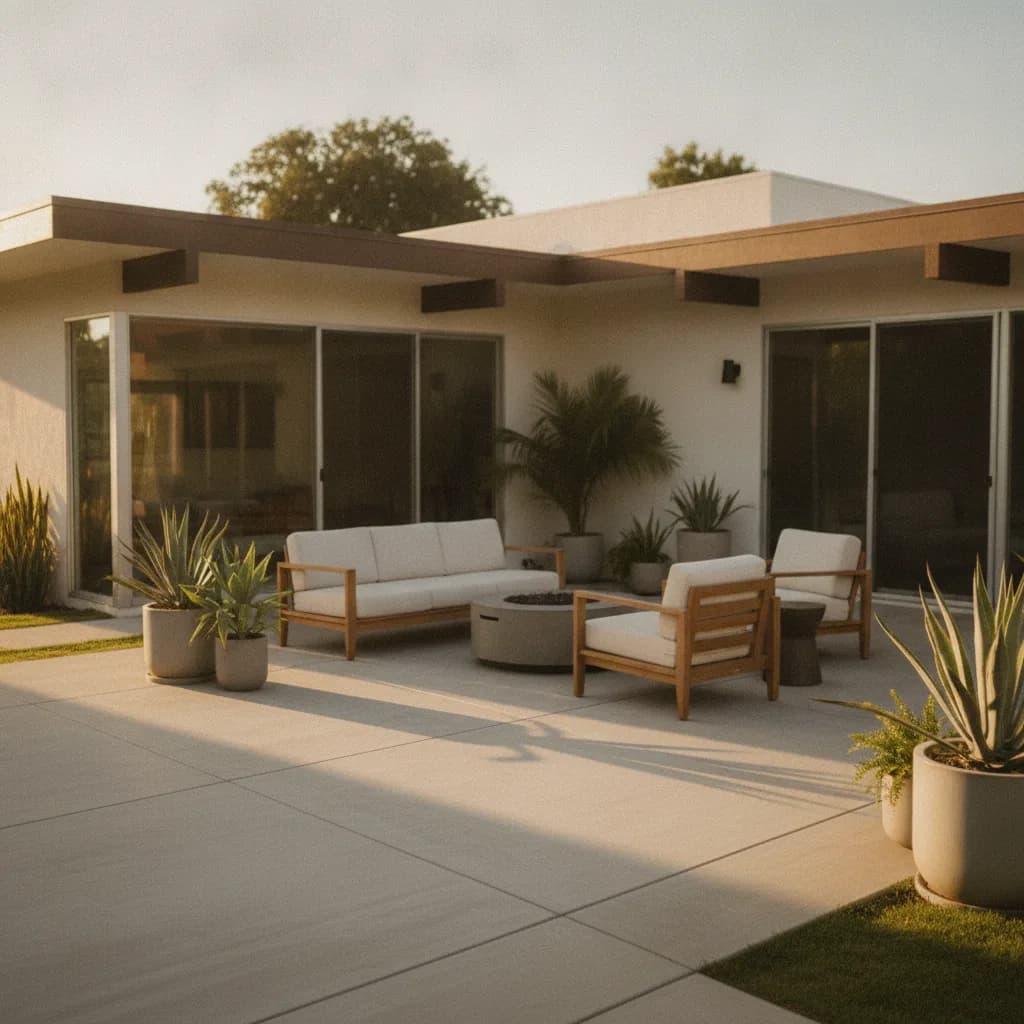
For a 400-square-foot concrete patio, the budgeting scenarios in this guide run from $8,800 at $22 per square foot to $28,000 at $70 per square foot. At an assumed $30–$45 per square foot, the same area works out to $12,000–$18,000. These are Golden Yards planning assumptions carried forward for comparison, not a verified Los Angeles market average or a contractor offer. A site-specific quote may be lower or higher.
Use the calculations to compare the scope of written bids. Before comparing a price per square foot, establish whether it includes removal of the old patio, excavation, base preparation, reinforcement, the chosen finish, access equipment, drainage and any required approvals.
Concrete patio cost by size: show the calculation
Multiply the measured patio area by the rate in the quote. The table below is arithmetic, not a claim that every contractor charges these rates. A 20-by-20-foot rectangle is 400 square feet; steps, walls and connecting paths should be measured or priced separately.
| Patio area | At $22/sq ft | At $30/sq ft | At $45/sq ft | At $70/sq ft |
|---|---|---|---|---|
| 200 sq ft | $4,400 | $6,000 | $9,000 | $14,000 |
| 300 sq ft | $6,600 | $9,000 | $13,500 | $21,000 |
| 400 sq ft | $8,800 | $12,000 | $18,000 | $28,000 |
| 500 sq ft | $11,000 | $15,000 | $22,500 | $35,000 |
Scope matters: if your quoted rate includes demolition, do not add demolition again. If it excludes a retaining wall, add the separately quoted wall cost. A $35,000 budget is equivalent to $87.50 per square foot for 400 square feet, or $70 per square foot for 500 square feet. Those are different scenarios.
Broom finish or stamped concrete?
A plain broom finish and a decorative stamped finish should be quoted as separate options for the same measured area and site preparation. Ask for the difference in finish cost while holding the rest of the scope constant. That makes it possible to decide whether the pattern and color are worth the additional amount to you.
Los Angeles County installer Concrete Etc. describes how finish, site preparation, reinforcement and access affect patio quotes. Its guide explains that stamping and coloring add labor and materials; it does not publish a countywide installed price. It is a contractor's perspective, rather than an independent pricing survey.
- Broom finish: ask to see a sample of the texture and edge treatment.
- Stamped finish: specify the pattern, colors, borders and sealer in the proposal. Photographs of a different finish are not a specification.
- Existing patio: ask whether the bid is for removal and replacement, a new extension, or a surface treatment. Do not compare those as equivalent projects.
Compare the full installed scope
Ask each bidder to complete the same list. A low headline rate can be useful, but only when the inclusions match the work your yard needs. Do not assume that another website's estimate excludes preparation or permits; read its stated scope.
| Line item | What to put in writing |
|---|---|
| Area and layout | Square footage, dimensions, curves, steps and separate areas |
| Removal | Existing material, demolition, loading, haul-away and disposal |
| Ground preparation | Excavation, soil export, base material and preparation method |
| Concrete and reinforcement | Specified thickness, mix, reinforcement and the basis for those choices |
| Finish | Texture or stamp, colors, borders, joints, curing and sealing scope |
| Access | Equipment access, pumping or other concrete placement arrangements |
| Drainage | How runoff is handled and whether drains or other work are included |
| Approvals | Who confirms requirements, obtains any required permits and pays the fees |
| Extras and exclusions | Walls, landscaping restoration, utility work, taxes and allowances |
The American Concrete Institute's ACI 332.1R-18 guide addresses residential concrete construction. A reference to a guide is not proof that a particular bid or installation complies with it. Ask the responsible professional to explain the specification for your soil, drainage and intended loads, including any hot tub or built-in kitchen.
A worked 400-square-foot budget example
Ready to compare vetted project options?
Use Project Match privately when your scope is clear enough for contractor conversations.
Start Project MatchSuppose a written proposal lists 400 square feet at $40 per square foot and explicitly includes removal, preparation and the selected finish. The quoted base is 400 × $40 = $16,000. If a separate drainage item is quoted at $1,200, the combined quoted scope is $17,200. If you choose to reserve another $1,600 for agreed changes, your planning total is $18,800.
Every number in this example is illustrative. It is not a completed homeowner project, an invoice, a recommended contingency percentage or a local price average. Replace each assumption with the figures and inclusions in your own proposals.
Which site details can change the quote?
Photograph the existing surface and access route before requesting bids. Record the gate width, any steps between the street and the yard, visible drainage problems and nearby features you want to keep. Ask the contractor to inspect the property before treating a remote estimate as a final price.
Separate known work from allowances. For example, the proposal might include removal of the visible slab but leave concealed obstructions as an allowance. Ask how additional work will be measured, priced and approved through a written change order. That question is more useful than assuming one Los Angeles neighborhood must always cost more than another city.
For a sloping site, request separate prices for the patio surface and any retaining wall or drainage work. Do not use the flatwork rate to estimate a supporting wall. Confirm how the proposed base preparation relates to the conditions found on the site.
Do you need a permit for a concrete patio in Los Angeles?
Confirm the requirements for the address and the complete scope with the local building department. This guide does not establish a universal 200-square-foot patio permit threshold. A patio surface, a patio cover, grading, a retaining wall and electrical work are different scopes and should be identified separately when you ask.
For property within the City of Los Angeles, use the LADBS plan review, permitting and appointment resources. Other cities in Los Angeles County have their own building departments. Provide a sketch with dimensions, the height above surrounding ground, drainage changes and any attached structures. Ask what approvals apply before accepting a bid that assumes no approval costs.
Have the contractor identify who will obtain any required permits and arrange inspections. The proposal should explain whether those costs are included or allowances. A permit assumption should not be hidden inside a generic percentage of the project price.
What should the schedule cover?
Request a schedule that separates design and approvals, ordering, demolition and preparation, the concrete placement day, and the date the installer permits use of the finished surface. Crew days and the total calendar duration are different measures. Ask how weather, inspection availability, curing and the chosen sealer affect the promised handover date.
Ask for care instructions for the actual finish and sealer used, along with the written warranty and its exclusions. No generic combination of slab thickness and base depth guarantees a crack-free surface or a fixed lifespan. Keep photographs of the preparation and the completed work with your contract.
Use the same scope to request comparable bids
Start with a measured area, a preferred finish and a short list of required extras. Send that same scope to each contractor. Compare the total, allowances and exclusions together, and ask for explanations where the proposed specifications differ.
For material comparisons, continue to the California patio guide or the Patio Cost Index. If the project also includes vehicle-bearing concrete, use the separate Los Angeles stamped concrete driveway guide; a driveway calculator is not a patio quote. When the scope is ready, start Project Match to discuss contractor options.
Sources and Methodology
The dollar amounts on this page are explicit editorial budgeting scenarios. The $22, $30, $45 and $70 unit rates are retained assumptions from this guide's earlier planning range, not independently verified market statistics. The tables multiply those assumptions by area. No claimed median, completed-project sample or invoice dataset underpins these calculations.
The linked contractor article supports discussion of scope factors; the ACI publication identifies a technical reference; LADBS provides the official route for City of Los Angeles project questions. None of these sources verifies this page's dollar assumptions. Read our methodology for the distinction between planning guidance and a project-specific bid.
Ready to start your patio project?
Find My ProsFrequently Asked Questions
How much does a 400-square-foot concrete patio cost in Los Angeles?
At an assumed $30–$45 per square foot, 400 square feet calculates to $12,000–$18,000. These are editorial budgeting scenarios, not a verified Los Angeles average. Replace the assumed rate with a written quote and add only items excluded from that quote.
Is stamped concrete more expensive than broom-finished concrete?
Stamping and coloring add work and materials. Ask for separate finish options on the same patio area and preparation scope so that the price difference is comparable. The selected pattern, colors and sealer should be written into the proposal.
Do I need a permit for a concrete patio in Los Angeles?
Confirm the requirements for your address and full scope with the responsible building department. Do not assume a universal 200-square-foot rule. Identify the patio surface, covers, grading, walls, drainage changes and electrical work separately when asking. Use LADBS for City of Los Angeles property and the relevant building department for other cities.
What should a concrete patio quote include?
Ask for the measured area, demolition and disposal, ground preparation, concrete and reinforcement specification, finish, access arrangements, drainage, any required approvals, and written exclusions or allowances. Compare the total scope, not just the price per square foot.