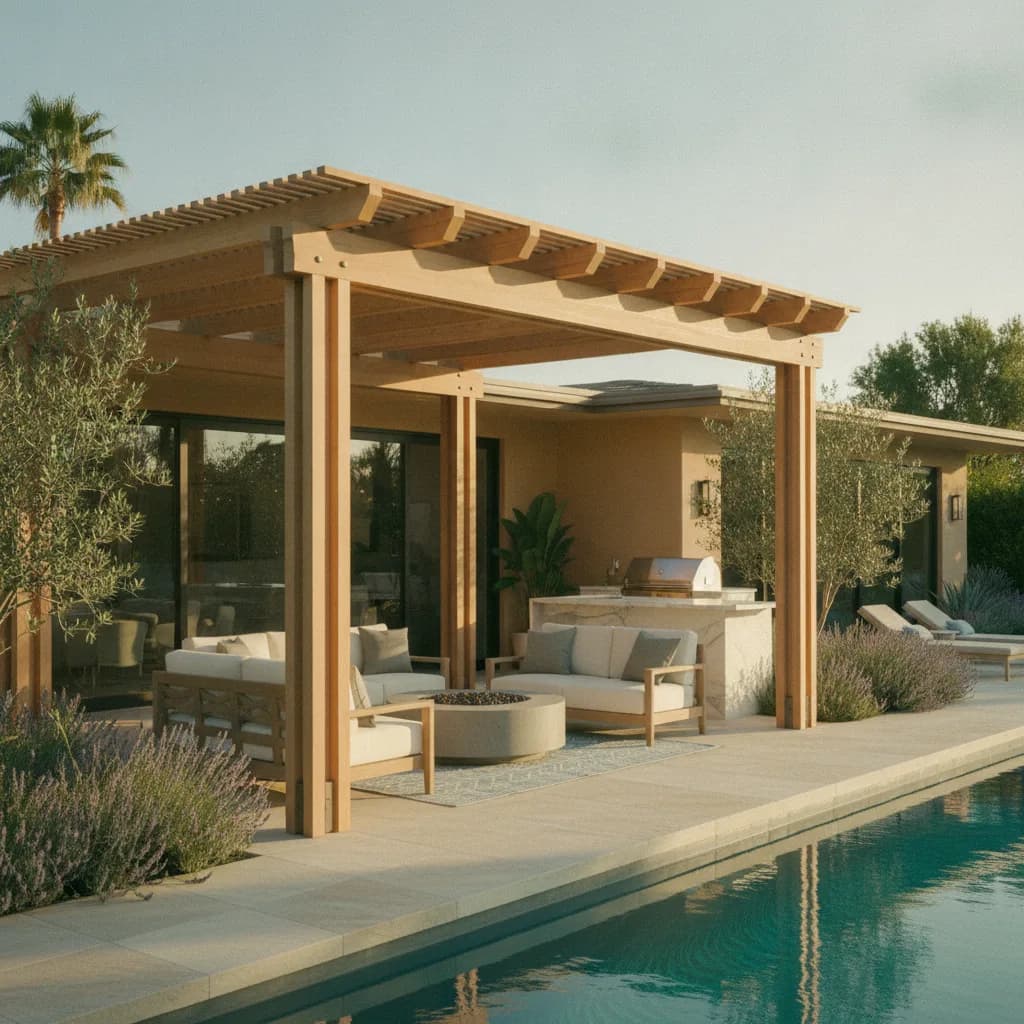
A pergola estimate becomes useful when it identifies the structure, the site work and who will complete each part. A delivered kit, a kit with assembly and a permitted custom installation are different purchases. Compare those scopes before deciding whether a Los Angeles quote is expensive.
Quick answer: start with a product or materials price, then add design, approvals, foundations, installation, utilities and other project charges. This guide provides a dated manufacturer price, a separate hypothetical budget and a financing example. It does not establish an average installed pergola price for Los Angeles. Use the budget worksheet to request an itemized proposal and the financing section to compare repayment costs.
A published kit price is the starting point
On September 14, 2026, Backyard Discovery's US page listed its 12x10 Beaumont cedar pergola, shipping-included variant, at a sale price of $1,199. That is a dated product-price example. Confirm the selected configuration, current price, tax, delivery eligibility and availability before ordering. Assembly is offered separately; the product price is not a complete Los Angeles construction quote.
For an installed proposal, ask what happens before and after assembly. Who checks the site and the manufacturer's installation requirements? Are foundations, anchors, demolition, electrical work, plans, permit charges and cleanup included? Does a price assume that the existing patio is suitable? An attractive kit price does not answer those questions.
For a custom structure, request dimensions, roof type, materials, finish and connection details at the same time as the total. There is no universal dealer markup or price-per-square-foot premium established here. Compare equivalent work rather than subtracting a retail kit price from an unrelated custom bid.
Compare the actual systems, not just material names
Wood, fixed metal and adjustable-louver systems can serve different uses. Specify how much shade or rain protection you want, whether the structure attaches to the house, and which optional features matter. Ask suppliers to document product performance and maintenance; a marketing wind rating is not a site-specific building approval.
| System to compare | Put in the quote | Check before choosing |
|---|---|---|
| Wood kit or custom wood | Species, grade, dimensions, finish, connections and installation | Finishing schedule, moisture exposure, repair access and applicable fire requirements |
| Fixed metal structure | Product model, coating, roof or shade components, foundations and assembly | Corrosion warranty, local exposure, drainage and replacement parts |
| Adjustable louver system | Manual or motorized operation, controls, wiring, drainage and optional screens | Operating limits, service access, electronics warranty and maintenance obligations |
If the pergola will share space with a grill, pizza oven or heater, coordinate the structure with the exact equipment instructions before purchase. Review clearances, ventilation and permitted covered-area use with the responsible professionals. A closable roof is not automatically suitable over cooking equipment. Our outdoor kitchen planning guide covers the wider equipment and utility scope.
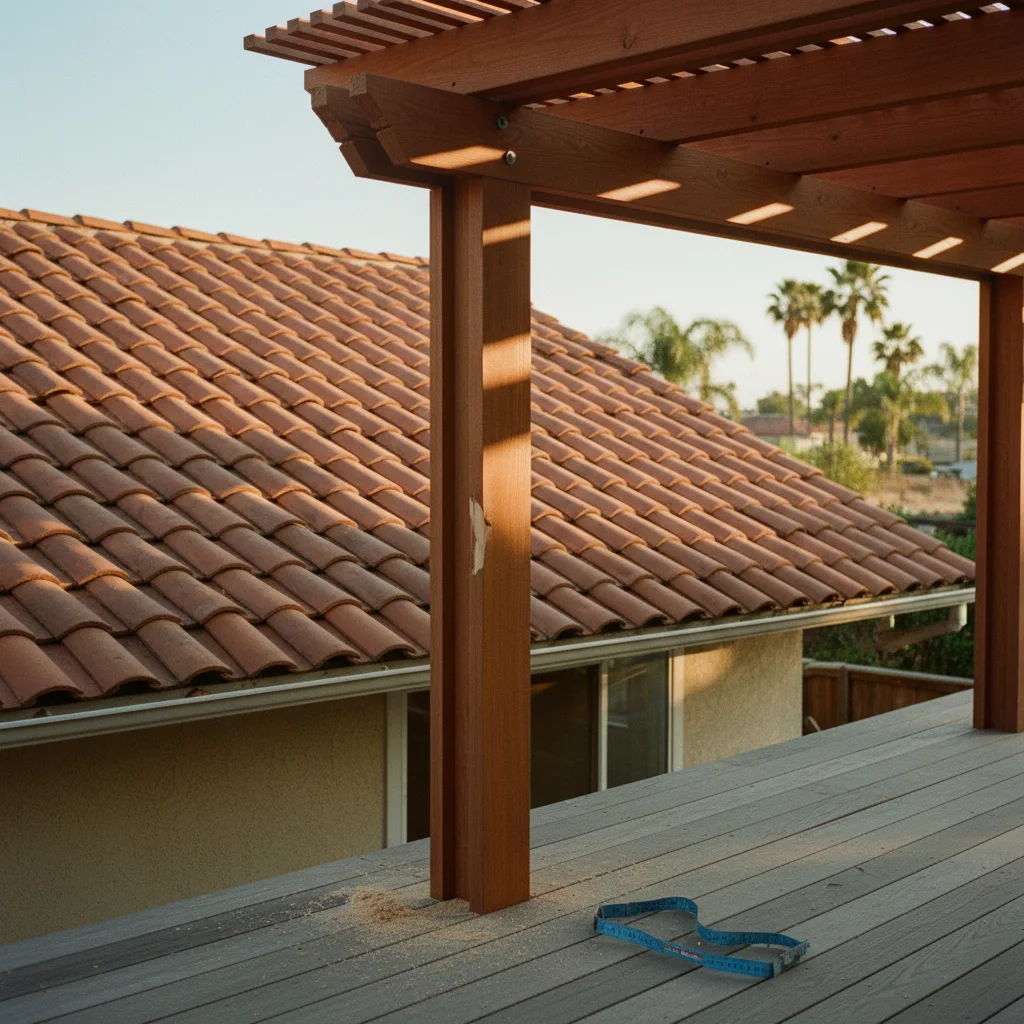
Build a complete pergola budget
Hypothetical $20,000 project: the table below is a separate budgeting exercise, not a price for the Beaumont kit or a surveyed Los Angeles installation. Every allowance is invented to illustrate scope. Replace each with a written quote or actual charge, and change the spending ceiling if the required work does not fit.
| Budget line | Illustrative allowance | Confirm with the proposal |
|---|---|---|
| Structure and materials | $6,000 | Exact system, dimensions, finish and included hardware |
| Design and approvals | $2,000 | Professional scope and actual jurisdiction charges |
| Site work and foundations | $4,500 | Access, demolition, excavation, support and restoration |
| Installation | $4,000 | Assembly, connections, equipment and cleanup |
| Electrical work | $1,500 | Selected equipment, supply route and required approvals |
| Taxes, delivery and owner reserve | $2,000 | Actual charges and a separately chosen reserve |
| Example total | $20,000 | Arithmetic illustration, not a contractor offer |
This example excludes a new outdoor kitchen or pool, major grading, retaining walls and extensive rebuilding of the house or patio. Identify overlap between line items so labor or delivery is not counted twice. The Los Angeles concrete patio guide can help separate the adjacent paving scope.
For comparison only, dividing this hypothetical total by an assumed 200-square-foot footprint gives $100 per square foot. That number includes all the example allowances; it is neither a local market rate nor the cost of the structure material alone. Specify the area measurement and inclusions whenever a proposal uses a unit rate.
Confirm permits for the actual address and design
Ready to compare vetted project options?
Use Project Match privately when your scope is clear enough for contractor conversations.
Start Project MatchStart by identifying the building authority. Properties inside the City of Los Angeles use LADBS; unincorporated Los Angeles County and separate cities such as Santa Monica or Pasadena have different authorities. An LA mailing address, an HOA approval or a manufacturer's product listing does not establish the permit path.
Use the current LADBS plan-review and permitting guidance to determine the appropriate process. Ask how the proposed attachment, dimensions, roof, electrical work and parcel conditions affect approvals. Do not assume a size threshold alone settles every building, zoning or electrical question.
LADBS also explains that a standard plan needs site-specific adaptation and department review before a permit can be obtained. Confirm whether the chosen design can use that process. Put responsibility for plans, submissions, fees, inspections and corrections in the written scope.
Check applicable HOA or historic-review requirements early. For a hillside, coastal or fire-exposure location, have the responsible designer identify the site's actual requirements. Avoid choosing a material on a blanket promise that it is fire-safe or that a generic foundation detail works everywhere.
Compare pergola financing by total repayment
Compare financing only after defining the project cost and the amount you intend to borrow. Request the lender's disclosures: interest rate, APR where applicable, fees, repayment term, payment schedule, total repayment, collateral and any prepayment conditions. A smaller monthly payment can result from a longer term and a higher total cost.
- Home equity borrowing: the CFPB's HELOC explanation describes borrowing against the home and variable-rate considerations. Understand changes between borrowing and repayment periods and the consequences of using the home as security.
- Personal installment loan: compare actual offers and charges using the CFPB's installment-loan guidance. This article has not verified current rates or eligibility for a particular borrower.
- Promotional financing: distinguish a genuine introductory zero-interest period from deferred interest. The CFPB explains that deferred interest can reach back to the purchase date if the qualifying balance is not paid in full by the deadline. Read the actual offer, including its later rate and payment conditions.
Hypothetical loan calculation: borrowing $20,000 at a fixed 8% annual interest rate, repaid with 60 equal monthly payments, gives a payment of approximately $405.53 per month. With no fees, no extra payments and the stated monthly amortization, total repayment is about $24,332, including about $4,332 in interest. Totals are rounded from the unrounded calculation; a lender's final payment may adjust for rounding. The 8% rate is an invented calculation input, not a current APR offer, approval or recommendation.
The calculation uses a monthly rate of 0.08 divided by 12 and the standard payment formula: principal × monthly rate ÷ [1 − (1 + monthly rate)−60]. Adding fees or changing the rate, term or payment timing changes the result. Compare the complete loan terms rather than treating the example as an available financing plan.
Keep contractor payments separate from the loan
For California home improvement contracts covered by Business and Professions Code section 7159.5, the general down-payment limit is the lesser of $1,000 or 10% of the contract amount. For a $20,000 contract, that general limit is $1,000. Financing approval does not by itself remove the payment restrictions.
The statute generally requires a progress-payment schedule tied to work and supplied materials, and prohibits advance payments exceeding work performed or materials delivered apart from the allowed down payment. Section 7159.5(a)(8) provides specified bond or approved joint-control exceptions; ask CSLB to confirm any claimed exception. Do not treat a routine license bond as proof that an exception applies.
The CSLB contract guide also explains written scope, permit responsibility, completion dates and signed change orders. Request both the construction contract and any separate financing agreement. This guide does not verify a contractor, lender or financing arrangement.
Allow for ownership costs without guessing a fixed premium
Request a maintenance plan for the actual structure, coating, roof mechanism and accessories. Ask which tasks preserve the warranty, who performs repairs, whether parts remain available and which labor or callout charges are excluded. We have not verified universal motor lifespans or repair-price ranges for the systems considered here.
For powered accessories, use the selected equipment's power demand and expected hours of operation with the applicable utility tariff. Energy use in kilowatt-hours equals kilowatts multiplied by operating hours. Add heating separately; do not copy a generic monthly utility allowance across different products or households.
Property tax: the California Board of Equalization explains that new construction may increase assessed value, depending on the work. Ask the county assessor how the planned addition would be treated instead of applying a guessed percentage to the entire home's value.
Insurance: the California Department of Insurance distinguishes attached structures from other structures in its homeowners guide. Ask the insurer how the proposed pergola is covered, including limits, deductibles, exclusions and replacement-cost terms. This article does not establish a premium increase or guarantee coverage.
Request comparable Los Angeles pergola estimates
Give each prospective contractor the same brief: address and jurisdiction, approximate dimensions, attached or freestanding design, preferred roof and materials, existing patio condition, required accessories, access constraints and target schedule. Include photographs and a sketch if you have them, and ask which decisions remain allowances.
Request a complete price, exclusions, payment milestones, permit responsibilities and written warranty. Resolve major differences in scope before comparing totals. Our patio and pergola guide provides broader design context. When the brief is ready, explore Project Match, a separate commercial contractor-matching service. This article does not promise a number of bids or a response deadline.
Sources & Methodology
Reviewed September 14, 2026. The manufacturer example is a dated retail observation, not an installed-price survey. The budget and loan are hypothetical calculations; material comparisons and quote questions are editorial guidance. Permit, payment, credit, tax and insurance statements use the linked public-agency sources. No local invoice sample, current financing offer, rebate eligibility or resale return was verified for this article. See the Golden Yards methodology for evidence labels and limitations.
Ready to start your pergola project?
Find My ProsFrequently Asked Questions
What does a pergola cost in Los Angeles?
This guide does not establish an average installed Los Angeles price. As a dated product example, the shipping-included 12x10 Beaumont kit was listed at $1,199 on September 14, 2026; installation and other project work must be priced separately. Compare proposals including the structure, design, approvals, foundations, installation, utilities, taxes, delivery and exclusions.
What does the $20,000 pergola budget example include?
The hypothetical allocation is $6,000 for the structure and materials, $2,000 for design and approvals, $4,500 for site work and foundations, $4,000 for installation, $1,500 for electrical work, and $2,000 for taxes, delivery and reserve. These are invented allowances, not local prices or a quote for the manufacturer kit. A new kitchen, pool or major site reconstruction is excluded.
How should I compare pergola cost per square foot?
Use the same area definition and scope. Dividing our hypothetical $20,000 total by an assumed 200-square-foot footprint gives $100 per square foot, including all example allowances. This is arithmetic, not a Los Angeles market rate or a materials-only price. Compare dimensions, roof type, foundations, installation and exclusions before comparing unit rates.
Do I need a permit for a pergola in Los Angeles?
Confirm the actual design with the authority responsible for the parcel. City of Los Angeles properties use LADBS; separate cities and unincorporated County areas have different authorities. Attachment, dimensions, roof, electrical work and site conditions affect the review. A size threshold, HOA approval or product listing alone does not establish every applicable approval.
What financing rates are available for a Los Angeles pergola?
No current lender rate or borrower eligibility was verified for this guide. Obtain actual disclosures for the amount, interest rate, APR where applicable, fees, term, payments, total repayment and collateral. The 8% annual interest input in our example is hypothetical, not an available financing offer. Home equity borrowing and promotional credit have different terms and risks.
What is the monthly payment on a hypothetical $20,000 pergola loan?
At an invented fixed 8% annual interest rate over 60 equal monthly payments, with no fees or extra payments, the amortized payment is about $405.53. Total repayment is approximately $24,332, including approximately $4,332 in interest. Totals are rounded from the unrounded calculation, and the final payment may adjust for rounding. Actual offers can differ.
Can a California pergola contractor require a 20% deposit?
For covered home improvement contracts, the general limit under Business and Professions Code section 7159.5 is the lesser of $1,000 or 10% of the contract amount. On a $20,000 contract, that is $1,000. The law has specified bond or approved joint-control exceptions; confirm any claimed exception with CSLB. Loan approval alone does not remove the restrictions.
Is deferred-interest financing the same as a 0% introductory offer?
No. The CFPB explains that deferred-interest promotions can add interest back to the purchase date if the qualifying balance is not paid in full by the deadline. A genuine zero-interest introductory period works differently. Read the actual offer's payment conditions, promotional end date and later rate before comparing total costs.
Will a pergola increase my property tax or insurance premium?
The effect depends on the project and policy. California's Board of Equalization explains that new construction may increase assessed value; ask the county assessor about the planned work. Ask your insurer how an attached or detached pergola would be covered, including limits and exclusions. This guide does not establish a fixed tax or premium increase.
What should I send when requesting a pergola estimate?
Provide the address and jurisdiction, approximate dimensions, attached or freestanding design, roof and material preferences, patio condition, desired accessories, access constraints and target schedule. Ask each contractor for the same complete scope, exclusions, payment milestones, permit responsibilities and warranty so the totals can be compared.