The reason you searched this is not that you want a number. It is that you have already heard $48,000 from one contractor and $185,000 from the next, and now you are trying to figure out which one of them is bidding the actual scope of work.
That spread is real. We have closed enough basement work inside the Village over the past two years to publish numbers that are not metro-Denver averages stretched to include Cherry Hills as a service-area footnote. This guide does three things that the metro-Denver cost pages do not.
One, the ranges below are tier-locked: functional, full finish, luxury build, with a tight range for each. Two, the numbers reflect Cherry Hills Village reality, where the median basement footprint is 2,400 square feet on a 1-acre lot, not 1,100 square feet on a quarter-acre. Three, we walk through what actually drives the spread inside each tier, so the next time you hold two quotes side by side you can read them line by line and know which contractor is bidding the work and which is hiding three change orders inside the deposit.
The honest answer up front
For a typical Cherry Hills Village basement finish in 2026:
- Functional finish, 1,800-2,400 sq ft, no wet bar: $42,000 to $68,000
- Full finish, 2,200-2,800 sq ft, wet bar + theater wiring + 2 baths: $72,000 to $110,000
- Luxury build, 2,800-3,500+ sq ft, wine cellar / golf simulator / gym / slab stone bath: $135,000 to $220,000
Smaller basements in Glenmoor or the Cherry Hills North overlay (where lot sizes drop below 1 acre) run lower because the square footage drops. Larger walk-out basements in the Old Cherry Hills section near University Boulevard sometimes punch above the Luxury tier when the build includes structural changes to the lower-level exterior wall.
The middle tier is where roughly 65 percent of Cherry Hills Village finishes land. If your project looks like a full finish on a 2,400 square foot footprint with a wet bar and a guest suite, plan for $84,000 to $96,000 once selections are locked.
The five things that move the price inside each tier
Two homes on Quincy Avenue with basements of nearly identical square footage can come in $32,000 apart on the final quote. The reason is almost never markup. It is almost always one of these five.
1. Square footage and ceiling height
A 2,200 square foot Cherry Hills basement with 9-foot poured ceilings is a different project than a 2,200 square foot basement with the original 7-foot 6-inch beam-and-block ceilings of a 1968 ranch. The 9-foot space takes drywall, lighting, and HVAC routing in a straightforward sequence. The 7-foot 6-inch space requires soffit planning around every duct, joist, and structural drop.
A second-story addition done in 1996 over a 1972 basement sometimes leaves duct routing that consumes 18 inches of overhead clearance in three different rooms. That is a finish-carpentry problem that adds $4,500 to $8,000 to the framing scope.
2. Egress windows and radon mitigation
This is the line item the Village is strictest on, and the line item that homeowners are most surprised to find on a quote.
Every bedroom in a finished Cherry Hills basement requires a code-compliant egress window. If the basement is fully below grade, that means a window well cut into the foundation, a structural opening framed for an oversized casement, and the well itself sized to the International Residential Code minimums (5.7 sq ft of opening, 36 inches wide, 24 inches high, with a ladder if more than 44 inches deep).
Each egress window install in Cherry Hills Village runs $3,800 to $6,500 depending on the depth and whether the foundation is poured concrete or the older cinder block found in homes built before 1975. Two egress windows for a guest suite plus a media-room-converted-to-bedroom is $7,600 to $13,000 on its own.
Radon mitigation is separate. Colorado is EPA Radon Zone 1, and Cherry Hills Village sits at 5,300 feet of elevation in a geology that produces measurable radon in roughly 60 percent of homes tested below grade. The Village does not require a mitigation system on a finished basement, but most homeowners install one once they see test results above 4.0 pCi/L. Plan $1,800 to $4,500 for a passive sub-slab depressurization system with an active fan.
3. Wet bar and second kitchen complexity
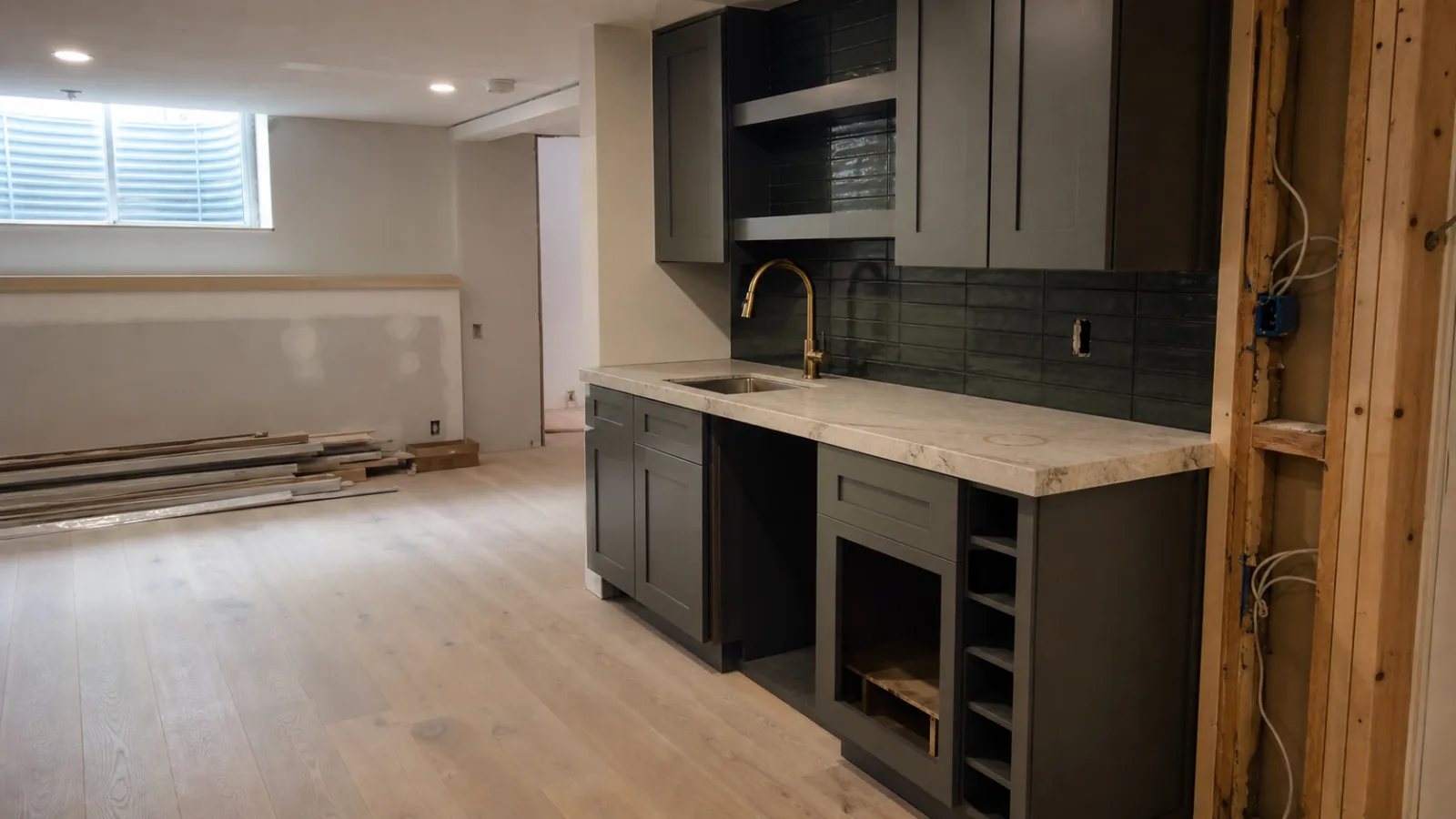
A wet bar with a sink, an ice maker, a beverage fridge, and a six-foot counter is a $9,500 to $14,000 line item. A second kitchen with a range, a hood, a 36-inch refrigerator, a dishwasher, and full counter run is $32,000 to $58,000 because every appliance carries its own circuit, vent, and supply line, and a gas range under the slab requires either a soft-copper run or a CSST line with bonding to the panel.
The Village permit office reviews second-kitchen installs more carefully than single-vanity bath installs. The plan reviewer at City Hall (2450 East Quincy Avenue) will return any submission that does not show vent path and clearance to combustibles on a hood over a gas range. We file these weekly.
4. Theater, gym, golf simulator, wine cellar add-ons
Each of these moves the project into the Luxury tier whether or not the rest of the scope changes.
- Home theater with riser, soffit lighting, blackout panels, and surround wiring: $14,000 to $32,000 in build cost on top of the AV gear
- Gym with rubber flooring, mirror wall, and 220V circuit for a sauna or treadmill: $8,000 to $16,000
- Indoor golf simulator with reinforced ceiling, 16-foot screen wall, and projector mount: $22,000 to $45,000 in build cost plus the simulator itself
- Wine cellar with cooling unit, insulated and vapor-sealed walls, custom racking: $24,000 to $65,000 depending on size
We have seen all four added to a single Cherry Hills Village basement finish. The combined add-on stack pushed a $148,000 project to $231,000 final. Every one of those add-ons was specified before the contract was signed. None of them were change orders.
5. Permits and inspections
Cherry Hills Village has its own building department, separate from Denver County, separate from Greenwood Village, separate from Englewood. Permits file at the Cherry Hills Village City Hall, 2450 East Quincy Avenue, Cherry Hills Village, CO 80113.
Permit fees for a residential basement finish run $850 to $2,400 depending on declared project valuation, plus a $150 to $400 plan review fee. Each inspection (rough framing, rough electrical, rough plumbing, rough HVAC, insulation, drywall, final) is scheduled through the Village office with 24 to 48 hours notice.
A contractor who has filed three Village permits in the past five years will quote the same fee on paper but will take two to three weeks longer to get a rough-in inspection scheduled, because the relationships at the Village office matter and the Village inspector knows which contractors deliver complete permit packets and which submit drawings that come back for correction. We submit complete packets on Monday morning and typically have approval back by Friday of the same week.
If your quote does not break out the permit fee as a line item, the contractor is either eating it (fine, but rare on a Cherry Hills Village job) or hiding it (not fine). Ask which.
Get a fixed-price Cherry Hills Village quote
Tier comparison: DIY vs General Contractor vs Our Crew
Ready to compare vetted project options?
Use Project Match privately when your scope is clear enough for contractor conversations.
Start Project Match| What you get | DIY weekend project | Average GC | Our Cherry Hills crew |
|---|---|---|---|
| Cost (2,400 sq ft full finish) | $35,000–$55,000 in materials, no labor billed | $88,000–$120,000 | $84,000–$96,000 fixed price |
| Time to completion | 9 to 18 months (after-work + weekends) | 16 to 24 working weeks | 12 to 14 working weeks |
| Permit handling | Homeowner pulls, manages corrections | Subbed to permit expediter, $1,200–$2,400 markup | Filed at Village Hall by our project manager, included |
| Outcome | One or two rooms code-compliant, rest grey area | Code-passing but generic finish | Tier-locked finish, Village inspection signed off, daily photo log |
| Resale impact | Variable, often a discount at sale due to unpermitted work | Neutral to slight premium | $80,000 to $140,000 lift on Village comps in 2026 |
Neighborhood-specific cost variations inside Cherry Hills Village
The Village is not one cost market. The same basement scope can run $18,000 apart on opposite sides of University Boulevard for reasons that have nothing to do with margin.
Old Cherry Hills (80113, original platting, north of Quincy)
Full finishes close between $86,000 and $115,000 on a 2,400 sq ft footprint. The housing stock is 1955 to 1975 ranch and split-level, with original poured-concrete foundations that are generally clean. Ceiling heights are the lever: pre-1968 builds run 7-foot 4-inch to 7-foot 8-inch. Soffit planning around HVAC and structural drops adds 8 to 12 percent to framing on these.
Cherry Hills Park area (south of Belleview, west of University)
$78,000 to $108,000 for the same scope. Newer build dates (1980-2000) mean 8-foot to 9-foot poured ceilings and modern duct routing. Easier projects, faster turn.
Cherry Hills North overlay (smaller lots, 80113/80111 border)
$62,000 to $94,000 because the basement footprint is smaller. Permit process is identical because the overlay is still inside the Village limits.
Glenmoor and Buell Mansion subdivisions
Larger homes, larger basements, broader range. $135,000 to $220,000 for full finishes because the basement footprints run 3,000 to 4,200 sq ft and the finish expectations skew Luxury tier by default. Several of these have full second kitchens, dual-zone HVAC, and home theaters that approach commercial spec.
Timeline reality, in working days
The most common complaint on Reddit threads about Denver basement finishes is that projects went months over schedule. The complaint is almost always true. The reason is that quoted timelines are marketing numbers, not project numbers.
Honest project durations:
- Tier 1 functional finish: 35 to 45 working days from demo to walk-through
- Tier 2 full finish: 55 to 75 working days
- Tier 3 luxury build: 90 to 140 working days, longer if a wine cellar cooling unit or golf simulator screen is on a long supplier lead
Add 10 to 20 working days for selections if you are starting cold and 5 to 10 working days for Village permit issuance after a complete submission.
The single biggest timeline killer is selection drift, not contractor pace. The second is Village permit corrections from an incomplete drawing set. We submit complete packets on Monday morning and usually have approval back the same week. A contractor whose timeline assumes three to four weeks of permit wait is telling you the truth about their packet quality.
How to read a Cherry Hills basement quote
If you take one thing from this guide, take this. A quote that does not look like the structure below is hiding something.
Every honest Cherry Hills Village basement finish quote should list:
- Demolition and disposal (separate dumpster line)
- Framing and structural (subfloor, blocking, any beam pocket changes)
- Egress window installation (with count, sized to IRC R310)
- Plumbing rough-in (with fixture count, any wet bar or second kitchen called out)
- Electrical rough-in (circuit count, AFCI and GFCI count, lighting fixture count)
- HVAC modifications (zoning, return air, supply runs)
- Radon mitigation (with active fan and PVC stack, if specified)
- Insulation and vapor barrier
- Drywall and finish
- Flooring (with material allowance)
- Trim, doors, paint
- Cherry Hills Village permit and inspection fees
- Project management and supervision
- Contingency reserve (typically 5 to 8 percent)
If you see "interior finishes: $34,000" with no breakdown, you cannot compare that to any other quote. Ask for the line items. A contractor who refuses is telling you something.
A real Cherry Hills Village project (anonymized)
A 2024-built home on Cherry Hills Park Drive came to us in March 2026 with a 2,650 sq ft unfinished basement and a clear ask: a guest suite for visiting in-laws, a media room, a wet bar, and a small home gym. The owner had two prior quotes, one at $94,000 and one at $148,000.
The $94,000 quote did not include egress windows (two were required by code for the bedroom), did not separate the permit fee, and had "interior finishes: $42,000" as a single line. The $148,000 quote included a 12 percent contingency padding that was not labeled as such, plus a $9,000 line for "site supervision" that did not exist on the lower bid.
Our walk-through identified seven items missing from both bids: the two egress windows, a sub-slab radon stack (testing came back at 5.8 pCi/L), a dedicated 240V circuit for the gym sauna the owner was planning to add later, a returns-air upgrade for the new partitioned space, frost-protected vent termination on the bath fan, slab moisture testing before flooring (the slab tested at 4.1 lbs/MVER), and a separate gas line for the wet bar fireplace.
Final fixed-price quote: $112,000, signed in 48 hours after the walk-through. Project completed in 68 working days. No change orders.
Cost versus resale uplift in Cherry Hills Village
A basement finish in the Village is not a textbook ROI investment. The Cost vs. Value Report from Remodeling Magazine puts mid-range basement finishes nationally at roughly 70 to 75 percent cost recovery at sale. The Denver market trends slightly higher because basement-as-living-space is the local expectation, and Cherry Hills Village trends higher still because the price point at sale assumes a finished lower level.
A 1972-era unfinished basement in a Village home priced at the neighborhood median will reduce the sale price by more than the cost of the finish. Three local real estate teams have given us the same feedback over the past year: an unfinished basement on a $3.2 million Cherry Hills listing produces offers $180,000 to $260,000 below comparable finished comps.
That is not an "ROI" math problem. It is a "your unfinished basement is the reason the offer came in $200,000 light" problem.
The version of the math that matters: a $96,000 full finish does not "return" $72,000 at sale. It removes a $180,000 to $260,000 drag on the offer price.
For the editorial perspective on Cherry Hills basements
For the editorial take on why Cherry Hills Village homeowners build down instead of out, our partner Renology published this companion piece: The Cherry Hills Basement: Why Denver's Wealthiest Suburb Builds Down, Not Out.
Get the Cherry Hills Village Basement Permit Checklist 2026 (PDF)
FAQ
What is the average cost of a basement finish in Cherry Hills Village in 2026?
The average Cherry Hills Village basement finish is $86,000 in 2026, based on Village projects closed in the past 18 months. A functional finish (1,800-2,400 sq ft, no wet bar) runs $42,000 to $68,000. A full finish (2,400 sq ft with wet bar, two baths, theater wiring) runs $72,000 to $110,000. A luxury build with wine cellar, golf simulator, or full second kitchen runs $135,000 to $220,000. Numbers reflect closed projects on Quincy Avenue, University Boulevard, Cherry Hills Park Drive, and Belleview Avenue.
Do I need a permit to finish a basement in Cherry Hills Village?
Yes. Any basement finish that adds living space, plumbing, electrical circuits, or HVAC modifications requires a permit filed at Cherry Hills Village City Hall, 2450 East Quincy Avenue. The Village has its own building department, independent of Denver County, Greenwood Village, and Englewood. Permit fees run $850 to $2,400 plus a $150 to $400 plan review fee.
How long does a basement finish take in Cherry Hills Village?
Average 55 to 75 working days for a full finish from demo to final walk-through. Functional finishes run 35 to 45 working days. Luxury builds with wine cellars or golf simulators run 90 to 140 working days. Village permit issuance adds 5 to 10 business days after complete submission.
Why are basement finish quotes so different between Denver-metro contractors?
Three reasons. First, scope ambiguity: a "basement finish" can mean drywall and carpet ($42,000) or full custom build ($180,000). Second, missing egress windows: most metro quotes assume no code-compliant egress window install is needed, when Cherry Hills Village requires at least one for any bedroom. Third, hidden change-order math: lower quotes often exclude radon mitigation, slab moisture testing, second-kitchen gas lines, and the actual Cherry Hills Village permit fee.
Do I need radon mitigation on a finished Cherry Hills basement?
The Village does not require active mitigation on a finished basement, but the EPA classifies Colorado as Radon Zone 1 and roughly 60 percent of Cherry Hills Village homes test above 4.0 pCi/L in below-grade space. Most homeowners install a passive sub-slab depressurization system with an active fan during framing, at $1,800 to $4,500. Retrofitting later costs $4,500 to $7,500.
What are egress window requirements in Cherry Hills Village?
Every bedroom in a finished basement requires an egress window meeting IRC R310: 5.7 square feet of net clear opening, 24-inch minimum opening height, 20-inch minimum opening width, sill no higher than 44 inches above the floor, and a window well with permanent ladder if the well is deeper than 44 inches. Each install in Cherry Hills Village runs $3,800 to $6,500.
Can I see recent Cherry Hills Village basement projects?
Yes. Our portfolio includes completed basements on Quincy Avenue, University Boulevard, Cherry Hills Park Drive, and Belleview Avenue within the past six months. Each project page lists the street (not full address), completion date, scope, and tier. Three current homeowner references are provided on request after the first design consultation.
Is it cheaper to finish a basement in Cherry Hills Village or in Denver proper?
Slightly cheaper in Denver proper on a per-square-foot basis (by 8 to 12 percent), but the Cherry Hills Village basement footprint is typically 2,000 to 3,000 sq ft compared to a Denver-proper 900 to 1,400 sq ft, so total project cost runs higher. Village permit and inspection process is more rigorous, which adds 1 to 2 weeks of timeline but produces a cleaner Certificate of Occupancy at closing.
How is the payment schedule structured?
Five milestone payments tied to inspection-verified completion: 15 percent at contract signing, 25 percent at rough framing inspection passed, 25 percent at rough plumbing and electrical passed, 25 percent at drywall and flooring complete, 10 percent at final Village inspection signed off. No payment is due before the prior milestone is documented complete.
Can I save money by buying my own materials for a basement finish?
Sometimes. Homeowners who source their own flooring, vanities, and fixtures save 6 to 12 percent on materials but introduce coordination risk: back-orders and wrong-delivery items slip the timeline, and the contractor is not responsible. The savings make sense if you have time to manage procurement. They do not if the contractor's trade discounts close the gap.
What if my basement has water intrusion history?
A finished basement over a wet slab is a future demo. Slab moisture testing (calcium chloride per ASTM F1869) is mandatory before flooring. Exterior drainage assessment, sump pump verification, and vapor barrier specification are all priced into our Cherry Hills Village quotes when intrusion history is disclosed at walk-through. Cost adds $4,500 to $14,000 depending on findings.
Does the Cherry Hills Village Building Department review wet bar and second kitchen plans?
Yes. The Village plan reviewer requires complete venting diagrams, clearance-to-combustibles documentation for any gas appliance, and electrical load calculations for circuits added to the existing panel. Incomplete submissions are returned and add 1 to 2 weeks to the permit timeline.
Sources & Methodology
Golden Yards reviews public permit and code signals, material pricing, climate and site constraints, contractor quote patterns, comparable projects, the Golden Yards Cost Index, and the Golden Yards Methodology. Cost references are planning ranges, not fixed bids.
- City of Cherry Hills Village, Building Division. Permit and inspection schedule. https://www.cherryhillsvillage.com/206/Building
- 2024 International Residential Code (IRC), Section R310, on emergency escape and rescue openings in basements.
- 2024 International Plumbing Code (IPC), Sections 702 and 906, on venting and drainage for wet bars and second kitchens.
- Colorado Department of Public Health, Radon Program. Zone 1 designation and mitigation guidance. https://cdphe.colorado.gov/radon
- 2026 Cost vs. Value Report, Remodeling Magazine, Mountain Region basement finish data.
- Denver Metro Association of Realtors, 2026 Q1 housing report on finished vs. unfinished basement comparables.
Mike Reynolds covers structural, permit, and inspection topics for Golden Yards. He writes from a contractor's pragmatic frame about what fails under real loads, what gets caught at inspection, and what pencils out over ten years of use.
Ready to start your basement finishing project?
Find My ProsFrequently Asked Questions
What is the average cost of a basement finish in Cherry Hills Village in 2026?
The average cost for a basement finish in Cherry Hills Village is $86,000 in 2026, based on projects closed in the past 18 months. Costs range from $42,000 for a functional finish up to $220,000 for a luxury build with amenities like a wine cellar or golf simulator.
The $86,000 average covers several project types. A functional finish for a 1,800 to 2,400 square foot space without a wet bar costs $42,000 to $68,000. A full finish for 2,400 square feet with a wet bar, two baths, and theater wiring runs $72,000 to $110,000.
Luxury builds with a wine cellar, golf simulator, or full second kitchen cost $135,000 to $220,000. These 2026 numbers reflect closed projects on Quincy Avenue, University Boulevard, Cherry Hills Park Drive, and Belleview Avenue.
Do I need a permit to finish a basement in Cherry Hills Village?
Yes, a permit is required to finish a basement in Cherry Hills Village if the project adds living space, plumbing, electrical circuits, or HVAC modifications. Permits are filed at City Hall, 2450 East Quincy Avenue. Fees range from $850 to $2,400, plus a $150 to $400 plan review fee.
The Village of Cherry Hills Village operates its own building department, which is independent of surrounding jurisdictions like Denver County, Greenwood Village, and Englewood. Therefore, all permit applications for basement projects must be submitted directly to the city at 2450 East Quincy Avenue. The total cost will include the permit fees, which run from $850 to $2,400, and a separate plan review fee costing between $150 and $400.
How long does a basement finish take in Cherry Hills Village?
In Cherry Hills Village, a full basement finish takes 55 to 75 working days from demo to final walk-through. Functional finishes are quicker at 35 to 45 days, while luxury builds with wine cellars or golf simulators require 90 to 140 days. Village permit issuance adds another 5 to 10 business days.
The timeline for a basement project in Cherry Hills Village depends on its complexity. A standard full finish averages 55 to 75 working days. More basic, functional finishes can be completed in 35 to 45 working days. For high-end projects that include custom features like wine cellars or golf simulators, the construction period extends significantly to 90 to 140 working days. It is also important to account for the administrative phase, as permit issuance by the Village takes an additional 5 to 10 business days after a complete submission.
Why are basement finish quotes so different between Denver-metro contractors?
Denver-metro basement quotes differ due to three factors: scope ambiguity, code compliance, and hidden costs. A basic finish can cost $42,000, while a full custom build can be $180,000. Many quotes omit egress windows, which Cherry Hills Village requires for bedrooms, and exclude fees for permits or radon mitigation.
The definition of a "basement finish" is a primary variable, with costs spanning from $42,000 for drywall and carpet to $180,000 for a custom project. Code compliance is another key factor. For instance, Cherry Hills Village requires at least one code-compliant egress window for any bedroom, an item often missing from initial quotes. Lower bids frequently hide future expenses through change orders, excluding necessary work like radon mitigation, slab moisture testing, second-kitchen gas lines, and the actual Cherry Hills Village permit fee.
Do I need radon mitigation on a finished Cherry Hills basement?
No, Cherry Hills Village does not require active radon mitigation for a finished basement. However, the EPA classifies Colorado as Radon Zone 1, and about 60 percent of local homes test above 4.0 pCi/L. Proactive installation during framing costs $1,800 to $4,500, while retrofitting later costs $4,500 to $7,500.
Although the Village does not mandate it, mitigation is a common consideration. The EPA places all of Colorado in Radon Zone 1, its highest risk category. Specifically in Cherry Hills Village, data shows roughly 60 percent of homes have radon levels above the EPA's 4.0 pCi/L action level in below-grade space.
Most homeowners who act preemptively install a passive sub-slab depressurization system with an active fan during the framing stage. This approach is most cost-effective, typically running from $1,800 to $4,500. Waiting to retrofit the same system into an existing home is more complex and costs significantly more, from $4,500 to $7,500.
What are egress window requirements in Cherry Hills Village?
In Cherry Hills Village, basement bedroom egress windows must meet IRC R310. This requires a 5.7 square foot net clear opening, 24-inch minimum height, 20-inch minimum width, and a sill no higher than 44 inches from the floor. Costs range from $3,800 to $6,500. A ladder is required for wells deeper than 44 inches.
The requirements for egress windows in Cherry Hills Village are based on the International Residential Code, specifically section IRC R310, to ensure a safe exit from a finished basement bedroom. The opening must be at least 5.7 square feet, with a minimum opening height of 24 inches and a minimum width of 20 inches.
To allow for easy escape, the sill's height cannot exceed 44 inches from the floor. Additionally, if an exterior window well is necessary and its depth is greater than 44 inches, it must have a permanently attached ladder. The estimated cost for a compliant installation in this area is between $3,800 and $6,500.
Can I see recent Cherry Hills Village basement projects?
Yes. Our portfolio features recently completed Cherry Hills Village basements on Quincy Avenue, University Boulevard, Cherry Hills Park Drive, and Belleview Avenue, all finished within the past six months. Each project page details the street, completion date, scope, and tier. We provide three homeowner references upon request after your first design consultation.
You can review our recent work in Cherry Hills Village to see examples of our finished basements. Within the last six months, we have completed projects on Quincy Avenue, University Boulevard, Cherry Hills Park Drive, and Belleview Avenue. The online portfolio for each project shows its scope, tier, completion date, and street name, but not the full address for privacy.
After your initial design consultation, we can provide you with three current homeowner references. This step ensures our clients' privacy is respected while giving you a chance to speak with people who have direct experience working with our team on their own homes.
Is it cheaper to finish a basement in Cherry Hills Village or in Denver proper?
It is slightly cheaper to finish a basement in Denver proper, where per-square-foot costs are 8 to 12 percent lower. However, the total project cost is typically higher in Cherry Hills Village because its basement footprints are larger, 2,000 to 3,000 sq ft, compared to Denver's 900 to 1,400 sq ft.
While the per-square-foot rate is lower in Denver proper, the overall project expense is greater in Cherry Hills Village due to scale. Basements in the Village commonly range from 2,000 to 3,000 square feet, substantially larger than the 900 to 1,400 square foot footprints found in Denver proper.
Additionally, the permit and inspection process in Cherry Hills Village is more rigorous. This adds 1 to 2 weeks to the project timeline but results in a cleaner Certificate of Occupancy at closing, which can be an advantage when selling the home.
How is the payment schedule structured?
The payment schedule has five milestone payments tied to verified completion. It starts with 15 percent at contract signing, followed by three 25 percent payments after passing rough framing, rough plumbing/electrical, and completing drywall/flooring. The final 10 percent is due after the final Village inspection is signed off.
Our payment structure is based on five key milestones, and no payment is due until the prior milestone is documented as complete. The process begins with a 15 percent payment when the contract is signed.
Three subsequent payments of 25 percent each are tied directly to inspection approvals for rough framing and then for rough plumbing and electrical. Another 25 percent is due once drywall and flooring are finished. The final 10 percent balance is paid only after the project passes its final Village inspection, ensuring all work is fully approved.
Can I save money by buying my own materials for a basement finish?
Yes, sometimes. Homeowners who source their own flooring, vanities, and fixtures can save 6 to 12 percent on materials. However, this approach introduces coordination risks like back-orders and wrong deliveries that can delay the project. The contractor is not responsible for timeline slips caused by materials you provide.
The potential savings of 6 to 12 percent make sense if you have enough time to manage the entire procurement process yourself. This includes ordering materials and handling any issues that arise, such as back-orders or incorrect items arriving, which can disrupt the construction schedule.
Before deciding, consider that the contractor is not responsible for these delays. You should also ask about the contractor's trade discounts. In many cases, their professional pricing can close the savings gap, making it more efficient to have them supply the materials without the added coordination risk for you.
What if my basement has water intrusion history?
Disclosing water intrusion history is critical, as a finished basement over a wet slab is a future demolition. We mandate slab moisture testing (calcium chloride per ASTM F1869) before flooring. For Cherry Hills Village projects where this is disclosed, remediation adds $4,500 to $14,000 to the project cost.
When a history of water intrusion is disclosed at a walk-through in Cherry Hills Village, our quotes automatically include an exterior drainage assessment, sump pump verification, and a proper vapor barrier specification. These steps are essential because installing flooring over a wet slab will lead to failure.
The final cost, from $4,500 to $14,000, depends on the findings from these assessments and the mandatory slab moisture test, which follows the calcium chloride method per ASTM F1869. Addressing moisture correctly is the only way to ensure the long-term success of your finished basement.
Does the Cherry Hills Village Building Department review wet bar and second kitchen plans?
Yes, the Cherry Hills Village Building Department reviews wet bar and second kitchen plans. The Village plan reviewer requires complete venting diagrams, clearance-to-combustibles documentation for any gas appliance, and electrical load calculations for new circuits. Incomplete submissions are returned, adding 1 to 2 weeks to the permit timeline.
The Cherry Hills Village Building Department requires a thorough review for wet bar and second kitchen projects. Applicants must submit a complete package to avoid delays. This includes full venting diagrams and specific clearance-to-combustibles documentation for any gas appliances planned for the space.
Furthermore, your submission must contain electrical load calculations for any circuits being added to an existing panel. Be aware that incomplete applications will be returned by the plan reviewer. This will add an estimated 1 to 2 weeks to your permit approval timeline, so careful preparation is important.