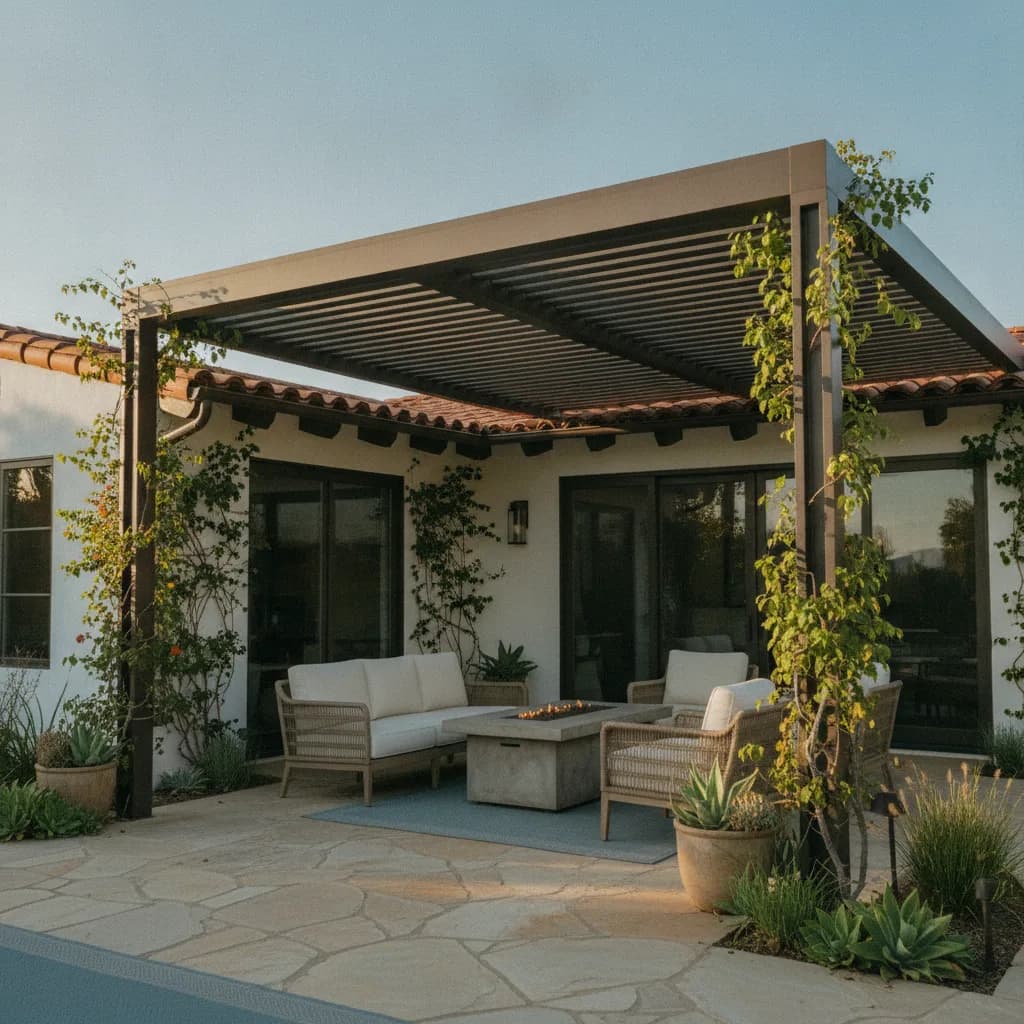
A pergola can transform a sun-drenched California patio into a comfortable, stylish outdoor living room. But estimating the pergola cost involves more than just picking a design. From simple prefabricated kits to sophisticated custom and louvered systems, the final price tag depends on materials, site conditions, and labor. This guide compares three popular pergola options to help you understand the scope, trade-offs, and total investment required for your backyard project.
In a Nutshell
- Pergola Kits: The most budget-friendly option, with installed costs from $1,450 to $5,750. Best for standard spaces and those comfortable with some DIY, but offer limited customization.
- Custom-Built Pergolas: Offer complete design freedom for about $30 to $65 per square foot. Ideal for unique spaces, specific material choices like redwood, or integrating with existing architecture.
- Louvered Pergolas: The premium choice for adjustable sun and rain protection, typically costing $6,500 to $18,000. These complex systems often include motors and electrical work, adding to the installation scope.
- Total Project Cost: The pergola itself is just one part. Always budget separately for site preparation, concrete footings, permits, electrical work, and any necessary drainage solutions.
Understanding Pergola Cost Components in California
When homeowners begin researching the pergola cost, they often focus on the price of the structure itself. However, the total project cost is a sum of many parts. To create an accurate budget, you must separate the main components and understand what each contributes to the final invoice. Think of it as three distinct categories: the pergola structure, site-specific work, and long-term upkeep.
First is the structure, which includes the materials (wood, vinyl, aluminum), hardware, and the labor to assemble it. This is the figure most often advertised, but it rarely represents the full expense. A pergola is a fantastic addition to a new or existing patio, creating a defined outdoor room. When planning your patio design, it is crucial to think about how a structure like this fits into the overall budget and landscape.
Second is the foundational and site-specific work. A pergola needs a solid foundation, which typically means concrete footings dug to a depth specified by local building codes. This is especially important in California, where seismic requirements influence construction standards. Site work also includes ensuring the area is level, has proper drainage, and is clear of underground utilities. If your property has difficult access for machinery or material delivery, labor costs may increase. Finally, consider additions like electrical wiring for lights or fans, which require a licensed electrician and a separate permit.
The third category includes administrative and long-term costs. This covers building permits, which can involve fees and the cost of drawing up plans for city approval. After installation, consider the ongoing maintenance. A wood pergola will require periodic staining or sealing, while a louvered system has moving parts that may need service. Factoring these elements in from the start provides a more realistic picture of the total investment.
Pergola Kits: The Prefabricated Option
Pergola kits offer a straightforward path to adding a shade structure to your yard. These come with all the pre-cut and pre-drilled pieces, hardware, and instructions needed for assembly. According to HomeGuide, an installed prefab pergola kit costs between $1,450 and $5,750. This price range typically reflects differences in material, size, and the complexity of the installation included in the quote.
The primary advantage of a kit is cost predictability. You are buying a complete package, which minimizes the risk of unexpected material expenses. Materials commonly include pressure-treated pine, cedar, vinyl, or aluminum, each with its own look and maintenance profile. For homeowners with solid DIY skills, assembling a kit can be a weekend project, eliminating labor costs entirely. However, installing footings and securing the structure properly requires care and knowledge of local codes, so hiring a professional for at least that portion is often wise.
The main trade-off is a lack of customization. Kits come in standard dimensions, such as 10x10 or 12x14 feet. If your patio has an unusual shape or you need a specific size, a kit is unlikely to be a perfect fit. The design and color options are also limited to what the manufacturer offers. While often more affordable, some kits may use lighter-gauge materials than what a custom builder would specify, so it is important to check the specifications before purchasing. When getting quotes for installation, clarify if the price includes site preparation and pouring concrete footings, as these are frequently excluded from a basic assembly fee.
Custom-Built Pergolas: Tailored to Your Space
Ready to compare vetted project options?
Use Project Match privately when your scope is clear enough for contractor conversations.
Start Project MatchA custom-built pergola provides complete freedom over design, materials, and dimensions, making it the ideal choice for homeowners with a specific vision or a challenging site. Unlike a kit, a custom pergola is designed and built from scratch to integrate perfectly with your home's architecture and landscape. HomeGuide estimates the cost for a custom pergola at $30 to $65 per square foot for materials and installation.
The higher pergola cost reflects the personalized nature of the project. You can choose the exact size to cover your patio, select premium materials like California redwood or heavy-gauge Douglas fir, and incorporate unique design elements like arched tops, decorative post bases, or integrated benches. This approach is particularly well-suited for properties with slopes, oddly shaped spaces, or for pergolas that need to be attached to the house, which requires careful engineering and waterproofing.
Working with a contractor on a custom build involves a design phase, material sourcing, and on-site construction. The process is more involved and takes longer than assembling a kit. The per-square-foot cost can be influenced by several factors. A complex design with many cuts and joints will require more labor than a simple post-and-beam structure. The choice of wood is also significant; clear-grade redwood, for example, is substantially more expensive than pressure-treated pine. When planning a custom build, ensure your contractor provides a detailed proposal that specifies all materials, labor, footing construction, and finishing work like staining or painting.
Louvered Pergolas: The Premium for Control
Louvered pergolas represent the top tier of outdoor shade structures, offering an unparalleled level of control over sun, shade, and rain. These systems feature a series of horizontal slats, or louvers, that can be rotated or retracted. A simple turn of a crank or press of a button can pivot the louvers from fully open, allowing maximum sunlight, to fully closed, creating a solid, waterproof roof. This versatility makes them an excellent choice for California homeowners who want to use their outdoor spaces in various weather conditions.
This advanced functionality comes at a premium. HomeGuide reports that a louvered pergola typically costs between $6,500 and $18,000. For homeowners seeking a permanent, solid roof instead of adjustable louvers, costs can range from $45 to $125 per square foot. The price for a louvered system depends on its size, material (usually aluminum), and operating mechanism. Manual systems are less expensive, while motorized versions with remote controls, rain sensors, and wind sensors are at the higher end of the range. Installation is also more complex, often requiring specialized technicians and a licensed electrician to wire the motor and controls.
The main benefit is functionality. A louvered pergola can provide full shade during the hottest part of the day and protect outdoor furniture from rain, effectively extending your home's living space. They are durable, typically made from powder-coated aluminum that resists rust and requires minimal maintenance. The trade-off is the significant upfront cost and mechanical complexity. The moving parts and electrical components may require service or repair over the structure's lifetime, which is an important long-term consideration.
Hypothetical Budget Scenarios: Comparing Pergola Types
Hypothetical planning examples, not documented projects. These scenarios assume a 12x12-foot (144 sq ft) pergola on a level, accessible site. Actual costs will vary based on your location, material choices, and contractor.
To better illustrate the differences in pergola cost, let's compare three hypothetical projects for the same 144-square-foot space.
Scenario 1: Installed Mid-Range Vinyl Pergola Kit
This homeowner chooses a quality vinyl kit for its low maintenance. The installed price falls in the middle of the typical range.
- Assumptions: The quote includes basic assembly of the kit and securing it to an existing concrete patio. It excludes new footings or permit fees, as the structure is under the local threshold for permits.
- Hypothetical Cost Breakdown:
- Vinyl Pergola Kit & Delivery: $2,500
- Labor for Assembly (2 workers, 8 hours): $1,000
- Estimated Total: $3,500
Scenario 2: Custom-Built Redwood Pergola
This homeowner wants a classic California look using redwood and needs a structure built to specific dimensions. The project requires new concrete footings and a permit.
- Assumptions: The cost is based on a mid-range per-square-foot price for a standard design.
- Hypothetical Cost Breakdown:
- Custom Pergola (144 sq ft x $50/sq ft): $7,200
- Concrete Footings (4 footings): $800
- Permit Application & Fees: $500
- Estimated Total: $8,500
Scenario 3: Motorized Louvered Aluminum Pergola
This homeowner desires an all-weather outdoor room with automated controls. The project requires a dedicated electrical circuit.
- Assumptions: The price is for a standard-sized motorized system from a reputable brand, including specialized installation.
- Hypothetical Cost Breakdown:
- Louvered Pergola System & Installation: $12,000
- Electrical Work (new circuit & outlet): $900
- Concrete Footings & Permit: $1,300
- Estimated Total: $14,200
These examples highlight how the scope of work dramatically affects the final price. The kit is the most affordable structure, but the custom and louvered options require significant additional investment in foundations, permits, and specialized labor.
Site Preparation and Installation Factors
The condition of your property is a major variable in the total pergola cost. A perfectly flat, clear, and accessible site will always be less expensive to build on than a sloped or crowded one. Before any structure can be erected, significant preparation work is often necessary, and these costs are almost never included in the advertised price of a pergola itself.
The most critical element is the foundation. Pergolas are heavy and must be anchored securely to resist wind and, in California, seismic activity. This means pouring substantial concrete footings for each post. The size and depth of these footings are dictated by local building codes, which consider factors like soil type and the pergola's size and weight. Digging, forming, and pouring these footings is a labor-intensive process that adds a significant cost. If your yard is rocky or has heavy clay soil, excavation can be more difficult and expensive.
Site access is another key consideration. If your backyard is easily reachable for a small excavator and a cement truck, the work will be more efficient. However, if materials and equipment must be carried through a narrow side yard or up a flight of stairs, the labor hours will increase substantially. Similarly, grading and drainage must be addressed. A pergola should not be built in an area where water pools. The ground may need to be graded to slope away from the posts, or a French drain system might be required to manage water runoff and prevent wood rot or foundation erosion.
Finally, always account for underground utilities. Before any digging begins, it is a legal requirement to call 811 to have public utility lines (gas, electric, water) marked. A contractor may also need to locate private lines, such as irrigation or landscape lighting wires, to avoid costly damage during excavation for the footings.
Permits, Codes, and California-Specific Regulations
Navigating the world of building permits and local regulations can be one of the most confusing parts of a pergola project. In California, whether you need a permit depends on your specific city or county, as well as the size, height, and placement of the structure. It is a mistake to assume a permit is not needed, as building without one can lead to fines and orders to remove the structure.
Generally, freestanding structures under a certain square footage (often 120 square feet) and height may not require a permit. However, this exemption varies widely between jurisdictions. Any pergola attached to your house, regardless of size, will almost certainly require a permit because it affects the home's primary structure. Projects that include electrical wiring for lights and fans or gas lines for heaters will also require separate electrical or mechanical permits and inspections.
California's building codes also include specific requirements for structural integrity, especially concerning wind loads and seismic forces. Your plans may need to show that the post-to-beam connections and foundation footings are designed to meet these standards., many California communities are located in a Wildland-Urban Interface (WUI) zone, which has strict fire safety codes. In these areas, you may be required to use non-combustible materials like steel, or specific types of fire-resistant wood and roofing materials for your pergola.
Before you start, contact your local building department. They are the definitive authority on what is required for your property. A reputable contractor will be familiar with these rules and can manage the permitting process for you, but the ultimate responsibility lies with the homeowner. Confirming setback requirements from property lines and any rules from a Homeowners Association (HOA) is also a critical early step.
Long-Term Care and Maintenance Costs
The initial pergola cost is not the final expense. Over its lifetime, your pergola will require maintenance to keep it safe and looking its best. The amount of work and money involved depends almost entirely on the material you choose. The intense California sun, seasonal rains, and coastal salt air all contribute to wear and tear.
Wood pergolas demand the most upkeep. Materials like cedar and redwood have natural resistance to rot and insects, but they are not immune to the elements. To prevent graying, cracking, and water damage, a wood pergola should be cleaned and re-sealed or re-stained every two to three years. The cost for this can range from a few hundred dollars for a DIY job to over a thousand dollars for professional service, depending on the pergola's size and condition.
Vinyl (PVC) and aluminum pergolas are popular low-maintenance alternatives. Vinyl is easy to clean with soap and water and never needs painting. Its primary drawback is that it can become brittle and may crack after many years of direct sun exposure. Aluminum, typically protected with a durable powder-coat finish, is highly resistant to rust and corrosion. Maintenance usually involves just rinsing it down. However, the finish can be scratched or chipped, which may require touch-up paint to prevent the underlying metal from oxidizing.
Louvered pergolas have their own unique maintenance needs. In addition to cleaning the structure, the moving parts require attention. The channels and pivot points for the louvers should be kept free of leaves and debris to ensure smooth operation. The mechanism itself, whether manual or motorized, may need occasional lubrication. For motorized systems, you also have electrical components that could eventually fail and require replacement by a qualified technician.
Choosing a Contractor and Evaluating Quotes
The success of your pergola project hinges on selecting the right contractor. A qualified professional will not only build a beautiful and safe structure but also guide you through material selection, design, and the permitting process. In California, any contractor performing work valued at $500 or more must be licensed by the Contractors State License Board (CSLB). Always verify a contractor's license number and check for workers' compensation and liability insurance before signing a contract.
When you solicit bids, aim for at least three. Do not simply look at the final number; you need to compare itemized quotes to understand what each contractor is offering. A vague proposal is a red flag. A detailed quote should break down the pergola cost into distinct line items: materials (specifying type and grade), labor, footings, permit fees, electrical or other subcontracted work, and cleanup.
As you review the quotes, ask clarifying questions. Does the price for a wood pergola include staining or painting? What is the warranty on materials and workmanship? Who is responsible for repairing any landscape damage that occurs during construction? How will they handle unexpected issues, like hitting rock while digging footings? Compare the shell, surrounding work and equipment as separate lines. Then ask what each quote includes for access, utilities and future maintenance before choosing the lowest total. The cheapest bid may not be the best value if it excludes critical components or uses inferior materials. Check references and look at a portfolio of their past work to assess the quality of their craftsmanship before making your final decision.
Sources & Methodology
See the Golden Yards Methodology for how sources are reviewed, ranges are normalized, and planning-data limits are handled.
The links below are resources for checking project requirements. Their inclusion does not establish that scenario prices or timelines were observed in those sources. Hypothetical examples are planning assumptions, not documented projects.
- HomeGuide, 'How Much Does It Cost To Build A Pergola?'
Golden Yards Magazine Take
Choosing a pergola is about more than just price; it is about defining how you want to live outdoors. Before comparing costs, first define your primary goal. Are you seeking a simple, architectural element to frame a garden view, a reliable source of deep shade for dining, or an all-weather extension of your living room? Your answer will point you toward the right type of structure. A kit may be perfect for a straightforward shade solution, while the flexibility of a custom build is essential for integrating with complex architecture. For those who want to use their patio rain or shine, the high functionality of a louvered system may justify its premium cost. Once you have a clear purpose, you can align your budget with the option that best serves that need. Always insist on itemized quotes that separate the cost of the structure from the essential site work, and verify all local requirements before committing to the project.
Ready to start your pergola project?
Find My ProsFrequently Asked Questions
How much does a 12x12 pergola cost in California?
A hypothetical 12x12 foot pergola project in California could range from $3,500 for an installed kit to over $14,000 for a motorized louvered system. A custom-built wood pergola might fall in the middle, around $8,000 to $9,000. These are planning estimates, not quotes; actual costs depend on materials, site complexity, and local labor rates.
These hypothetical examples assume a level, accessible site and include allowances for necessary work like footings and permits where applicable. The kit price is based on mid-range prefabricated models with professional assembly. The custom price assumes a rate of $50 per square foot for the structure plus site work. The louvered system price includes electrical work. Always get itemized quotes from licensed local contractors for an accurate price.
Do I need a permit for a pergola in California?
You might need a permit, depending on the pergola's size, height, and location on your property. In many California cities, freestanding structures under 120 square feet may be exempt, but this rule varies. Any pergola attached to your house or equipped with electricity will almost certainly require a permit and inspections.
Always confirm the specific requirements with your local city or county building department before beginning any work. A licensed contractor can help you work through this process. Failing to get a required permit can result in fines and potential legal issues when you sell your home. It is better to verify the rules upfront.
Is a louvered pergola worth the extra cost?
A louvered pergola is worth the cost if you want maximum flexibility for your outdoor space. The ability to switch between sun, shade, and a waterproof roof at the touch of a button allows you to use your patio in all weather conditions. This can effectively create an additional room for your home.
However, the cost is significantly higher than for a standard pergola, and the motorized systems have mechanical and electrical components that may require future maintenance. If you only need partial shade and do not need rain protection, a traditional custom or kit pergola is a much more budget-friendly choice that still adds value and comfort.
Can I build a pergola myself to save money?
Building a pergola yourself can save thousands of dollars in labor costs, especially if you use a prefabricated kit. If you have strong carpentry skills, the right tools, and experience with similar projects, a DIY installation is a feasible option. It offers a great sense of accomplishment and significant savings.
However, pergola construction is a serious undertaking. The structure must be square, level, and safely anchored to concrete footings that meet local codes. Mistakes can be costly and dangerous. For custom designs, attached structures, or any project requiring a permit, hiring a licensed professional is often the wisest and safest choice.
What's the most durable material for a pergola in the California climate?
Aluminum is often considered the most durable, low-maintenance material for California's climate. A quality powder-coat finish resists fading from intense sun, and the material will not rust or rot, making it ideal for both inland heat and coastal salt air. Vinyl is also very durable and low-maintenance but can become brittle over many years.
For those who prefer a natural look, woods like redwood and cedar offer excellent natural resistance to decay and insects. However, to maintain their durability and appearance under the California sun, they require regular cleaning and sealing every two to three years. Without this maintenance, they will weather to a silver-gray and can be more susceptible to cracking.