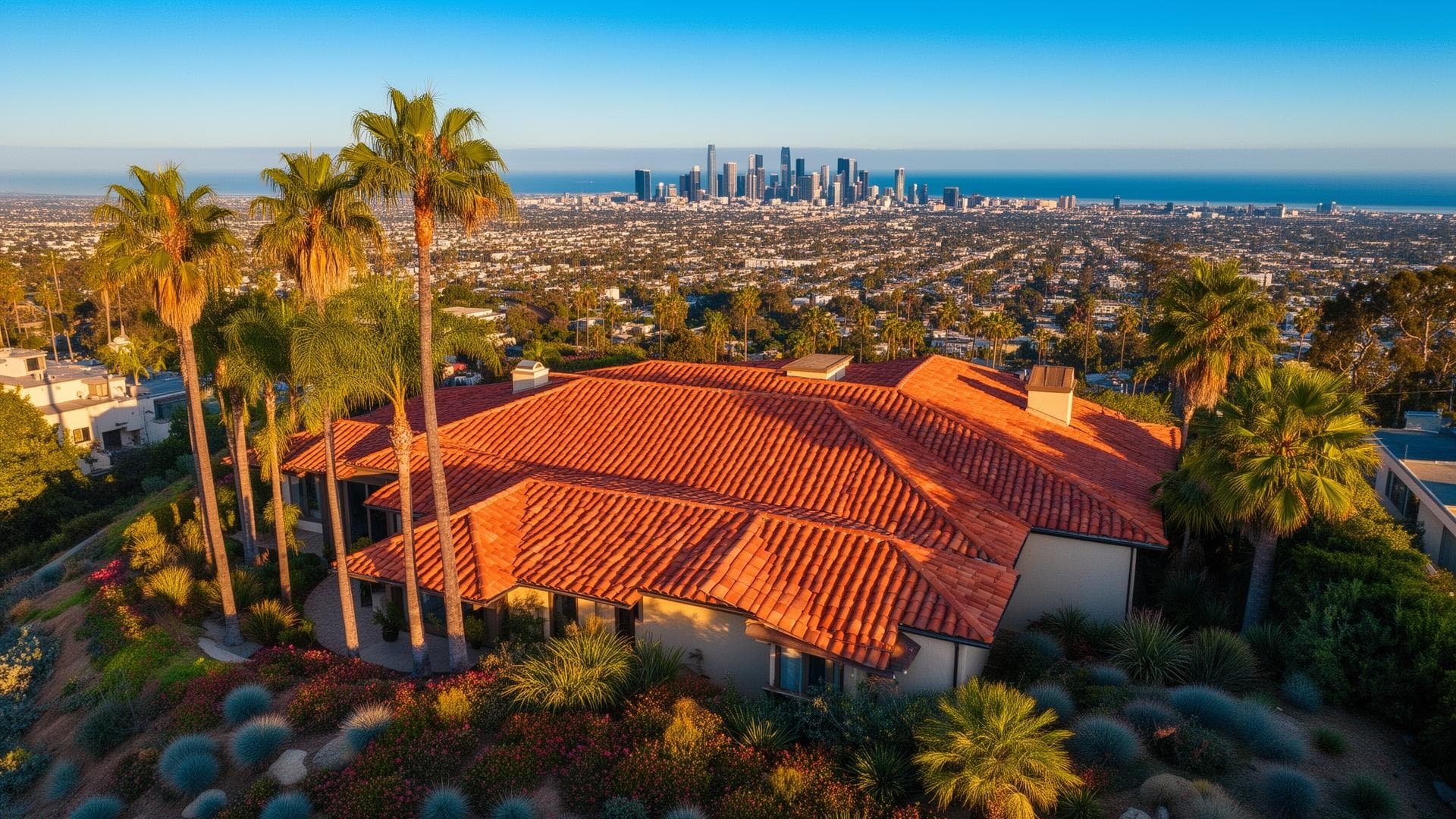
Service Guide
Roof Replacement Costs in California
Compare complete roofing quotes, choose a suitable material and check the permit, cool-roof and fire requirements for your property.
Start Project MatchRoof area
Measure the surface
Full scope
Compare every inclusion
Cool roofing
Check product ratings
Fire rating
Verify the assembly
How much does roof replacement cost?
A useful roof replacement estimate starts with the measured roof area and a specified installation system. Add removal, flashing, repairs, approvals and any solar work to the base price. A price per square foot without those inclusions cannot establish the full cost of your California project.
Do not substitute the home’s listed floor area for the roof surface. Pitch, overhangs, garages and roof shape affect the measurement. Ask bidders to separate measured area from material order quantity and waste. A simple roof and a roof with many valleys or penetrations can require different work even at the same area.
A worked budget using assumed prices
For this fictional example, assume a 1,500-square-foot roof and an $8-per-square-foot base installation covering the specified roof material, underlayment and installation labor. The separate items below produce an $18,000 planning total. All amounts are editorial assumptions, not observed invoices, California averages or a quote. Solar work, structural changes, taxes and financing costs are outside this example.
| Assumed scope | Amount |
|---|---|
| Base installation: 1,500 sq ft × assumed $8/sq ft | $12,000 |
| Removal and disposal | $1,800 |
| Flashing and penetration work | $1,200 |
| Sheathing repair allowance | $1,000 |
| Approval allowance | $500 |
| Project reserve | $1,500 |
| Illustrative total | $18,000 |
In this example, a $1-per-square-foot change to the assumed base rate changes the total by $1,500. A repair allowance is different: agree what happens if the actual quantity is higher or lower. Request a repair unit price and written authorization before additional work rather than treating the allowance as an unlimited commitment.
Compare the roof system, not just the covering
Shortlist materials that suit the roof’s slope, support, details and exposure. Ask for the exact product and assembly in writing, including underlayment, attachment and flashing. A broad label such as “tile,” “metal” or “cool shingle” leaves too much unspecified for a meaningful bid comparison.
| Material | Confirm before selection | Compare in the quote |
|---|---|---|
| Asphalt shingles | Exact shingle, color, approved slope and complete underlayment specification. | Removal layers, ventilation work, flashing and product versus workmanship coverage. |
| Clay or concrete tile | Existing support capacity, tile profile and the complete assembly below it. | Structural assessment, underlayment, broken-tile allowance and details at roof edges. |
| Metal roofing | Panel or shingle system, finish, attachment and compatibility with the site. | Seams, transitions, penetrations, corrosion exposure and finish-warranty exclusions. |
| Low-slope membrane | A system suitable for the measured slope, substrate and drainage layout. | Deck condition, drains, edge details, insulation and penetrations. |
When changing material, have the responsible professional assess the existing support and any required modifications. Do not infer capacity from the roof’s appearance. Ask whether a proposal replaces the entire assembly or reuses some components, and identify who will inspect those retained components.
Compare warranties separately from service-life claims. Product coverage, installation coverage, labor, removal costs and transfer rights can differ. A long warranty on the covering is not a promise that every roof component will remain serviceable for that period.
Start with the building department for your address
Ask the city or county responsible for your property how it handles the exact reroof scope, including added layers, sheathing repairs, material changes and structural work. Confirm the applicant, documents, inspection stages and any local requirements before scheduling removal. LADBS is the City of Los Angeles department, not a statewide permitting authority.
The CEC’s 2025 Energy Code overview sets January 1, 2026 as the normal application-date transition to that code. Have the permit office confirm the applicable edition and any special rebuild provisions for your project. Permit timing and local amendments matter; the calendar year on a roofing advertisement is not enough.
Ask about historic-property or association approvals where relevant, and coordinate roof work with an ADU project or other planned construction. Separate permit processing, materials and inspections from the installer’s working days. Agree how weather and hidden damage affect the schedule and temporary protection.
Which cool-roof requirements apply in 2026?
For existing single-family buildings, the 2025 prescriptive roof-replacement rule in Section 150.2(b)1I, printed pages 446–448 applies its listed provisions when more than 50% of the roof is replaced, including a new surface layer. The following summarizes the product-rating thresholds, not the entire compliance path.
| Roof slope | Climate zones | Minimum product ratings |
|---|---|---|
| Steep | 4 and 8–15 | Aged solar reflectance 0.20 and thermal emittance 0.75; or SRI 16. |
| Low | 4 and 6–15 | Aged solar reflectance 0.63 and thermal emittance 0.75; or SRI 75. |
Exceptions and alternatives exist; low-slope insulation provisions also need review. Confirm the address’s climate zone, measured slope and selected compliance path with the project professional. These figures do not describe new construction, additions or multifamily roofs. Local requirements may be different.
CRRC’s current California guidance explains the product rating and labeling requirements. Match the exact product and color to its active listing and use the required aged ratings. A light appearance alone does not prove compliance. The ENERGY STAR roofing-products program ended June 1, 2022; an old ENERGY STAR statement is not current roof certification.
EPA’s cool-roof explanation describes reduced heat absorption and potential cooling benefits, with results depending on the building and climate. Heating-season effects can also matter. Ask for the assumptions behind a savings estimate; do not build the purchase decision around a guaranteed percentage reduction in your household bill.
Check the fire-rated assembly and the surrounding details
UC ANR’s roof guidance explains that Class A is the highest roof fire-resistance classification and that some products achieve a rating only as part of a specified assembly. Confirm the covering, underlying layers and installation details together. “Metal” or “tile” alone does not document the required rating.
Use the State Fire Marshal’s fire-hazard maps and ask the local authority which requirements apply to the address. A hazard designation does not itself establish a property-specific risk assessment or an insurance outcome. Obtain any proposed premium change directly from the insurer before including it in your budget.
CAL FIRE’s home-hardening guidance addresses roofs alongside vents, eaves and other vulnerable parts of the home. Include debris removal and roof-edge or intersection details in the discussion. Have a qualified professional evaluate ember-resistant measures without compromising drainage or ventilation. Roofing is one part of wildfire preparation, not a guarantee that a home cannot burn.
Bring this checklist to each roofing bidder
CSLB lists roofing under its C-39 contractor classification. Verify the contractor’s current license and suitability for the contracted work. Collect proposals with the same product, area and assembly so that a lower number does not simply reflect a missing task.
- Existing conditions: measured area, number of layers to remove, known leaks and the method for documenting concealed damage.
- Installation: exact covering and color, underlayment, flashing, edge details, penetrations, ventilation scope and required ratings.
- Variable work: repair unit rates, allowance limits, exclusions and a written change-authorization process.
- Site and schedule: delivery access, landscaping protection, debris disposal, temporary weather protection and inspections.
- Solar coordination: responsibility for disconnection, removal, storage, reinstallation and recommissioning, plus warranty implications.
- Closeout: inspection records, applicable energy documentation, product labels, warranties, photographs and the service contact.
For a simple comparison exercise, a fictional $14,000 bid that excludes $3,000 of agreed removal and flashing work becomes $17,000 before remaining unknowns. Compare that adjusted scope with a $16,500 bid including those tasks. These are assumed figures demonstrating why the headline price alone can mislead.
From roof assessment to final inspection
1. Document the existing roof
Gather the roof measurements, covering type, leak history, accessible photographs and solar information. Have a qualified professional assess conditions that cannot be confirmed from the ground.
2. Resolve the approval and assembly requirements
Confirm the responsible building department, applicable code, climate zone and fire requirements. Record the proposed roof assembly, product ratings and any required structural review.
3. Compare an identical written scope
Separate the base installation, removal, flashing, repair unit rates, approvals, solar work and exclusions. Use a stated reserve for unknowns and agree how changes will be authorized.
4. Agree the construction sequence
Confirm material availability, property protection, temporary weather protection, inspection stages and coordination with other trades before removal starts.
5. Collect closeout documents
Obtain inspection records, product and color details, applicable compliance documents, photographs, warranties and maintenance instructions. Record the contact for any post-installation issue.
Ready to start your Roofing project?
Get matched with 2-3 vetted California contractors. 100% free, no obligation.
Find My ProsRoof replacement questions
How much does roof replacement cost in California?
Price the measured roof and a defined installation scope, then add removal, flashing, repairs, approvals and any solar work. This guide’s $18,000 example uses assumed inputs, including 1,500 square feet at $8 per square foot for the base installation. It is a budgeting exercise, not a California average or a contractor quote. Compare written proposals for the same roof area and inclusions.
Can I use my home’s floor area to estimate roofing?
Floor area does not establish roof surface area. Roof pitch, overhangs, garages and the shape of the building affect the measurement. Ask each bidder to state the measured roof area, material order quantity and waste allowance separately. Use the same area and scope when comparing a total with a per-square-foot price.
Do I need a roof replacement permit in California?
Check with the city or county building department responsible for the address before signing. Describe the work: replacement covering, an additional layer, sheathing repairs, material changes or structural work. Confirm the application, inspections and who obtains approvals. LADBS serves the City of Los Angeles; it is not the permitting authority for every California property.
Does every California reroof need a cool roof?
No single requirement applies to every reroof. The building type, climate zone, slope, scope, applicable code and compliance path matter. This guide summarizes the 2025 single-family prescriptive roof-replacement provision; additions, new buildings and multifamily projects require their own checks. Have the project’s compliance documentation identify the applicable requirement or exception.
What does a Class A roof rating mean?
Class A is the highest roof fire-resistance classification described by UC ANR. Check the tested assembly, not just the visible covering: some systems need specified underlying layers to achieve that rating. A Class A roof is not a guarantee against wildfire damage and does not establish a promised insurance discount.
Does a cool roof have to be white?
Color alone does not establish a cool-roof rating. Match the exact product and color to the CRRC listing and the ratings required for your project. The ENERGY STAR roofing-products certification program ended June 1, 2022, so an old ENERGY STAR claim is not current roof certification.
How long does replacing a roof take?
Ask for separate dates for approvals and material availability, removal, repairs, installation and inspections. Roof size, access, weather, hidden damage and coordination with solar equipment can change the schedule. The contractor’s written sequence should explain how the building will be protected between stages; this guide does not promise a statewide two-to-seven-day completion window.
What should happen to existing solar panels during a reroof?
Obtain a separate written scope for any disconnection, removal, storage, reinstallation and recommissioning. Coordinate the roofer, solar provider and applicable approvals before work starts. Identify who handles penetrations, damage and leak responsibility, and check the roof and solar warranty conditions. Do not assume the roofing price includes this work.
How do I compare roof warranties?
Compare the manufacturer’s product coverage with the installer’s workmanship coverage. Ask about term, exclusions, labor, removal costs, transfer rules, maintenance obligations and the claims contact. A long product warranty is not a prediction of the entire roof’s service life, and it does not automatically cover workmanship or solar-related leaks.
Sources and scope of this guide
Reviewed September 16, 2026. Code figures are limited to the cited single-family replacement provision. Project examples use explicit assumed prices; this page does not establish a statewide invoice sample, guaranteed completion time or insurance saving. Product and jurisdiction checks belong to the particular project.
The linked CEC, CRRC, EPA, UC ANR, CAL FIRE, State Fire Marshal and CSLB sources support the relevant sections above. Read our editorial methodology for how we distinguish planning inputs from observed costs. Keep the final product specifications and approvals with the written contract.
Cost Index
Roofing budget ranges
See 2026 planning ranges, cost drivers, budget tiers, and timeline notes for this project type.
Open cost dataMethodology
How Golden Yards builds ranges
Review how we normalize California costs, site conditions, source limits, and editorial updates.
Read methodologyGlossary
Terms that change bids
Define base prep, drainage, allowances, setbacks, permits, and other outdoor project terms.
Browse termsTerms in this guide
Quick definitions for the bid language that changes scope, cost, and contractor comparison.
Keep Reading
Explore More California Guides
Recent articles in this topic
Specific reporting and how-to from the Roofing beat across California.
Cost Guide
Roof Replacement Cost in Los Angeles: Quotes, Permits & Rebates
Compare complete Los Angeles roofing quotes with a sample budget, LADBS permit and cool-roof checks, repair allowances and LADWP rebate eligibility.
Cost Guide
Roof Replacement Cost in Seattle (2026): What Homeowners Actually Pay
A full roof replacement in Seattle costs between $18,500 and $34,000 in 2026, with a median project around $26,000. Learn why high labor costs and climate-specific needs drive up the price.
Process
The 4-Phase Roof Replacement Replacement in San Jose (How Long Each Phase Really Takes)
A full roof replacement in San Jose takes 4 to 8 weeks, not the 3 days you see in ads. We break down the four phases, from permitting to final inspection, and reveal the #1 cause of delays.
Process
How a Roof Replacement Replacement in Bellevue Actually Goes (2026 Timeline)
A full roof replacement in Bellevue is a 3 to 5-week process, accounting for permits, inspections, and potential weather delays. Learn the four phases and what can impact your project's timeline and cost.
Comparison
Roof Replacement: Premium vs. Mid-Tier in Long Beach (Real-World 2026 Comparison)
Comparing mid-tier architectural shingles vs. premium standing seam metal for a Long Beach roof replacement in 2026. We break down costs, permits, and coastal climate performance.
Trends
What's Changing in Beverly Hills Roof Replacements for 2026
For 2026, Beverly Hills roof replacements are transforming into high-performance systems. Discover the trends driving costs past $100k, from integrated solar to mandated cool roofs and Class A fire ratings.
Mistakes
What Most Sacramento Homeowners Get Wrong About Roof Replacements
A bad roof replacement in Sacramento isn't just a leak; it's a $12,000 re-do. Learn the six costliest mistakes homeowners make, from ignoring Title 24 energy codes to choosing the wrong materials.
Roofing
Roofing and Climate Considerations in Studio City: A 2026 Homeowner's
Studio City roofing requires climate-specific materials for heat, fire, and UV. Learn 2026 costs, permits, cool roof tech, and ROI for your Studio City home.
Roofing
Northridge Roofing: Climate-Ready Materials & Local Budgeting
Planning Northridge roofing in 2026? Discover climate-resilient materials, local budget ranges, and essential sequencing tips for your home.
Outdoor Living
Roofing and Climate Considerations in Long Beach: A Comprehensive
As a homeowner in Long Beach, your roof isn't just a cap on your house; it's the primary shield against the unique environmental challenges of Southern Calif...

Roofing
Arcadia Roofing & Climate: Materials, Costs, and Local Regulations
Arcadia homeowners need climate-resilient roofing. Learn about material costs ($12k-$45k+), local permits, energy savings, and fire safety for 2026.
Roofing
Anaheim Roofing & Climate: Your 2026 Guide to Durability and Value
Anaheim roofing costs range from $12,000-$35,000. This 2026 guide covers climate-resilient materials, permits, and ROI for Anaheim homeowners. Optimize your roof!