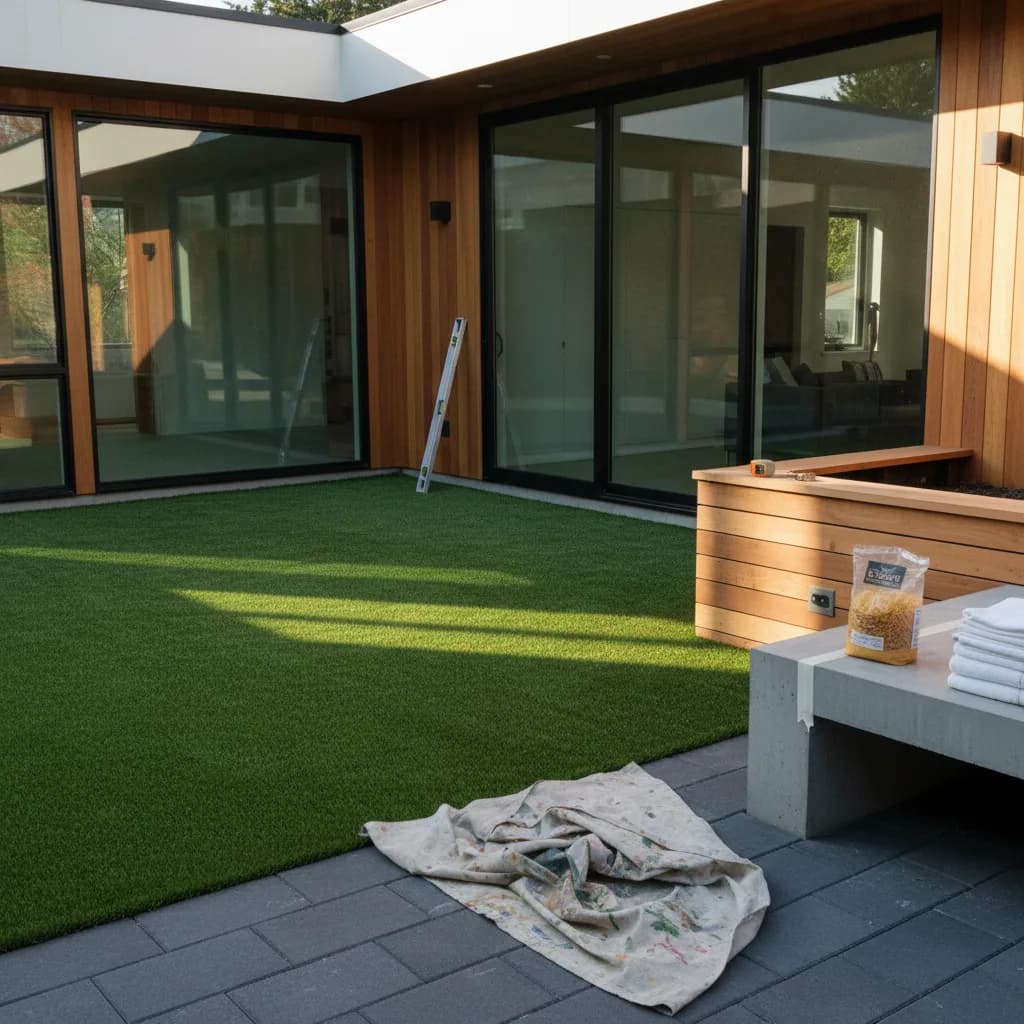
An artificial turf installation for a typical 800-square-foot Bellevue lawn costs between $11,200 and $19,200 in 2026, which breaks down to a range of $14 to $24 per square foot. While project costs can start lower for simple townhome patio overlays or small refresh projects, this range reflects a full-service installation involving significant excavation, a solid drainage base, and premium-grade turf. The real budget story isn't the turf itself; it’s the extensive site work required to manage the Pacific Northwest's persistent rainfall. Homeowners are often surprised by the cost of proper base preparation ($6 to $10 per square foot) and the necessary perimeter French drain system ($2,500 to $4,500) that is rarely included in the initial per-square-foot quote for a Bellevue artificial turf install.
In a Nutshell
- Typical 2026 Bellevue Cost: $14 to $24 per square foot, installed. An 800-square-foot project averages $15,000.
- Key Cost Driver: Drainage. The base layer of crushed rock must be deeper and more meticulously graded here than in drier climates, driving up labor and material costs.
- Project Timeline: Two to five days for a standard backyard, from excavation to final grooming.
- Biggest Homeowner Mistake: Focusing on the turf's face weight and color while under-budgeting for the sub-base, which is the most critical component for longevity in a wet climate.
- Secret Weapon: Choosing a contractor who specializes in Pacific Northwest installations and can show you a portfolio of local projects that have endured several rainy seasons.
Why is an Artificial Turf Install in Bellevue More Expensive?
The premium price for an artificial turf install in Bellevue comes down to three factors: specialized labor, climate-specific materials, and challenging site conditions. First, labor rates are higher. According to Washington State L&I contractor licensing and labor rate data, skilled landscape construction labor in the Seattle-Bellevue metro commands a significant wage, which is reflected in the installation price. This isn't a job for general landscapers; it requires technicians who understand precision seaming and proper base compaction.
Second, the materials required for a durable install in our rainy climate are more solid. The turf needs a high-flow, polyurethane backing for maximum permeability, not a standard latex one. The aggregate base beneath the turf must be four to six inches deep, compared to the two to three inches that might suffice in Arizona. This doubles the cost of gravel and the labor to install it. Finally, Bellevue's geography, with its hills and often dense, clay-like soil, makes excavation and hauling more difficult and expensive than in areas with sandy, easy-to-work soil.
The Three Tiers of Bellevue Artificial Turf Install Costs in 2026
Understanding the cost spectrum helps you align your budget with the right materials and scope. The price per square foot is a composite of the turf product, the depth of the base, the type of infill, and the complexity of the labor.
- Entry-Level ($12 - $16 per sq. ft.): This tier typically includes a domestic turf product with a 40 to 50-ounce face weight and a standard polyurethane backing. The base is a properly compacted three-inch layer of crushed rock, and the infill is basic washed silica sand. This is suitable for low-traffic areas or small, simple footprints without significant drainage challenges.
- Mid-Range ($17 - $22 per sq. ft.): This is the sweet spot for most Bellevue homeowners. It features a premium turf like SYNLawn's SYNAugustine 347, with a 60 to 80-ounce face weight, heat-reflective technology, and superior backing. The base is deepened to four or five inches, and the infill is upgraded to a coated, antimicrobial product like Envirofill, which is better for pets and stays cooler.
- High-End ($23 - $30+ per sq. ft.): At the premium level, you get top-tier turf with the most realistic blade structure and coloration. The project includes a six-inch or deeper aggregate base, often with integrated drainage channels or connections to a French drain system. The infill is a specialized, pet-deodorizing system like ZeoFill, and the scope may include significant grading and site work on challenging lots in neighborhoods like Somerset or Clyde Hill.
Three Representative Projects from 2026
Ready to compare vetted project options?
Use Project Match privately when your scope is clear enough for contractor conversations.
Start Project MatchThree representative projects from 2026, scoped similarly, reconstructed from Golden Yards Magazine's Project of the Day network and used here in aggregate form:
- The Downtown Bellevue Condo Patio (250 sq. ft.): A simple overlay project on an existing concrete patio cost the homeowner $4,500. This involved no excavation, just a drainage mat and a mid-grade turf product like ProGreen's PG 4000 glued down at the perimeter. The cost was almost entirely materials and a half-day of skilled labor.
- The Somerset Family Backyard (700 sq. ft.): This project on a sloped lot cost $15,400. The budget included excavation of four inches of soil, a five-inch compacted base, and a premium pet-friendly turf. The key addition was a $3,200 perimeter French drain tied into the home's downspouts to manage runoff from the hill, a common requirement in the area.
- The Medina Estate Lawn Replacement (1,500 sq. ft.): A large, high-end installation came in at $39,000. This involved removing an old, failing lawn, significant re-grading for perfect contouring, a six-inch 'bomb-proof' base, and a top-of-the-line SYNLawn product. The price reflects the extensive labor, high volume of materials, and the precision required for a large, multi-seam installation.
Your Step-by-Step Bellevue Artificial Turf Install Guide
A successful artificial turf install in Bellevue is all about process. Following these steps ensures your investment is built on a foundation that can handle the local climate.
- Define Your Scope & Select Your Turf. First, determine the exact footprint and intended use. Is it a dog run, a putting green, or a play area for kids? This dictates the ideal pile height, face weight, and blade shape. Collect samples from reputable brands like FieldTurf or SYNLawn. Why: Matching the turf specifications to your lifestyle prevents premature wear and ensures you're happy with the look and feel. Watch out for: Unbranded, low-cost turf from online wholesalers, which often lacks proper UV inhibitors and can fade or degrade quickly in the sun.
- Vet Your Bellevue Artificial Turf Install Contractor. Get at least three bids from licensed, bonded, and insured contractors who specialize in synthetic turf. Ask for addresses of local installations from three to five years ago to see how their work holds up. Why: The quality of the base preparation, which you'll never see, is far more important than the turf itself, and only experienced installers get it right. Watch out for: General landscapers who offer turf as a side service; they often lack the specialized equipment and knowledge for proper seaming and compaction.
- Confirm Site Prep and Excavation Plan. The crew will remove three to six inches of existing sod and soil. Confirm the plan for protecting surrounding landscaping and how they will haul away the debris. Why: Proper excavation creates the necessary canvas for the new base and ensures no organic material is left to decompose under the turf. Watch out for: Quotes that don't explicitly include the cost of soil disposal, which can be a surprise charge of $500 to $1,500 depending on the project size.
- Oversee Base Compaction and Drainage Layers. This is the most critical stage. A layer of crushed rock (typically 3/4-inch clean) is spread, graded for drainage, and compacted with a plate compactor multiple times. Why: A perfectly compacted and graded base is what guarantees water will flow through the turf and away from your home, preventing puddles and sogginess. Watch out for: Crews who skip the plate compactor or only do a single pass; an insufficiently compacted base will settle unevenly over time, creating dips and voids.
- Inspect the Turf Laying and Seaming. The turf rolls are laid out, cut to shape, and seamed together using specialized tape and adhesive. The perimeter is then secured, often with long, galvanized spikes. Why: Meticulous seaming is the art of the installation, making multiple pieces look like a single, monolithic lawn. Watch out for: Visible seams from a distance, which is the number one sign of a rushed or amateur job and is nearly impossible to fix after the fact.
- Approve Infill Application and Power Brushing. Once the turf is secured, a layer of infill (like silica sand or Envirofill) is spread evenly over the surface and then worked down into the base of the fibers with a power broom. Why: The infill provides ballast to hold the turf down, protects the backing from UV rays, and helps the blades stand upright. Watch out for: Installers who just rake the infill in by hand; a power broom is essential for ensuring the infill settles deep into the base of the turf for a professional finish.
Avoiding Budget Overruns on Your Turf Project
The most common budget surprises in Bellevue turf projects are related to water and soil. If your yard has existing drainage problems, the turf installation will not solve them; it may even worsen them without proper planning. Budget for a potential perimeter French drain or a channel drain system, which can add $2,500 to $5,000 to the project. Another frequent surprise is the cost of grading. A quote might assume a flat area, but if your yard requires significant leveling, expect to add $1,500 to $4,000 for that work. Finally, always hold back a reserve. The National Association of Home Builders recommends a ten to fifteen percent contingency on renovations in homes over thirty years old. This covers unforeseen issues like discovering buried debris or needing to reroute sprinkler lines that weren't on the original plans. For a deeper dive into local requirements, see our Bellevue artificial turf permit playbook for 2026.
Your Bellevue Artificial Turf Install Checklist
- [ ] Obtain at least three quotes from specialized turf installers.
- [ ] Request and check at least three local, multi-year-old references for each contractor.
- [ ] Choose a turf product with a minimum 15-year warranty and polyurethane backing.
- [ ] Select an infill appropriate for your use (e.g., antimicrobial for pets).
- [ ] Confirm the quote includes all excavation, soil disposal, and a minimum four-inch compacted base.
- [ ] Discuss and budget for potential drainage upgrades (e.g., French drain).
- [ ] Verify the contractor uses a power broom for infill and provides a final grooming.
- [ ] Understand the warranty for both the turf product and the installation labor.
Sources & Methodology
See the Golden Yards Methodology for how sources are reviewed, ranges are normalized, and planning-data limits are handled.
Cost ranges in this guide draw on the following named industry sources, public agency datasets, and Golden Yards Magazine editorial research.
- Washington State Department of Labor & Industries (L&I), Prevailing Wage Data (2026)
- City of Bellevue, Development Services Department, Land Use Code (2026)
- Synthetic Turf Council, Guidelines for Synthetic Turf Installation (2025)
- National Association of Home Builders (NAHB), Remodeling Market Index (Q1 2026)
- University of Washington Botanic Gardens, Pacific Northwest Soil & Drainage (2024)
- Puget Sound Business Journal, Real Estate Market Data (2026)
Golden Yards Magazine Take
The meta-pattern most Bellevue homeowners miss is that they are not buying a product, they are investing in a system. The turf itself is just the green top layer. The real work, the real expense, and the real determinant of long-term success lies in the sophisticated drainage platform built beneath it. In our climate, you're essentially commissioning a large-scale, permeable paver system that happens to look like a perfect lawn. The success of your artificial turf install won't be measured on a sunny August afternoon; it will be proven during a week of relentless November rain. A great installation remains dry underfoot. A poor one becomes a swampy, puddled mess. Focus your vetting, your questions, and your budget on the contractor's detailed plan for moving water through and away from your new lawn.
Ready to start your artificial turf project?
Find My ProsFrequently Asked Questions
How does artificial turf handle Bellevue's heavy rain?
Properly installed artificial turf handles Bellevue's heavy rain exceptionally well. The turf's perforated backing and a crucial four-to-six-inch crushed aggregate sub-base create a highly permeable system. This foundation acts like a French drain, allowing water to percolate into the subsoil or a drainage system, keeping your lawn puddle-free.
The key to effective drainage in Bellevue is the sub-base engineering. While the turf itself has perforations for water to pass through, the foundation does the heavy work. A four-to-six-inch layer of compacted, crushed aggregate creates this permeable base. This system functions like a large French drain, collecting water and letting it slowly absorb into the subsoil. For properties with heavy clay soil or on a slope, contractors often install a perimeter French drain to actively channel water away, ensuring the lawn remains usable even after an atmospheric river.
What is the real maintenance for turf in a moss-prone climate?
Artificial turf in the Pacific Northwest requires low maintenance, not no maintenance. The main task is removing organic debris like leaves and seeds with a blower or stiff broom to prevent moss. High-traffic areas should be power broomed two to four times a year to fluff fibers and redistribute infill.
While you avoid mowing, watering, or fertilizing, keeping the surface clear is important. Debris can decompose and create a habitat for moss and weeds, especially in shady, damp corners. If moss or algae does appear, a simple spray-on treatment with a product like Wet & Forget or a diluted vinegar solution is usually effective. The periodic power brooming, about two to four times annually, helps maintain the turf's appearance by reviving matted fibers in frequently used areas.
Is artificial turf safe for kids and pets in Bellevue?
Yes, modern artificial turf in Bellevue is safe for kids and pets. Today's turf blades are made from non-toxic polyethylene, the same plastic in milk jugs, and require no pesticides or fertilizers. For pets, specialized infills like Envirofill or ZeoFill are non-toxic, antimicrobial to prevent odors, and help keep the surface cool.
The safety of contemporary turf systems comes from their improved materials. Reputable brands make grass blades from non-toxic polyethylene, a plastic also found in food containers. This eliminates the need for chemical treatments like pesticides, herbicides, or fertilizers, preventing exposure for your family and pets. The turf is also durable enough for energetic play.
For households with pets, the infill material is a key consideration for safety and cleanliness. We recommend upgrading from basic silica sand to a specialized pet infill like Envirofill or ZeoFill. These products are non-toxic and contain antimicrobial agents that inhibit odors from urine. They also help keep the surface cooler for paws and eliminate muddy tracks inside your home.
How much does artificial turf increase home value in Bellevue?
Artificial turf increases a Bellevue home's value by improving curb appeal and signaling low maintenance. While a precise dollar amount is hard to define, realtors report homes with modern landscaping often sell faster and for a slight premium. A pristine, evergreen lawn is a powerful selling feature in a competitive market.
The return on investment extends beyond finances to the yard's usability, a significant lifestyle upgrade for many Bellevue buyers. Artificial turf provides a dry, clean surface for kids and pets during soggy winter months. This finished, polished look appeals to busy professionals and families who value their weekend time, which can contribute to a quicker sale.
Can you install turf over an existing lawn or concrete patio?
You can install turf over a concrete patio but not over an existing lawn. Installing over a lawn causes an unstable, lumpy surface as the grass decomposes and impedes drainage. For concrete, a shock-absorbing drainage pad is installed first, then the turf is secured with adhesive. This requires good concrete condition.
Proper installation over a lawn requires excavating the sod and soil to build a stable, compacted aggregate base. Simply covering the organic material will fail.
Installing turf over concrete is a popular, faster, and less expensive option for balconies and urban yards. The process involves laying a shock-absorbing pad to cushion the surface and create channels for water to escape. The turf is then laid over the pad and secured around the perimeter. Success depends on the concrete being in good condition and properly sloped for drainage.