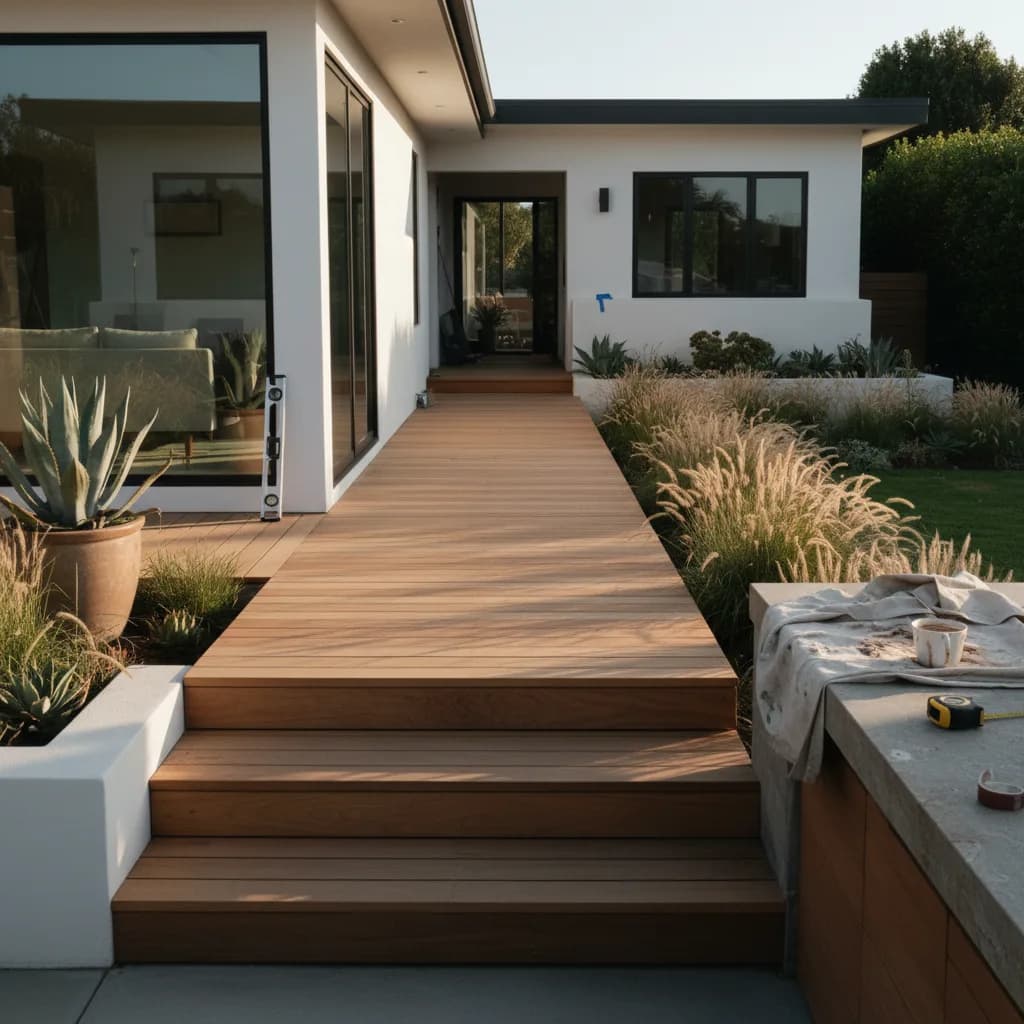
A 400-square-foot bluestone walkway in Newport Beach going over budget isn't a surprise, it's a statistical probability. A typical project overrun is twenty to thirty percent, turning a $15,000 quote into a $20,000 final bill and adding three weeks of crew traffic. The culprit isn't the stone you chose. It's the four inches of uncompacted base material you can't see, which is where the real cost of a callback is buried.
In a Nutshell
The cost of getting a walkway wrong is brutal. A heaved paver path or a cracked, spalling concrete walkway costs about 75% of the original project price to demolish and replace correctly. The three most common mistakes are ignoring subgrade preparation for coastal soils, using standard materials that fail in salt air, and accepting a scope of work that's silent on drainage. Your counter-move this week: before you even request a bid, download the Interlocking Concrete Pavement Institute (ICPI) Tech Spec 2 for paver bases. Read it. It's the standard your walkway contractor in Newport Beach should be meeting, or exceeding.
What a Newport Beach Walkway Really Costs
Let's talk numbers. The price for a professionally installed walkway in Newport Beach can start lower, often for simple concrete refresh projects on small condo lots, but a typical comprehensive project has a distinct cost structure. For a new paver or high-end concrete walkway, expect to invest between $35 and $65 per square foot. A 500-square-foot project lands between $17,500 and $32,500. Why the high price tag? Labor is a significant factor. The California Department of Industrial Relations prevailing wage data for Orange County sets a high bar for skilled hardscape labor. It’s not just about laying pavers; it’s about certified equipment operators for excavation and compaction, and masons who understand coastal concrete mixes.
Three representative projects from 2026, scoped similarly, reconstructed from Golden Yards Magazine's Project of the Day network and used here in aggregate form:
- Corona del Mar (450 sq. ft. Porcelain Paver Walkway): Tight access and significant grading pushed this project to $29,250. The spec included an 8-inch compacted base and a new subsurface drainage system tied into existing lines.
- Balboa Peninsula (300 sq. ft. Salt-Finish Concrete Path): At $13,500, this project required epoxy-coated rebar and a specific, low-slump concrete mix to combat salt air corrosion, adding to the material cost.
- Lido Isle (600 sq. ft. Permeable Paver Driveway Apron & Walkway): This $36,000 project involved a deeper, open-graded aggregate base to manage stormwater runoff, a requirement that adds excavation and material-handling costs.
Mistake #1: Ignoring the Subgrade
Most homeowners focus on the surface paver or the concrete finish. This is the primary mistake because the walkway's lifespan is determined by the unseen base beneath it. Newport Beach soils are a mix of sandy loam and pockets of expansive clay, a combination that requires a solid, engineered subgrade and base. Without it, differential settlement will cause pavers to heave and concrete to crack within three to five years, guaranteed. The counter-move is to insist on a written specification in the contract: a geotextile separation fabric laid over the compacted native subgrade, followed by a minimum six-inch base of ASTM #57 stone, compacted in two three-inch lifts to 95 percent Modified Proctor density. Anything less is a future failure.

Mistake #2: Underestimating Coastal Corrosion
Ready to compare vetted project options?
Use Project Match privately when your scope is clear enough for contractor conversations.
Start Project MatchHomeowners often approve a standard concrete spec with conventional steel rebar to save a few dollars. On a property in Newport Coast or along the bay, this is a five-year failure in the making. The persistent salt-laden marine layer infiltrates porous concrete and aggressively corrodes steel reinforcement. This rusting steel expands, exerting immense pressure that causes the concrete to crack and spall from within. The fix is to specify materials fit for the environment. Your contract should call for either epoxy-coated #5 rebar or, even better, fiberglass rebar which is inert to chloride corrosion. Combine this with a denser, low-permeability concrete mix and ensure the contractor maintains a minimum of three inches of concrete cover over the reinforcement grid.
Mistake #3: Choosing the Wrong Joint Sand
A contractor might propose using basic, inexpensive ASTM C33 sand for the joints between pavers. This is wrong because Newport's damp, foggy climate and seasonal rains will wash fine silica sand out in a year or two. This leads to paver instability, weed growth, and ant infestations. The surface you paid a premium for now looks unkempt and feels unstable underfoot. The professional move is to specify a high-quality polymeric sand. This sand contains a water-activated binding agent that hardens to lock pavers in place, resist erosion, and inhibit weed growth. For our coastal climate, a product specifically formulated to cure in higher humidity is essential for a lasting, low-maintenance finish.
Mistake #4: Forgetting Drainage and Slope
A walkway is often treated as a simple surface element, with little thought given to water management. This oversight can direct rainwater straight toward your home's foundation or create persistent puddles that become slick, mossy hazards. Every hardscape surface is a drainage system, for better or worse. The non-negotiable solution is to ensure the walkway is graded with a minimum cross-slope of one-quarter inch per foot, directing water away from structures and into landscape areas or designated drains. For long walkways running parallel to a house, a discreet channel drain installed along the edge is a smart, permanent solution to protect your foundation from water intrusion.
Mistake #5: Accepting a Vague Scope of Work
You receive a one-page quote that says "Install 400 sq. ft. paver walkway - $16,000." This is a red flag, not a contract. A vague scope is a contractor's license to use the cheapest materials and create a flurry of expensive change orders for anything not explicitly listed. The counter-move is to demand a detailed, multi-page scope of work. It should itemize everything: demolition, excavation depth, subgrade compaction standard, geotextile fabric type, base material and thickness, bedding sand spec (ICPI Tech Spec 2 recommends ASTM C33), paver manufacturer and model, edge restraint type, joint sand product, and sealant application. A clear scope is your best tool for comparing bids and holding the contractor accountable. Get three quotes. Check three references. Visit one finished California job before signing. This due diligence is critical, and you can find guidance in our [Newport Beach walkway permit playbook for 2026](/guides/newport-beach-walkway-permit-playbook-2026) for what the city expects. The National Association of Home Builders recommends a ten to fifteen percent contingency on renovations in homes over thirty years old; a detailed scope helps protect that fund for true unknowns, not foreseeable work.
Mistake #6: Not Planning for Future Utilities
A year after your beautiful walkway is complete, you decide to add landscape lighting or run a new irrigation line. This common scenario becomes a costly problem, forcing you to either saw-cut your new hardscape or pay for expensive horizontal boring underneath it. The damage and expense are completely avoidable. The simple, forward-thinking solution is to install utility sleeves during construction. Have your contractor lay two or three 1.5-inch Schedule 40 PVC pipes as conduits beneath the walkway at strategic points. Cap them and mark their locations. For a material cost of less than $100, you've created easy access for any future low-voltage wiring or irrigation needs, saving thousands of dollars and preserving the integrity of your investment.
Golden Yards Magazine Take
The meta-mistake behind most walkway budget overruns in Newport Beach is a failure of categorization. Homeowners treat a walkway project like a decorative finish, similar to painting or planting. It is not. A walkway is a piece of light civil engineering. It's a structure that must manage soil mechanics, hydrostatic pressure, and relentless coastal weather. When you focus only on the color of the paver, you ignore the eighty percent of the work and material that lies underground. This is where durability is created or destroyed. The contractors who get callbacks are the ones who let clients dictate a price by skimping on the base. The ones who build 25-year walkways talk about compaction and drainage before they ever show you a stone sample.
Frequently Asked Questions
Our editors answer the most common questions about walkway installation costs and contractor selection in Newport Beach.
What's the most expensive mistake in a Newport Beach walkway?
The single most expensive mistake is inadequate subgrade and base preparation. Skimping here saves a few hundred dollars on materials and labor upfront but leads to catastrophic failure. When a walkway built on poorly compacted soil begins to sink and heave, the only fix is complete demolition and replacement. This means you pay for the project twice: once for the initial flawed installation, and a second time for the demolition, disposal, and proper reconstruction. The cost to rebuild is often 75-90% of the original price. This dwarfs the cost of any other mistake, like using the wrong sealant or even choosing a paver that fades. Always invest in the foundation; it's the part of the project you can't see but matters the most.
How do I know if my walkway contractor is qualified for coastal work?
Look for specificity in their proposal and their past work. A qualified coastal contractor won't just list "concrete path"; they will specify a low-permeability concrete mix with a water-reducing admixture and recommend epoxy-coated or fiberglass rebar to prevent spalling from salt air. For pavers, they should discuss polymeric sand formulated for damp environments and stainless steel or heavily galvanized edge restraints. Ask to see projects they completed in Newport Beach, Corona del Mar, or Laguna Beach that are at least five years old. Check for paver settlement, joint integrity, and any signs of concrete spalling. A contractor accustomed to inland work may not appreciate the unique corrosive challenges of a marine environment.
When should I walk away from a walkway quote?
Walk away from any quote that is significantly lower than the others, lacks detail, or comes from a contractor who resists putting specifications in writing. A bid that's 20% or more below the competition isn't a bargain; it's a warning sign of uncompacted base, cheap materials, or uninsured labor. If a contractor tells you a permit isn't needed for work that involves significant grading or retaining elements, verify it yourself with the Newport Beach Building Division. Finally, if a contractor pressures you for a quick decision with a "special price" that expires today, thank them for their time and show them the door. Professional quotes are built on careful measurement and calculation, not sales tactics.
What's the fastest way to blow a walkway budget in Orange County?
The fastest way is through change orders stemming from a vague initial contract. If your agreement just says "install bluestone walkway," every single detail becomes a potential upcharge. "You want professional-grade edge restraints? That's a change order." "Oh, you need us to sleeve for future lighting? Change order." "Hauling away the old concrete? That wasn't in the bid." These small additions can inflate the final cost by 30% or more. Lock down every detail in the initial scope of work, from the brand of polymeric sand to the site cleanup standards. A detailed contract protects your budget from a thousand small cuts.
Sources & Methodology
Golden Yards reviews public permit and code signals, material pricing, climate and site constraints, contractor quote patterns, comparable projects, the Golden Yards Cost Index, and the Golden Yards Methodology. Cost references are planning ranges, not fixed bids.
The recommendations and data in this article are informed by leading industry and government sources.
Ready to start your hardscaping project?
Find My ProsFrequently Asked Questions
What's the most expensive mistake in a Newport Beach walkway?
The most expensive mistake for a Newport Beach walkway is inadequate subgrade and base preparation. Saving a few hundred dollars on this step leads to sinking and heaving, requiring complete demolition and replacement. This forces you to pay for the project twice, with the rebuild costing 75-90% of the original price.
Skimping on the foundation saves a small amount on initial materials and labor but results in catastrophic failure. When a walkway built on poorly compacted soil begins to sink, the only solution is a complete tear-out and rebuild. This means paying for the initial flawed installation and then again for the demolition, disposal, and proper reconstruction. The cost to rebuild, often 75-90% of the original price, far exceeds the cost of other mistakes like using the wrong sealant or choosing a paver that fades. Always invest in the foundation, the part you cannot see but which matters most.
How do I know if my walkway contractor is qualified for coastal work?
A qualified coastal contractor provides specific proposals. They will detail low-permeability concrete with epoxy-coated or fiberglass rebar to prevent salt air spalling and suggest polymeric sand with stainless steel restraints for pavers. Ask to see their projects in Newport Beach, Corona del Mar, or Laguna Beach that are at least five years old.
A contractor accustomed to inland work may not appreciate the unique corrosive challenges of a marine environment. A generic proposal for a 'concrete path' is a red flag. Instead, look for specifics like a low-permeability concrete mix with a water-reducing admixture to protect against salt air.
For pavers, the contractor should discuss using polymeric sand formulated for damp environments and stainless steel or heavily galvanized edge restraints. When you inspect their past projects, look closely for paver settlement, compromised joint integrity, and any signs of concrete spalling, which indicate materials unsuited for coastal conditions.
When should I walk away from a walkway quote?
Walk away from a walkway quote if it is vague, suspiciously low, or not in writing. A bid that is 20% or more below others is a warning sign, not a bargain. Dismiss high-pressure sales tactics like a 'special price' expiring today, and independently verify permit needs with the Newport Beach Building Division.
A quote that is 20% or more below the competition often indicates serious issues, such as plans for an uncompacted base, cheap materials, or the use of uninsured labor. These shortcuts can lead to premature failure of the walkway and leave you liable for accidents.
Insist on a detailed, written contract. If a contractor suggests a permit is not needed for work involving significant grading or retaining elements, you must verify it yourself with the Newport Beach Building Division. Professional quotes are based on careful calculation, so you should also be wary of anyone pressuring you for a quick decision with a limited-time offer.
What's the fastest way to blow a walkway budget in Orange County?
The fastest way to blow a walkway budget in Orange County is through change orders that result from a vague initial contract. An agreement for just a 'bluestone walkway' allows for upcharges on every detail, from edge restraints to hauling old concrete, potentially inflating the final cost by 30% or more.
A vague contract leaves your budget vulnerable. Every unspecified detail can become an extra charge. For example, needing to sleeve for future lighting or wanting professional-grade edge restraints could each trigger a change order. Even hauling away the old concrete might not be included in the original bid. To protect your budget from these unexpected expenses, ensure the initial scope of work is highly detailed. It should specify everything from the brand of polymeric sand to the exact standards for site cleanup upon completion.