A San Diego front walkway is a small project with several separate decisions: surface appearance, drainage, the route to the door, and what happens when part of the paving needs repair. Stamped concrete and interlocking concrete pavers can both be sensible choices. A material labeled “premium” does not tell you whether the quote includes the right preparation.
Our comparison: shortlist stamped concrete when you want a continuous patterned surface and have an agreed joint and curing plan. Shortlist interlocking pavers when replacing individual units or reopening the path for utility work matters. Evaluate permeable paving as a separate drainage system. Choose between complete proposals for your property, rather than assuming one material always costs less.
This September 2026 review does not establish a verified San Diego installed-price average. The cost example below is invented to demonstrate quote comparison; it is not a contractor bid or a completed local project.
Stamped concrete vs. pavers: what are you buying?
| Decision | Stamped concrete | Interlocking concrete pavers |
|---|---|---|
| Appearance | A poured surface with a selected pattern, color and finish. | Separate units assembled in a selected size, color and laying pattern. |
| Details to review | Slab design, joint locations, finishing and curing method. | Subgrade, base, bedding, edge restraints and joint material as one assembly. |
| Future access | Ask how a repair or utility opening will be finished and how visible it may remain. | Ask whether units can be lifted and reinstated, and keep matching spare units. |
| Water management | Show the intended surface drainage and discharge location on the plan. | Conventional pavers also need a drainage plan; joints alone do not establish permeability. |
| Price comparison | Obtain a total with preparation, finish, drainage and exclusions identified. | Obtain the same scope, naming the actual paver and installation system. |
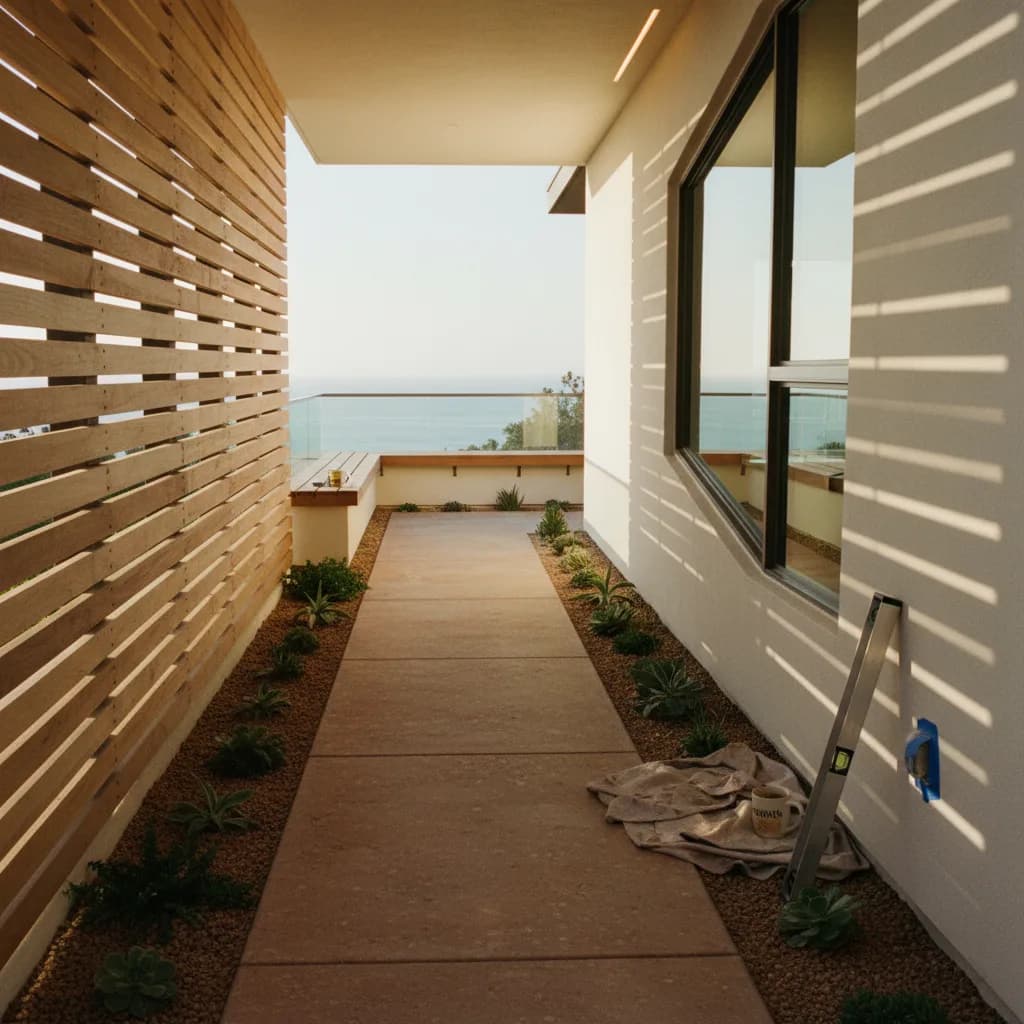
These are decision prompts, not a ranking of every product. Natural flagstone, porcelain slabs and mortar-set paving are different assemblies. If a quote substitutes one of them, request its installation detail instead of applying a concrete-paver specification. The hero image illustrates a stone-pattern path; it is not evidence of either quoted system or a completed San Diego job.
Compare walkway cost using the same scope
Measure the path, landings and any widened entry area before asking for prices. State which existing materials must be removed, how equipment can reach the work, and whether the quote includes disposal. Request steps, lighting, irrigation relocation and retaining work as explicit items. A surface-only price cannot answer the cost of the complete project.
Illustrative calculation, not local pricing: imagine two invented proposals for the same 400-square-foot path. Proposal A is $12,000, or $30 per square foot; Proposal B is $15,000, or $37.50 per square foot. If A excludes $3,000 of drainage and disposal that B includes, both total $15,000 after equalizing that scope. The apparent $3,000 saving disappears.
Use your own written quotes in that calculation. Add only items actually omitted from a proposal, avoid counting allowances twice, and retain a separate list of unresolved costs. Compare the final totals first; divide by the same measured area only after the inclusions match. These arithmetic examples provide no evidence that either number is a normal San Diego price.
For broader layout choices, start with our hardscaping planning guide. Keep the walkway comparison focused on its own measured area and construction scope.
Ask for the construction detail behind the finish
For a conventional aggregate-base paver installation, CMHA’s construction guidance describes a sequence that includes preparing the soil, building the base, providing edge restraints, placing bedding sand and installing the units. Base design depends on conditions and loading. Ask the installer to identify the applicable detail and inspection or quality checks, rather than copying one base depth or compaction number into every job.
For poured concrete, ask for the slab and joint plan before approving a stamped pattern. NRMCA’s joint guidance explains how planned joints manage where movement-related cracks occur. Decorative lines are not a substitute for that plan. The proposed mix, reinforcement where specified, joint construction and timing should suit the actual project; this guide does not prescribe a universal reinforcement grid.
Include curing in the proposal. NRMCA describes curing as maintaining suitable moisture and temperature after placement so concrete can develop its intended properties. Ask who protects the new surface, how long access is restricted, and when cleaning or sealing products may be applied. A date for the pour is not a date for unrestricted use.
Check City of San Diego permits and the property boundary
Ready to compare vetted project options?
Use Project Match privately when your scope is clear enough for contractor conversations.
Start Project MatchThe City’s Municipal Code §129.0203(a)(7) provides a building-permit exemption for sidewalks and driveways no more than 30 inches above adjacent grade, not above a basement or story, and not part of an accessible route under the California Building Code. The section includes exceptions for historical resources and environmentally sensitive lands. Confirm the applicable classification with Development Services; width alone is not the test listed in this exemption.
Public sidewalk work is a separate question. City Bulletin 165 describes right-of-way permits for standard public improvements, including sidewalk replacement. Some limited sidewalk projects qualify for its Rapid Review category, but that is a review route, not a waiver of approval. Locate the property line before treating everything between the door and curb as private paving.
Bring a dimensioned sketch to the City’s permit review process and identify drainage changes, steps, walls and any coastal or historic constraints. A San Diego mailing address does not by itself establish City jurisdiction. For a property in another municipality, such as Del Mar or Encinitas, verify that municipality’s requirements.
Coastal exposure, sealing and repairs
For a coastal site, request written care instructions for the exact product, finish and exposure. Do not accept a blanket promise that any paving material is immune to salt-related deterioration. Ask how the supplier addresses staining, surface wear, irrigation overspray and the selected cleaning products.
CMHA’s maintenance guide covers joint-sand loss, settlement, staining and removal and reinstatement of interlocking pavers. The ability to replace units is useful, but the cause of settlement still needs attention. Keep the product name and spare units with your project records; replacing one unit is different from repairing a failing base.
Sealing is a product and maintenance decision. CMHA’s cleaning and sealing guidance explains that reapplication depends on use, climate and sealer quality, and cautions about slip resistance. Request a sample showing the final appearance and advice on wet-surface performance. Avoid a universal resealing calendar or the assumption that a glossy finish is suitable for every front-door route.
When to consider a permeable walkway
Permeable interlocking concrete pavement is more than ordinary pavers with wider gaps. CMHA’s permeable-system guidance describes permeable joints, open-graded bedding and an aggregate reservoir. Depending on the site, the design may use infiltration, storage and an underdrain. It should not be assembled by mixing conventional bedding-sand instructions with an unrelated permeable base detail.
Ask where water enters, where it is stored, and where excess water goes. Identify the adjacent planting areas and the maintenance needed to keep sediment out of the joints. Have the designer explain the soil and drainage assumptions. Obtain a separate price for the complete permeable system; this review has no verified basis for a fixed percentage premium in San Diego.
Request a schedule with usable milestones
Ask the contractor to separate approvals and product delivery from active site work. Then identify demolition, preparation, drainage work, paving, protection of the new surface, cleanup and handover. Agree on access to the front door during each stage. If the path crosses the only practical entrance, that access plan deserves attention before work begins.
Request the conditions that could move each milestone: hidden utilities, unsuitable existing base, design changes, weather and required inspections. For concrete, include curing and reopening instructions; for pavers, include completion of joints, edges and any specified treatment. We have not verified a universal one- or two-week schedule for San Diego walkways.
Bring this checklist to the site visit
| Item | What to have written down |
|---|---|
| Measured scope | Area, route width, landings, steps and the exact boundaries of the work. |
| Preparation | Demolition, disposal, access constraints and treatment of unsuitable existing material. |
| Assembly | Product, finish, supporting layers, edges or joints, and the applicable installation detail. |
| Water and utilities | Drainage destination, irrigation changes, utility access and any additional design work. |
| Approvals | Jurisdiction, permit responsibilities, fees and any public right-of-way work. |
| Price changes | Included allowances, exclusions and the process for agreeing to additional work. |
| Handover | Access restrictions, maintenance instructions, spare materials and written warranty terms. |
Mark an unanswered item as unresolved instead of assigning it a guessed dollar amount. Once both proposals describe the same work, compare finish samples and the repair strategy alongside price. If you are ready to discuss that defined scope, Project Match is the site’s contractor-matching service.
Sources and methodology
Reviewed September 14, 2026. This is an editorial comparison based on the City and industry sources linked above. The City code copy reviewed is marked July 2026; Bulletin 165 is dated December 2025. Industry construction guidance is not a San Diego price survey. We have not verified local invoices, a material lifespan guarantee or a fixed premium for permeable work.
The revision replaces unsupported price bands and purported neighborhood project examples with a transparent calculation and a scope checklist. It also separates City building exemptions from public right-of-way approvals. See our methodology and editorial standards for how evidence and corrections are handled.
Ready to start your hardscaping project?
Find My ProsFrequently Asked Questions
Is stamped concrete or a paver walkway cheaper in San Diego?
This review does not establish a verified local price difference. Compare written proposals for the same measured path, preparation, drainage and finish. A lower surface price can exclude work included in another quote. The article’s $12,000 and $15,000 proposals are invented arithmetic examples, not San Diego market prices.
Do I need a permit for a new walkway in the City of San Diego?
The City’s sidewalk and driveway building exemption depends on height above grade, what is below the surface and accessible-route status, with additional exceptions in the code. Public right-of-way work has a separate approval process. Ask Development Services to review the location and scope; walkway width alone does not establish an exemption.
Are concrete pavers immune to damage near the coast?
Do not treat any paving product as immune to coastal exposure. Request care instructions for the actual material and finish. Interlocking pavers can need attention to joints, staining and settlement. Individual-unit replacement can help with repairs, but it does not correct an underlying base or drainage problem.
What is the difference between conventional and permeable pavers?
Conventional aggregate-base pavers and permeable interlocking concrete pavement use different system details. Permeable paving includes joints and supporting layers designed to manage water, sometimes with an underdrain. Ordinary pavers with gaps are not automatically a designed permeable system. Ask for the complete section and drainage destination.
Is dry-set paving always better than mortar-set paving?
There is no single installation method that this review recommends for every paving material and site. A conventional interlocking concrete-paver detail is not a specification for natural stone, porcelain or every mortar-set assembly. Ask the supplier and installer to identify the detail applicable to the exact product and proposed use.
How often should a San Diego paver walkway be sealed?
Use the product and sealer instructions rather than a universal calendar. CMHA explains that reapplication depends on use, climate and sealer quality, and that slip resistance needs attention. Confirm whether sealing is appropriate, what preparation is needed and how the treated surface performs when wet.
How long does a San Diego walkway installation take?
Request a project schedule separating approvals, delivery, preparation, paving and handover. For poured concrete, include curing and reopening instructions. Site access, drainage work, inspections and hidden conditions can change the schedule. This review does not verify a universal one- or two-week completion time.
Does a permeable walkway cost a fixed percentage more?
No fixed San Diego percentage premium is established by the sources reviewed here. Ask for a separate proposal covering the full permeable assembly, drainage provisions and maintenance needs. Compare that scope with the conventional alternative before interpreting any price difference.