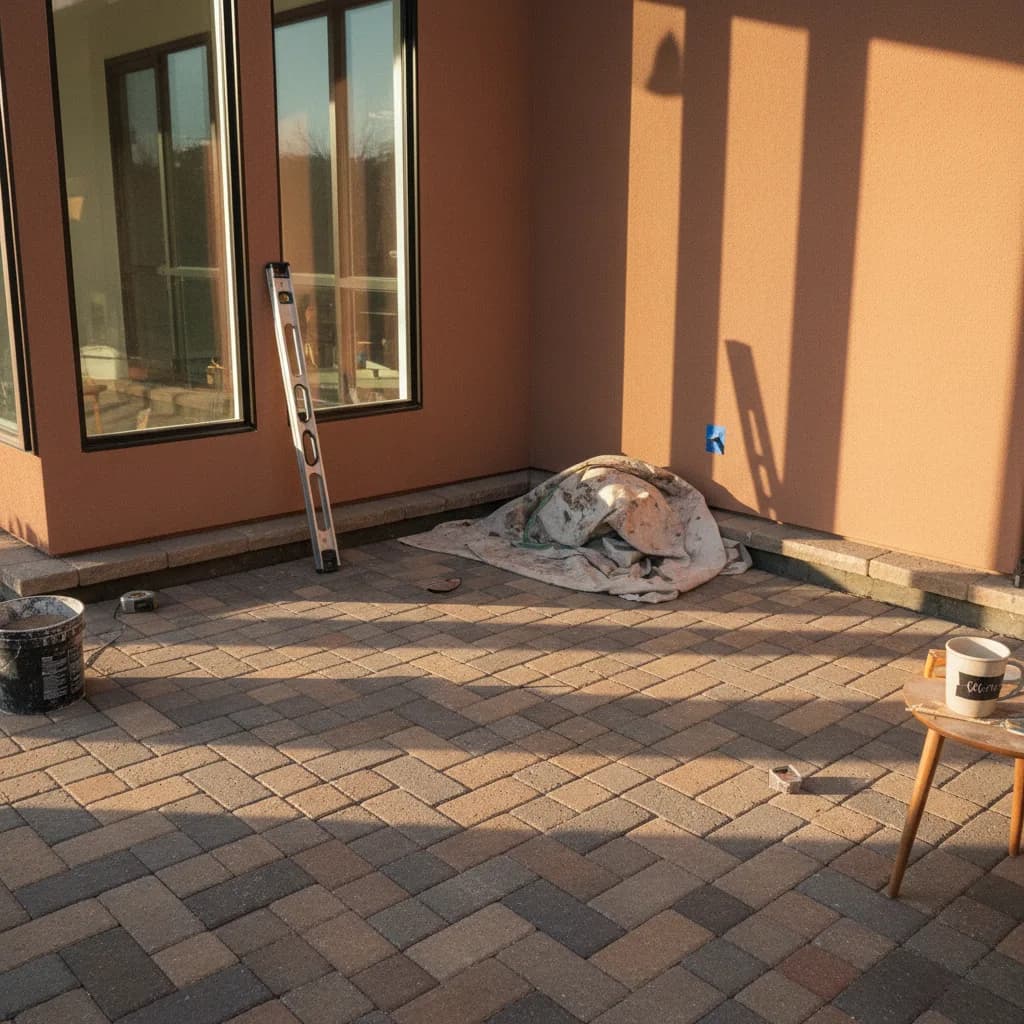
A professionally installed paver patio build in Sacramento in 2026 will cost between $25 and $55 per square foot. For a typical 600-square-foot project, this means a total investment of $18,000 to $35,000. While costs can start lower for a simple paver overlay on an existing concrete pad or a very small courtyard, most projects involving proper excavation of Sacramento’s notorious clay soil will fall squarely in this range. The final price tag is a direct function of material choice, site access, and most importantly, the depth and compaction of the sub-base, the part of the job you never see.
In a Nutshell: Sacramento Paver Patio Costs
- Total Cost Range: $12,000 to $75,000+
- Typical Mid-Range Project: $23,000 for a 600-square-foot patio with quality interlocking pavers (~$38/sq. ft.).
- Realistic Timeline: Three to five weeks from excavation to final joint sanding. The majority of this time is spent on subgrade and base preparation.
- Biggest Surprise Line Item: Excavation and off-haul of expansive clay soil, which can add $3,000 to $6,000 to a project before a single paver is laid.
What does a paver patio build actually cost in Sacramento in 2026?
The cost is tiered based on complexity and material specification. A contractor's quote reflects not just the visible pavers but the engineered system beneath them. Here’s a breakdown of what to expect at three distinct levels for a standard 500-square-foot patio.
| Tier | All-In Cost (per sq. ft.) | Estimated Total (500 sq. ft.) | Common Scope & Materials |
|---|---|---|---|
| Basic | $25 - $35 | $12,500 - $17,500 | Standard concrete pavers (e.g., Basalite Holland), simple rectangular layout, no steps, minimal cuts, good site access. ICPI-spec 4-inch aggregate base. |
| Mid-Range | $35 - $50 | $17,500 - $25,000 | Upgraded architectural slab pavers (e.g., Belgard or Techo-Bloc), soldier course border, gentle curves, standard concrete toe edge restraint. 6-inch aggregate base over geotextile fabric. |
| Premium | $50 - $85+ | $25,000 - $42,500+ | Porcelain pavers or natural stone, complex inlay patterns, integrated seat walls, steps, low-voltage lighting, channel drains. 8-inch+ open-graded base. |
The lowest-cost projects, often advertised below $20 per square foot, typically involve laying thin pavers over an existing concrete slab. This is not a proper build and inherits any problems, like cracking or settling, from the underlying concrete. A true paver patio build requires a full excavation and base installation.
Mid-Range Paver Patio Build: Cost Breakdown
- Labor & Installation: 45%
- Materials (Pavers, Base, Sand): 35%
- Site Prep (Excavation, Haul-Away, Demolition): 15%
- Permits, Design & Overhead: 5%
Why is a paver patio build more expensive in Sacramento than the national average?
Three regional factors drive costs higher in the Sacramento Valley: demanding soil conditions, high labor rates, and logistical premiums in established neighborhoods.
1. Expansive Clay Soil: Much of the Sacramento area sits on expansive clay, often called "adobe soil." This soil swells when wet and shrinks dramatically when dry, a cycle that destroys improperly prepared hardscapes. A professional Sacramento pavers contractor must excavate deeper (often 8-12 inches), install a geotextile separation layer to isolate the base from the subgrade, and import more aggregate base material (#57 stone or Class 2 permeable). This adds significant machine time, material costs, and dump fees compared to projects on more stable, sandy loam soils.
2. Skilled Labor Rates: The cost of qualified labor is a primary driver. According to the California Department of Industrial Relations prevailing wage data for Sacramento County, skilled landscape construction laborers and equipment operators command higher wages than in many other parts of the country. A shortage of ICPI-certified installers who understand the technical specifications for base construction further increases labor costs for top-tier firms. A paver patio build is labor-intensive, and that labor is expensive here.
3. Neighborhood & Logistical Premiums: Working in established neighborhoods like Land Park, East Sacramento, or even suburban areas like Granite Bay carries hidden costs. Tighter lot lines mean less room for equipment staging, requiring more manual labor. Street parking permits for dump trucks and delivery vehicles, noise ordinances, and higher homeowner expectations for site cleanliness and protection all add to a contractor's overhead, which is reflected in the final bid.
What do real Sacramento homeowners spend in 2026?
Ready to compare vetted project options?
Use Project Match privately when your scope is clear enough for contractor conversations.
Start Project MatchThree representative projects from 2026, scoped similarly, reconstructed from Golden Yards Magazine's Project of the Day network and used here in aggregate form:
1. Carmichael Ranch ($21,500): A 550-square-foot rectangular patio behind a 1970s ranch home. The project used Belgard Catalina Grana pavers and a simple soldier-course border. The key cost driver was the removal of an old, cracked concrete slab and the need for 8 inches of compacted base to counteract poor soil fill from the original construction.
2. East Sacramento Bungalow ($34,000): This 700-square-foot project for a historic home involved a more complex layout with curves to work through mature trees. The homeowners chose Techo-Bloc Blu 60 pavers. The price included a low, 18-inch-high matching seat wall and the installation of a new channel drain system tied into the property’s storm drainage, a critical feature given the lot's grading.
3. Granite Bay Custom Home ($68,000): A 900-square-foot multi-level patio using large-format porcelain pavers. The scope was extensive, including the structural base for a future outdoor kitchen, integrated low-voltage lighting within the steps and seat walls, and a permeable paver section to manage runoff. The higher cost reflects the precision cutting required for porcelain and the extensive electrical and drainage work.
Where does the money actually go? The hidden costs of a paver patio build
A good contractor’s bid includes items that are not immediately obvious. These are the unglamorous but critical components that ensure a patio lasts twenty-five years instead of five.
- Excavation & Soil Export: $2,500 - $6,000. This covers the labor, machinery (like a skid steer), and dump fees to remove hundreds of cubic feet of Sacramento soil.
- Geotextile Separation Fabric: $1.00 - $1.75 per sq. ft. A non-negotiable layer between the native clay subgrade and the aggregate base to prevent mixing and settlement.
- Aggregate Base Material & Delivery: $1,200 - $3,500. The cost of tons of #57 stone or Class 2 permeable base, including trucking fees.
- Compaction Equipment Rental & Fuel: $500 - $1,000. A reversible plate compactor capable of achieving 95 percent Modified Proctor density is required.
- Drainage System: $1,500 - $4,500. This can range from simple grading to installing channel drains or French drains to manage water.
- Permit & Plan Fees (City of Sacramento): $750 - $2,000. Depending on the project's complexity, impervious surface calculations, and whether it includes retaining walls.
- Polymeric Joint Sand & Sealer: $2.00 - $3.50 per sq. ft. A premium over cheap silica sand, but essential for locking pavers and preventing weed growth.
- Jobsite Protection & Cleanup: $600 - $1,200. Protecting existing lawns, driveways, and structures, plus final pressure washing and site cleanup.
What stops a Sacramento paver patio build from running over budget?
Budget overruns in hardscape projects are almost always tied to three things: unforeseen conditions, scope changes, or poor planning.
1. Unforeseen Subsurface Conditions. Even with careful planning, excavation can reveal surprises. Buried concrete from a previous structure, improperly compacted fill from the home’s construction, or a high water table can require significant extra work and materials to remedy. This is the most common cause of legitimate change orders.
2. Scope Creep. It starts with a simple question: "While you're here, can we add a small walkway?" Or perhaps a seat wall, some landscape lighting, or a fire pit. These additions, made after the contract is signed, can quickly escalate costs and extend timelines. Each change should be documented with a formal change order specifying the new cost and schedule impact.
3. Inadequate Specifications in the Contract. A vague contract that doesn't specify base depth, compaction standards, or paver manufacturer leaves the door open for disputes and unexpected costs. A quality contractor will provide a detailed scope of work that locks in these critical technical details from the start. The National Association of Home Builders recommends a ten to fifteen percent contingency on renovations in homes over thirty years old.
How much will my paver patio project cost?
To get a preliminary estimate based on your patio's square footage and material choices, you can use a detailed cost estimator. While designed for driveways, the material and labor calculations are directly applicable to patios. Our paver driveway cost calculator provides a solid starting point for budgeting your Sacramento paver patio build.
What should your Sacramento pavers contractor include in the quote?
A professional bid is a detailed scope of work, not a one-page estimate. It should protect both you and the contractor by specifying exactly what is included. Insist on a quote that contains these line items:
- Total square footage of the project.
- Manufacturer, style, and color of the specified paver (e.g., Belgard Lafitt Rustic Slab, Danville Beige).
- Depth of excavation (e.g., "Excavate 10 inches from final grade").
- Specification for aggregate base material (e.g., "6 inches of ¾-inch clean crushed stone / #57 stone").
- Compaction standard (e.g., "Compacted in 3-inch lifts to 95% Modified Proctor density").
- Inclusion of a geotextile separation fabric.
- Specification for bedding course (e.g., "1 inch of ASTM C33 concrete sand").
- Type of edge restraint (e.g., "Snap-Edge plastic restraint with 10-inch spikes" or "Poured concrete toe").
- Type of joint sand (e.g., "Gator Maxx G2 Polymeric Sand, color: Beige").
- Detailed drainage plan, including slope and any specified drains.
- Responsibility for permit acquisition; a good contractor handles this. You can learn more in our Sacramento paver permit playbook.
- Plan for site protection, cleanup, and debris removal.
- A clear payment schedule tied to project milestones.
- Workmanship warranty details (typically one to three years).
Sources & Methodology
See the Golden Yards Methodology for how sources are reviewed, ranges are normalized, and planning-data limits are handled.
Cost ranges in this guide draw on the following named industry sources, public agency datasets, and Golden Yards Magazine editorial research.
- National Association of Home Builders (NAHB) Remodeling Market Index (Q1 2026)
- California Department of Industrial Relations, Sacramento County Prevailing Wage Data (2026)
- City of Sacramento, Community Development Department, Permit Services (2026)
- California Contractors State License Board (CSLB), Licensee Demographics (2025)
- Interlocking Concrete Pavement Institute (ICPI), Tech Spec 2 (2024)
- Golden Yards Magazine, Editorial & Project Data Methodology (2026)
Golden Yards Magazine Take
The single biggest mistake a homeowner can make is choosing a pavers contractor sacramento based on the lowest price per square foot. That low price is almost always achieved by skimping on the base. A contractor can save thousands by excavating four inches instead of eight, by skipping the geotextile fabric, or by using a hand tamper instead of a proper plate compactor. The patio will look identical on day one. But by the third winter, after Sacramento's clay has swelled and shrunk, that patio will be a landscape of hills and valleys. The pavers are just the finish. The real product you are buying is the invisible, engineered base beneath them. Pay for the base. Test the base. The longevity of your entire investment depends on it.
Ready to start your patio project?
Find My ProsFrequently Asked Questions
Do I need a permit for a paver patio in Sacramento?
Yes, a permit is often required for a paver patio in the City of Sacramento. This is especially true for patios attached to the house foundation, those covering a significant area, or projects including permanent covers or retaining walls over four feet high. Securing a permit helps avoid potential fines.
A qualified pavers contractor in Sacramento will be familiar with city requirements and should handle the entire permitting process. This includes submitting plans and scheduling inspections. Failing to secure a permit is a significant risk, as it can result in fines and official orders to remove the completed work. This critical first step is common for patios attached to the house foundation, those covering a large portion of the yard impacting impervious surface limits, or installations with features like permanent covers or retaining walls over four feet in height.
How long should a paver patio last in Sacramento's climate?
A properly installed paver patio in Sacramento should last 20 to 25 years. While the concrete pavers themselves can last 30 to 50 years, the installation's lifespan depends entirely on the base quality. Early failure is almost always caused by poor base preparation to handle Sacramento's expansive clay soil, not faulty pavers.
The key to a long-lasting patio is its foundation. An installation following ICPI specifications, which includes a deep, well-compacted aggregate base over geotextile fabric, can easily last 20 to 25 years without significant issues. The primary threats in the Sacramento climate are poor drainage and subgrade failure from the expansive clay soil cycle. A patio that fails in five years almost always does so because the contractor cut corners on this unseen base preparation, not because the pavers themselves were defective.
What is the difference between an ICPI certified contractor and a regular one?
An ICPI certified contractor has completed formal training from the Interlocking Concrete Pavement Institute on industry best practices for paver installation. While not a legal requirement, this certification shows they understand the engineering principles that prevent common failures like settling and rutting, a significant mark of professionalism for contractors in Sacramento.
The specialized ICPI training covers critical details that a regular contractor might overlook. These topics include soil classification, proper subgrade compaction, aggregate base requirements, bedding sand, and correct paver installation techniques. Although it is not a state license, the certification demonstrates that a contractor invests in technical education. For a project in Sacramento, this certification is a strong indicator of a contractor's commitment to quality and durability.
Is polymeric sand worth the extra cost for a Sacramento paver patio build?
Yes, polymeric sand is worth the extra cost for a Sacramento patio. For an additional $1.00 to $1.50 per square foot, it locks pavers together, prevents sand loss from erosion, and inhibits weed growth. Unlike standard sand that washes out, its polymer hardens to create a stable, low-maintenance surface.
Standard silica sand washes out with rain and pressure washing, requiring frequent replacement and providing a perfect medium for weed seeds to germinate. Polymeric sand contains a polymer that, when activated with water, hardens to form a firm yet flexible joint. This action locks the pavers together and stabilizes the entire surface. In Sacramento's climate, this hardened joint is essential for preventing sand loss and dramatically inhibiting weed growth, justifying the small extra cost for a more durable patio.
Can you install pavers over an existing concrete slab?
No, installing pavers over an existing concrete slab is generally not recommended by professionals. While physically possible using an overlay technique, the new paver surface will only be as stable as the concrete beneath it. If the underlying slab cracks, settles, or heaves, the pavers will move with it, destroying the installation.
The new paver surface's integrity is entirely dependent on the condition of the concrete slab. Any existing or future cracks, settling, or heaving in the slab will transfer directly to the pavers, causing them to fail. Any money saved by avoiding excavation is often lost when the project requires premature replacement.
For a long-lasting paver patio build in Sacramento, the correct method is to remove the old concrete completely. Professionals then construct a proper aggregate base from the compacted subgrade up, ensuring a stable and durable foundation for the new pavers.