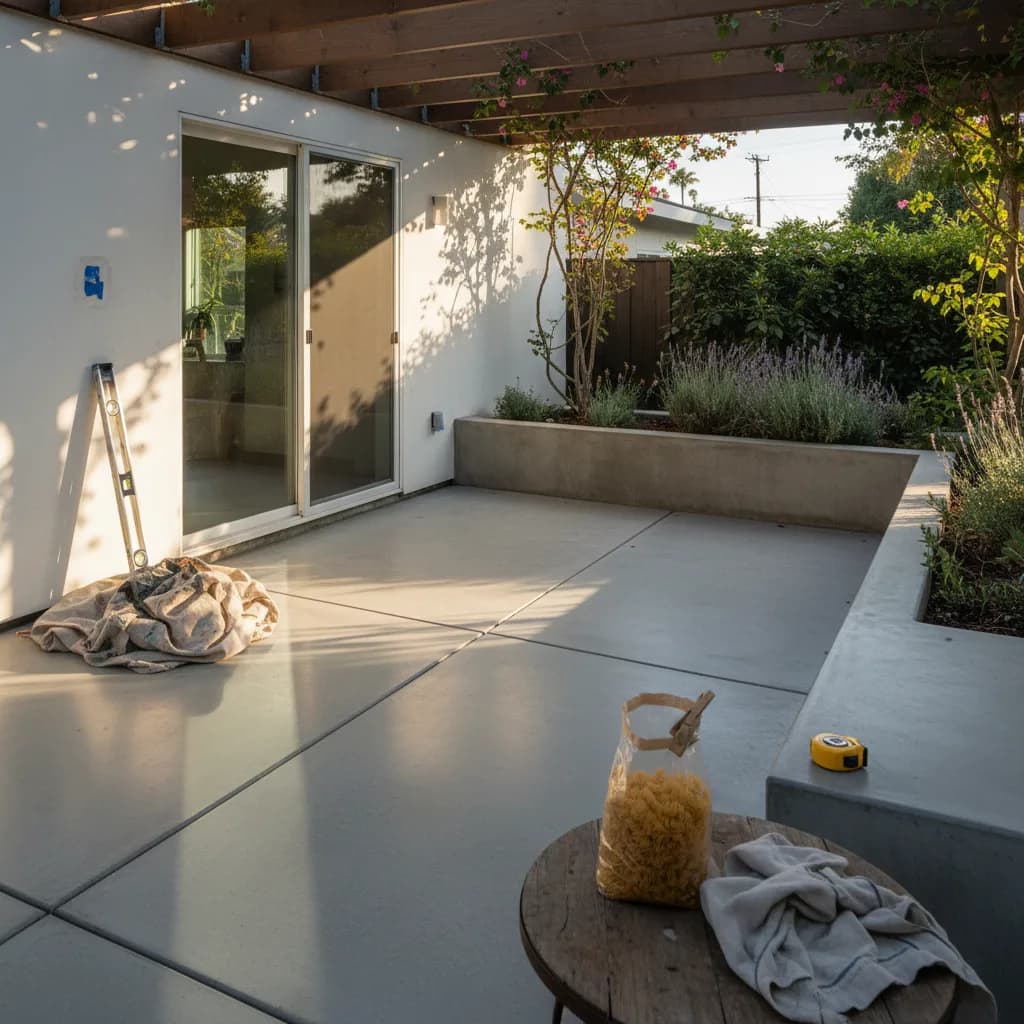
Concrete Patio Cost in San Jose (2026): What Homeowners Actually Pay
A professionally installed concrete patio in San Jose typically costs between $18 and $35 per square foot, placing a standard 400-square-foot project in the $7,200 to $14,000 range. The final invoice for a mid-range project with a quality finish often lands between $22,000 and $28,000. Costs can start lower, around $12 to $15 per square foot, for a simple, small-scale pour on perfectly level ground, like a pad for an ADU's HVAC unit or a small condo patio refresh where access is easy and site prep is minimal.
In a Nutshell
- Total Cost Range: $8,000 to $45,000+
- Mid-Range Project Average (400-600 sq. ft.): $24,500
- Typical Project Timeline: Three to five weeks from demolition to final cure.
- Biggest Surprise Line Item: Subgrade remediation. San Jose's expansive clay soil often requires over-excavation and engineered fill, adding thousands to the base preparation cost.
What does a concrete patio actually cost in San Jose in 2026?
The price per square foot is a blunt instrument. The real drivers are site access, demolition requirements, soil conditions, and finish complexity. A simple broom-finish rectangle on flat, stable soil is a world away from a multi-level, stamped-and-colored patio on a sloped yard with poor drainage.
| Tier | Cost per Sq. Ft. | Typical Project (400 sq. ft.) | Features |
|---|---|---|---|
| Basic | $18 - $24 | $7,200 - $9,600 | Standard 4-inch slab, 3000 PSI concrete, light broom finish, minimal site prep, easy access. |
| Mid-Range | $25 - $38 | $10,000 - $15,200 | 4000 PSI concrete, #3 rebar at 24" OC, integral color or salt finish, moderate grading, basic drainage. |
| Premium | $39 - $60+ | $15,600 - $24,000+ | Complex shape, stamped or exposed aggregate finish, multiple colors, integrated lighting, seat walls, extensive drainage and soil work. |
Note that the lowest-tier projects assume ideal conditions: no demolition of an old patio, no grading issues, and stable, non-expansive soil. This is not the typical San Jose backyard.
Mid-Range Concrete Patio Install: Cost Breakdown
For a typical 500-square-foot project in the San Jose area costing around $24,500, the budget allocation looks like this:
- Labor: 45% ($11,025)
- Materials (Concrete, Rebar, Base Rock): 30% ($7,350)
- Site Prep & Demolition: 15% ($3,675)
- Permits & Fees: 5% ($1,225)
- Contractor Overhead & Profit: 5% ($1,225)
Why is it more expensive in San Jose than the Central Valley?
Ready to compare vetted project options?
Use Project Match privately when your scope is clear enough for contractor conversations.
Start Project MatchThree factors drive San Jose's higher-than-average hardscaping costs: labor rates, material logistics, and site complexity.
First, labor is the single largest expense. According to the California Department of Industrial Relations prevailing wage data for Santa Clara County, skilled construction labor commands a significant premium over other regions. A journeyman cement mason's total compensation package, which contractors must factor into their pricing, is among the highest in the state. This isn't just about wages; it includes insurance, benefits, and payroll taxes that contribute to the higher cost structure for any legitimate concrete patio contractor in San Jose.
Second, material and equipment costs are inflated by Bay Area logistics. Concrete batch plants, aggregate quarries, and equipment rental yards all face higher land and operational costs, which are passed on to the contractor and, ultimately, the homeowner. Getting a concrete pump truck through South Bay traffic to a job site in Willow Glen costs more than it does in Fresno. Hauling away demolished concrete and soil for disposal also incurs higher fees.
Finally, neighborhood premiums and challenging site conditions add to the price. Working in affluent areas like Almaden Valley or nearby Los Gatos often involves stricter working hours, more complex access, and higher client expectations. More importantly, the region's geology is a major cost driver. The expansive clay soils prevalent throughout San Jose require significant subgrade preparation, often including over-excavation, installation of a geotextile separation layer, and importing a thicker-than-usual base of #57 stone, all compacted to 95 percent Modified Proctor density to prevent future movement and cracking.
What do real San Jose homeowners spend in 2026?
Three representative projects from 2026, scoped similarly, reconstructed from Golden Yards Magazine's Project of the Day network and used here in aggregate form:
- Willow Glen (450 sq. ft.): $21,500. This project involved removing an old, cracked brick patio and grinding several large tree roots. The soil was moderately expansive, requiring 6 inches of compacted base rock. The homeowner chose a simple salt finish with integral color and a new channel drain tied into existing downspouts. The job took four weeks, with one week lost to a failed initial compaction test that required rework.
- Almaden Valley (600 sq. ft.): $34,000. A more complex project on a slight slope. It required a low, 18-inch-tall concrete retaining wall on one side to create a level patio area. The patio itself was a two-color, stamped concrete in an Ashlar slate pattern. The price included significant grading, a solid drainage system with multiple catch basins, and #4 rebar at 16 inches on center to support a future outdoor kitchen.
- Cambrian Park (380 sq. ft.): $17,800. This was a more straightforward job replacing a section of lawn. Access was good, and the soil was less problematic than average for the area. The project specified a standard 4-inch slab with a broom finish and saw-cut control joints. The cost was kept down by the simple design and minimal site challenges, but it still required proper subgrade compaction and wire mesh reinforcement to pass city inspection.
Where does the money actually go?
Your contractor's proposal might not itemize every single cost. Here are some of the critical line items that are baked into the total price of a concrete patio install in San Jose:
- Demolition & Hauling ($1,500 - $4,000): Cost to break up and dispose of an old patio, lawn, or other landscaping. Disposal fees in Santa Clara County are not trivial.
- Subgrade Preparation ($2,000 - $7,000+): The most critical phase. This covers excavation, grading for proper slope, and compaction. In areas with expansive clay, this can include over-excavating and importing engineered fill.
- Compaction Testing ($500 - $850): A third-party geotechnical engineer may be required to certify that the subgrade and base have reached the required 95% Modified Proctor density before the pour. Your inspector will ask for the report.
- Formwork ($1,000 - $2,500): The cost of lumber and labor to build the temporary molds that hold the wet concrete in its final shape.
- Concrete Pumping Truck ($750 - $1,200): If the patio is in a backyard with no direct access for a concrete mixer truck, a pump is needed to transport the concrete from the street to the pour site.
- Reinforcement ($800 - $2,000): The cost of steel rebar (e.g., #3 or #4) or welded wire mesh, which provides tensile strength and helps control cracking.
- City Permits & Inspection Fees ($900 - $1,800): The cost for the City of San José to review plans and conduct site inspections at various stages of the project.
- Drainage System ($1,200 - $3,500): Installing channel drains, catch basins, and piping to direct water away from the patio and the home's foundation. This is a code requirement.
What stops a San Jose concrete patio from running over budget?
Three issues commonly derail project budgets: soil surprises, scope creep, and permit problems.
First, unforeseen subgrade conditions are the number one cause of cost overruns in San Jose. Your contractor might bid the job based on a visual inspection, but once excavation begins, they could discover highly expansive clay, a high water table, or buried debris that requires costly remediation. The fix isn't a thicker slab; it's proper soil engineering, which adds labor and material costs. The National Association of Home Builders recommends a ten to fifteen percent contingency on renovations in homes over thirty years old, and this is especially wise for any project involving excavation.
Second, scope creep is a constant threat. It's easy to decide mid-project to add a walkway, a seat wall, or electrical conduit for future lighting. Each of these changes has a ripple effect, impacting the schedule, material orders, and labor costs. Get all desired features into the initial contract. Adding them later is always more expensive.
Third, permit and inspection hurdles can cause expensive delays. If the inspector finds that the rebar is set too high, the subgrade isn't properly compacted, or the slope is incorrect, work stops. The contractor has to fix the issue and schedule a re-inspection, all while the project clock is ticking. This is why hiring an experienced San Jose concrete patio contractor who knows the local code and inspectors is critical.
How do I get a more accurate estimate?
For a more tailored estimate based on your specific dimensions and finish choices, our interactive [Hardscape Cost Calculator](/calculators/driveway-cost) can provide a preliminary budget to help you plan your San Jose concrete patio install.
What should your San Jose contractor include in the quote?
A legitimate quote is a detailed scope of work, not a one-page estimate. It should specify the technical details that guarantee a long-lasting patio. Look for these fourteen items:
- A detailed site plan or drawing.
- Scope of demolition, including disposal of all debris.
- Depth of excavation for the subgrade.
- Specification for the base material (e.g., 4-6 inches of Class 2 permeable or #57 stone).
- Subgrade and base compaction standard (e.g., to 95% Modified Proctor).
- Concrete strength specification (e.g., 4000 PSI at 28 days).
- Reinforcement details (e.g., #3 rebar at 18 inches on center, supported by chairs).
- Slab thickness (e.g., 4 inches minimum).
- Description of the finish (e.g., broom, salt, stamped pattern name, color chart numbers).
- Control joint layout and depth (must be at least 25% of the slab thickness).
- Drainage plan, including slope (1/4" per foot minimum) and drain types.
- Curing method and duration.
- Site cleanup plan.
- The permit number from the City of San José. For a detailed guide on the process, see our [San Jose concrete patio permit playbook for 2026](/guides/san-jose-concrete-patio-permit-playbook-2026).
Golden Yards Take
Homeowners get fixated on the surface. They spend weeks choosing between a 'Roman Slate' stamp and an 'Italian Ashlar' pattern, debating the merits of a 'Pewter' integral color versus a 'Smoke' release agent. These are aesthetic choices. The real decision, the one that determines if you're redoing this patio in seven years, happens below ground. The money you spend on an extra two inches of compacted base, on the geotextile fabric separating the base from San Jose's expansive clay, and on the third-party compaction test report is the best investment you can make. A beautiful surface on a weak foundation is a callback waiting to happen. Focus on the cross-section. Get the base right. The rest is just decoration.
Sources & Methodology
See the Golden Yards Methodology for how sources are reviewed, ranges are normalized, and planning-data limits are handled.
Cost ranges in this guide draw on the following named industry sources, public agency datasets, and Golden Yards Magazine editorial research.
- National Association of Home Builders (NAHB) Home Remodeling Index (Q1 2026)
- California Department of Industrial Relations, Santa Clara County Prevailing Wage Data (2026)
- City of San José, Planning, Building and Code Enforcement, Permit Services (2026)
- California Contractors State License Board (CSLB), Licensee Survey Data (2025)
- American Concrete Institute (ACI), ACI 332R-06 Guide to Residential Concrete (2024)
- Golden Yards Magazine Editorial Methodology & Project Data (2023-2026)
Ready to start your patio project?
Find My ProsFrequently Asked Questions
Do I need a permit for a concrete patio in San Jose?
Yes, a permit is usually required for a concrete patio in San Jose. The City of San José Planning, Building and Code Enforcement department mandates permits for patios more than 30 inches above grade or for any slab designed to support a future structure. Other work like grading or gas lines can also trigger this requirement.
The 30-inch height rule is a primary factor for needing a permit from the City of San José Planning, Building and Code Enforcement. However, even lower patios can require one if the project involves significant grading, new gas lines, extensive electrical work, or retaining walls. A permit is also mandatory for any concrete slab-on-grade that will support a future structure, such as a covered patio. A qualified local contractor typically manages the permitting process, ensuring the work is properly inspected and approved, which protects your property's value.
How long does a concrete patio last in the Bay Area climate?
A concrete patio in the San Jose climate lasts 25 to 30 years or more. Longevity depends on proper installation, not the weather. The main threat is ground movement from expansive clay soils, which can crack the slab within years if the base is not compacted to at least 95 percent Modified Proctor density.
A patio built to ACI 332 residential concrete specifications with proper reinforcement will withstand the South Bay's wet winters and dry summers for decades. The primary failure cause is not freeze-thaw cycles but the shrink-swell cycle of expansive soils. If the subgrade is not correctly excavated, graded, and compacted, the slab will crack from below. Other issues include surface spalling from a poor concrete mix or improper curing, and random cracking from insufficient control joints.
What's better for San Jose's clay soil: concrete or pavers?
For San Jose's expansive clay soil, pavers are often better as their flexible system tolerates more movement. However, both pavers and concrete require a costly, well-prepared base to succeed. A concrete slab needs a reinforced aggregate base to float over soil shifts, while pavers demand a multi-layer base according to ICPI Tech Spec 2.
Success with either material over San Jose's clay depends entirely on the base. A concrete slab requires a thick, compacted aggregate base, like #57 stone, and a grid of steel reinforcement to act as a rigid plate. While it can float over minor soil movements, a crack means a major repair. Pavers, following ICPI Tech Spec 2, need a meticulous multi-layer base to prevent sinking. Their key advantage is repairability, as a single sunken paver can be lifted and reset. The foundational cost for proper subgrade work will be high for both options.
Can I save money by doing the demolition myself?
Yes, you can save a few hundred to a thousand dollars, but DIY demolition has significant risks. You could hit underground utilities like gas or electrical lines, which is dangerous and expensive. Improper work can also disturb the subgrade soil, creating soft spots that require costly professional remediation before construction.
Demolition requires awareness of underground systems, including irrigation lines, low-voltage lighting, or even gas and electrical conduits. Hitting one can be dangerous and expensive to fix. Proper disposal of the old concrete or brick is another factor, as it is both costly and labor-intensive.
Most importantly, an amateur demolition can disturb the subgrade soil. This creates soft spots that your contractor will then have to charge you to remediate before they can begin their work, making it safer and more efficient to have professionals handle the entire process.
What is the difference between stamped concrete and a broom finish?
A broom finish is a standard, cost-effective concrete surface created by dragging a special broom across wet concrete for texture and slip resistance. Stamped concrete is a more expensive, decorative option using polyurethane stamps to mimic materials like stone or brick. It offers high-end aesthetics but requires resealing every two to three years.
A broom finish is the most common and affordable choice. After pouring and smoothing the concrete, a specialized broom is pulled across the surface, creating fine lines for a clean, durable, and slip-resistant texture. In contrast, stamped concrete provides a decorative look by imitating other materials. While the concrete is still pliable, large patterned stamps are pressed into it. Color is often added, either mixed into the concrete or broadcast on top as a color hardener. This option has a higher initial cost and requires long-term maintenance, including resealing every two to three years to protect its appearance.