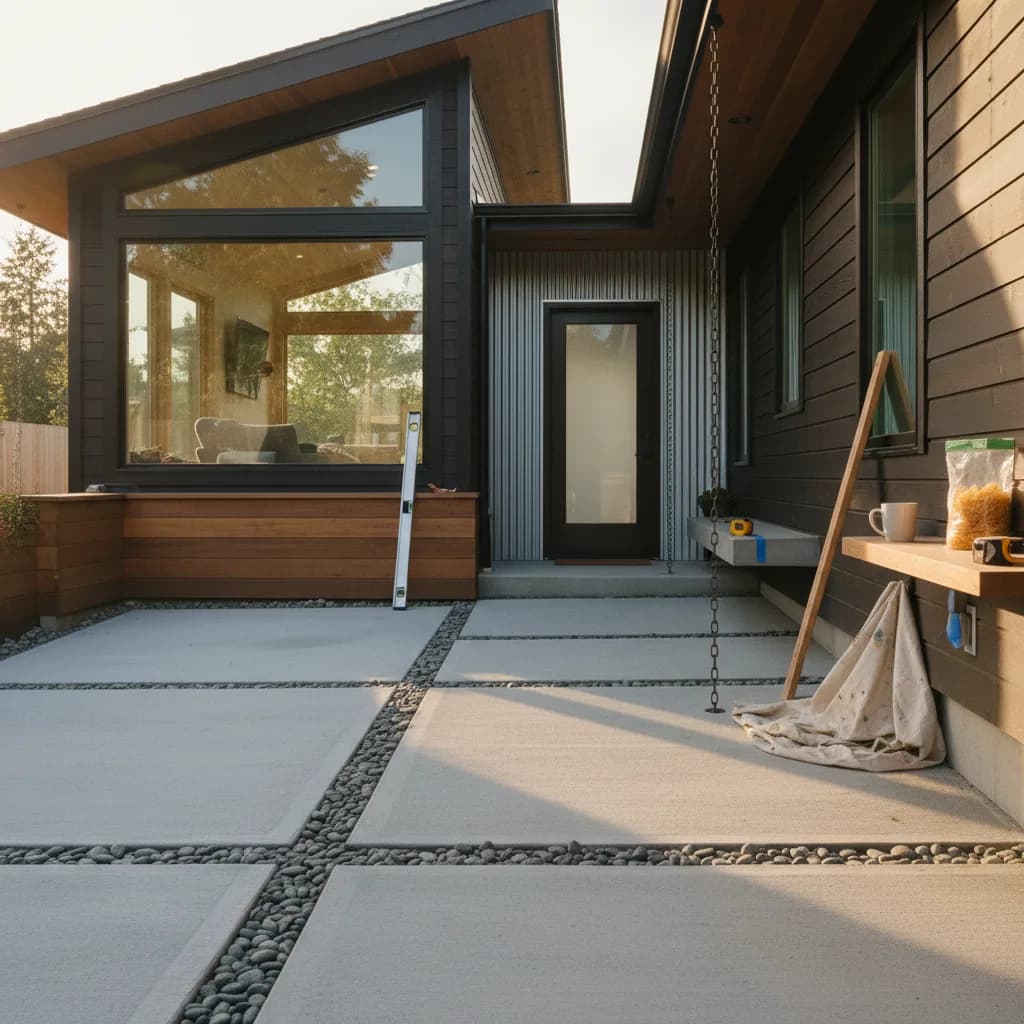
A new driveway in Seattle for 2026 will typically cost between $18,000 and $45,000, with a median project landing around $28,500 for a standard 600-square-foot installation using quality interlocking pavers. This price can start lower, in the $10,000 to $15,000 range, for a simple asphalt overlay or a small concrete pad for an ADU. But for a full tear-out and replacement that withstands Puget Sound rain, the real investment is in the unseen work below the surface.
In a Nutshell
- Total Cost Range: $12,000 to $65,000+
- Mid-Range Average (600 sq. ft. Pavers): $24,000 - $33,000
- Typical Timeline: Four to seven weeks, heavily dependent on weather windows for excavation and base compaction.
- Biggest Surprise Line Item: Stormwater management. Expect $3,000 to $8,000 for permeable base layers, French drains, or connections to city systems, as required by the Seattle Department of Construction & Inspections (SDCI).
What does a driveway actually cost in Seattle in 2026?
The final invoice for a driveway in Seattle is a story about water, soil, and access. A steep slope in Queen Anne requires more engineering than a flat lot in Ballard. The tables below show typical project scopes, but the real variable is the site work required to create a stable, free-draining foundation that won't heave or settle after three wet winters.
| Tier | Description | Cost per sq. ft. | Typical 600 sq. ft. Driveway Cost |
|---|---|---|---|
| Basic | Asphalt overlay or simple broom-finish concrete slab. Minimal excavation, assumes stable subgrade. | $18 - $28 | $10,800 - $16,800 |
| Mid-Range | Interlocking concrete pavers or stamped concrete. Includes full excavation, 8-10 inches of compacted base, and basic drainage. | $35 - $55 | $21,000 - $33,000 |
| Premium | Permeable pavers with a deep, open-graded base, extensive drainage system, or a heated system. High-end materials and complex patterns. | $60 - $100+ | $36,000 - $60,000+ |
A bottom-of-the-range project, like a simple asphalt patch or a small concrete pad for a detached ADU, isn't representative of a full driveway replacement, which involves significant demolition, earthwork, and base preparation.
Mid-Range Driveway Seattle Cost Breakdown (600 sq. ft. pavers)
- Materials (pavers, base rock, sand, edge restraints): 30% ($8,550)
- Labor (demolition, excavation, installation, cleanup): 45% ($12,825)
- Site Prep & Drainage (excavation, grading, sub-base compaction, drains): 15% ($4,275)
- Permits, Fees & Overhead: 10% ($2,850)
Why is it more expensive in Seattle than surrounding areas?
Three factors drive the cost of a driveway in Seattle: labor rates, complex site conditions, and stringent environmental regulations.
1. Skilled Labor Costs: King County has some of the highest construction labor rates in the state. A professional hardscape crew isn't just general labor; they are equipment operators and installers skilled in grading, compaction, and precision setting. According to Washington State L&I contractor licensing and labor rate data, prevailing wages for the operators and masons needed for this work are significantly higher in the Seattle metro than in Spokane or the Tri-Cities. This premium ensures your contractor is insured, bonded, and paying a wage that retains experienced talent.
2. Challenging Site Conditions: Seattle's topography and soil are unforgiving. Many properties in neighborhoods like Capitol Hill or Magnolia have steep grades, which complicates excavation, requires retaining walls, and increases soil hauling costs. The region's glacial till soil is dense and drains poorly, often requiring over-excavation and the import of multiple truckloads of WSDOT-spec 5/8-inch clean crushed rock for a stable, open-graded base. Poor access on tighter city lots also means more labor-intensive work with smaller equipment.
3. Stormwater Management Regulations: The City of Seattle is aggressive about managing stormwater runoff to protect Puget Sound. Any project creating over 500 square feet of new impervious surface often triggers requirements for on-site mitigation. This isn't a suggestion; it's a permit condition. For a driveway contractor in Seattle, this means installing permeable paver systems, catch basins, or dedicated rain gardens. These systems require deeper excavation and specialized materials, adding thousands to the project cost compared to a simple concrete slab in a less regulated municipality.
What do real Seattle homeowners spend in 2026?
Ready to compare vetted project options?
Use Project Match privately when your scope is clear enough for contractor conversations.
Start Project MatchThree representative projects from 2026, scoped similarly, reconstructed from Golden Yards Magazine's Project of the Day network and used here in aggregate form:
- Ballard Craftsman ($29,500): A 650-square-foot driveway replacement using traditional concrete pavers. The project involved removing a cracked concrete slab, excavating 12 inches, installing a geotextile separation layer, and laying an 8-inch compacted base of 5/8-inch crushed rock. The key cost driver was dealing with poor subgrade soil, which required an extra 4 inches of base material to meet compaction specs.
- West Seattle Mid-Century ($38,000): An 800-square-foot permeable paver installation. To satisfy SDCI stormwater rules, the design included a 14-inch deep open-graded base of #57 stone. The higher cost reflects the deeper excavation, increased volume of base aggregate, specialized permeable pavers, and the additional labor to correctly install the system to ensure long-term drainage performance.
- Queen Anne Tudor ($46,000): A 700-square-foot heated driveway using high-end pavers. The steep grade required a small, engineered concrete retaining wall at the base. The cost included the hydronic heating system components, extensive electrical work, and the logistical challenges of operating heavy equipment on narrow, sloping streets. The project was complex, but necessary for safe winter access.
Where does the money actually go?
The surface material is often less than a third of the budget. The real work is hidden underground. A professional driveway contractor in Seattle will have these costs built into their price, even if they aren't separate line items.
- Demolition and Hauling: $2,500 - $5,000. Breaking up and disposing of an old concrete or asphalt driveway is labor-intensive and includes heavy equipment and dump fees.
- Excavation and Grading: $3,000 - $7,000. This is for digging out poor soil and establishing the correct slope (a minimum 1/4-inch per foot) for drainage. More for steep lots.
- Subgrade Compaction: $1,000 - $2,500. The soil beneath the base rock must be compacted to at least 95 percent of its maximum dry density. This step prevents the number one cause of driveway failure: settlement.
- Geotextile Separation Fabric: $700 - $1,500. This fabric is laid between the compacted soil subgrade and the aggregate base. It prevents the base rock from sinking into the soil, preserving the structural integrity of the driveway.
- Aggregate Base Material & Compaction: $4,000 - $9,000. For Seattle, this should be a minimum of 8-10 inches of compacted, crushed angular rock, placed in 3-4 inch lifts. This is the load-bearing structure of the driveway.
- Stormwater Drainage System: $3,000 - $8,000. This could be a simple French drain or a complex permeable base system. It is non-negotiable for most Seattle projects.
- Permitting and Inspection Fees: $1,000 - $2,500. Includes plan preparation, submission to SDCI, and scheduling required site inspections.
What stops a Seattle driveway from running over budget?
Surprises underground are the primary cause of budget issues. A good contractor anticipates them, but some things can't be known until the old driveway is gone.
- Unforeseen Subgrade Issues: The crew breaks up the old concrete and finds a buried oil tank, massive tree roots, or a pocket of saturated, unstable clay. The fix requires over-excavation and bringing in engineered fill, adding days and thousands of dollars to the project. A geotechnical report on high-risk sites can prevent this.
- Scope Creep: The initial project was a driveway, but now it includes a matching walkway, a new garden wall, or landscape lighting. Each addition has material and labor costs. Formal change orders are the only way to manage this. Lock the scope. Document changes. Sign off on the new costs before work proceeds.
- Material Price Volatility: The price of concrete, pavers, and especially petroleum-based products like asphalt can fluctuate. A quote from six months ago may not be valid today. The best defense is a contract that locks in material prices upon signing or includes clear escalation clauses. The National Association of Home Builders recommends a ten to fifteen percent contingency on renovations in homes over thirty years old.
To better forecast your project's expenses, our free tool can help you estimate costs. You can use our driveway cost calculator to get a preliminary budget based on size and material choices.
What should your Seattle contractor include in the quote?
A legitimate bid is not a handshake and a number. It's a detailed scope of work that protects you and the installer. It should specify the methods and materials that separate a five-year driveway from a twenty-five-year one.
- Demolition and disposal of existing surface specified.
- Depth of excavation (e.g., "excavate to a depth of 12 inches below final grade").
- Subgrade compaction method and target density.
- Specification of geotextile fabric (e.g., "Mirafi 500X or equivalent").
- Type and depth of base aggregate (e.g., "8-inch compacted base of WSDOT 5/8-inch clean crushed rock").
- Base compaction method (e.g., "compacted in 3-inch lifts to 98% Standard Proctor density").
- Type and thickness of bedding course (e.g., "1-inch screeded course of ASTM C33 concrete sand").
- Paver manufacturer, style, and ASTM specification (e.g., "ASTM C936 for solid concrete interlocking pavers").
- Edge restraint specification (e.g., "Snap-Edge or equivalent, secured with 10-inch steel spikes").
- Joint sand type (e.g., "ASTM C144 jointing sand or polymeric sand per manufacturer specs").
- Drainage system details, including pipe size, type, and termination point.
- Site cleanup and protection plan.
- Warranty details on both materials and labor.
- A clear statement on who is responsible for pulling permits. For a project this size, you'll want to review the official city guidance. Our Seattle driveway permit playbook can help you understand the requirements.
Sources & Methodology
See the Golden Yards Methodology for how sources are reviewed, ranges are normalized, and planning-data limits are handled.
Cost ranges in this guide draw on the following named industry sources, public agency datasets, and Golden Yards Magazine editorial research.
- Seattle Department of Construction & Inspections (SDCI), Stormwater Code (2026)
- Washington State L&I, Prevailing Wage Data for King County (2026)
- Interlocking Concrete Pavement Institute (ICPI), Tech Spec 2 (2025)
- National Association of Home Builders (NAHB), Construction Cost Survey (Q4 2025)
- American Concrete Institute (ACI), ACI 330R-08 Guide for Concrete Parking Lots (2024)
- WSDOT Standard Specifications for Road, Bridge, and Municipal Construction (2025)
Golden Yards Magazine Take
Most failed driveways in Seattle are not material failures; they are water management failures. Homeowners focus on the color and pattern of the paver, which is the least important part of the system. The real investment, the part that dictates whether you'll see rutting and heaving in five years, is the base. A thick, open-graded, and properly compacted aggregate base on top of a stable, well-drained subgrade is the only thing that matters in a climate that gets 38 inches of rain a year. If a contractor's bid seems low, it's almost always because they are skimping on the base. Ask them how many inches of crushed rock they're putting down and how they plan to compact it. Their answer tells you everything you need to know.
Ready to start your driveway project?
Find My ProsFrequently Asked Questions
Are permeable pavers required for a new driveway in Seattle?
<p>Permeable pavers are often required in Seattle for projects creating or replacing over 500 square feet of impervious surface. The Seattle Department of Construction & Inspections (SDCI) mandates on-site stormwater management to reduce runoff into Puget Sound. Permeable systems are a common and effective way to meet this code requirement.</p> <p>This regulation is part of Seattle's Green Stormwater Infrastructure (GSI) initiative. A permeable paver system allows rainwater to pass through the surface into a deep, open-graded rock base, where it can slowly infiltrate into the ground. While more expensive upfront due to deeper excavation and more base material, they can prevent the need for more costly solutions like underground detention tanks. They also reduce puddling and ice formation on your driveway surface. Always confirm current requirements with your contractor and the SDCI before finalizing your design.</p>
What is the best driveway material for Seattle's rainy climate?
<p>The best material is one installed on a properly prepared, free-draining base. Interlocking concrete pavers or permeable pavers are excellent choices for Seattle. Their segmented nature allows for slight movement without cracking, and permeable options directly address the heavy rainfall. Properly sealed stamped concrete can also perform well.</p> <p>Asphalt is a lower-cost option but can be susceptible to cracking with ground movement and requires periodic sealing to prevent water penetration. Standard concrete is durable but prone to cracking if the subgrade settles, a common issue in areas with glacial till soil. The key isn't the surface material itself, but the 10-14 inches of excavation and compacted, multi-layered aggregate base beneath it. Without a solid foundation, any surface material will fail in Seattle's wet environment.</p>
How long does a new driveway installation take in Seattle?
<p>A typical 600-800 square foot driveway replacement takes four to seven weeks from start to finish. The actual on-site construction may only be two to three weeks, but weather is a significant variable. Rain can halt excavation, subgrade compaction, and paver installation for days at a time.</p> <p>The timeline includes several phases: demolition (1-2 days), excavation and grading (2-4 days), base installation and compaction (3-5 days), and surface installation (3-5 days). Permitting with the SDCI can add several weeks of lead time before any work begins. A professional contractor will build weather contingency days into their project schedule, but a particularly wet spring or fall can extend the timeline further.</p>
Can you pour a concrete driveway in the rain in Seattle?
<p>No, you cannot pour concrete during active rainfall. Water falling on fresh concrete will increase the water-to-cement ratio on the surface, weakening it and leading to future problems like spalling and dusting. Professional contractors will always reschedule a pour if rain is in the forecast.</p> <p>If a light, unexpected shower occurs after the concrete has been placed and finished, crews can cover it with plastic sheeting to protect the surface. However, the subgrade must also be dry and stable before the pour. Pouring concrete on a saturated, muddy subgrade is a recipe for failure, as it will lead to uneven curing and settlement cracks. In Seattle, finding a multi-day dry window is a critical part of scheduling a concrete driveway project.</p>