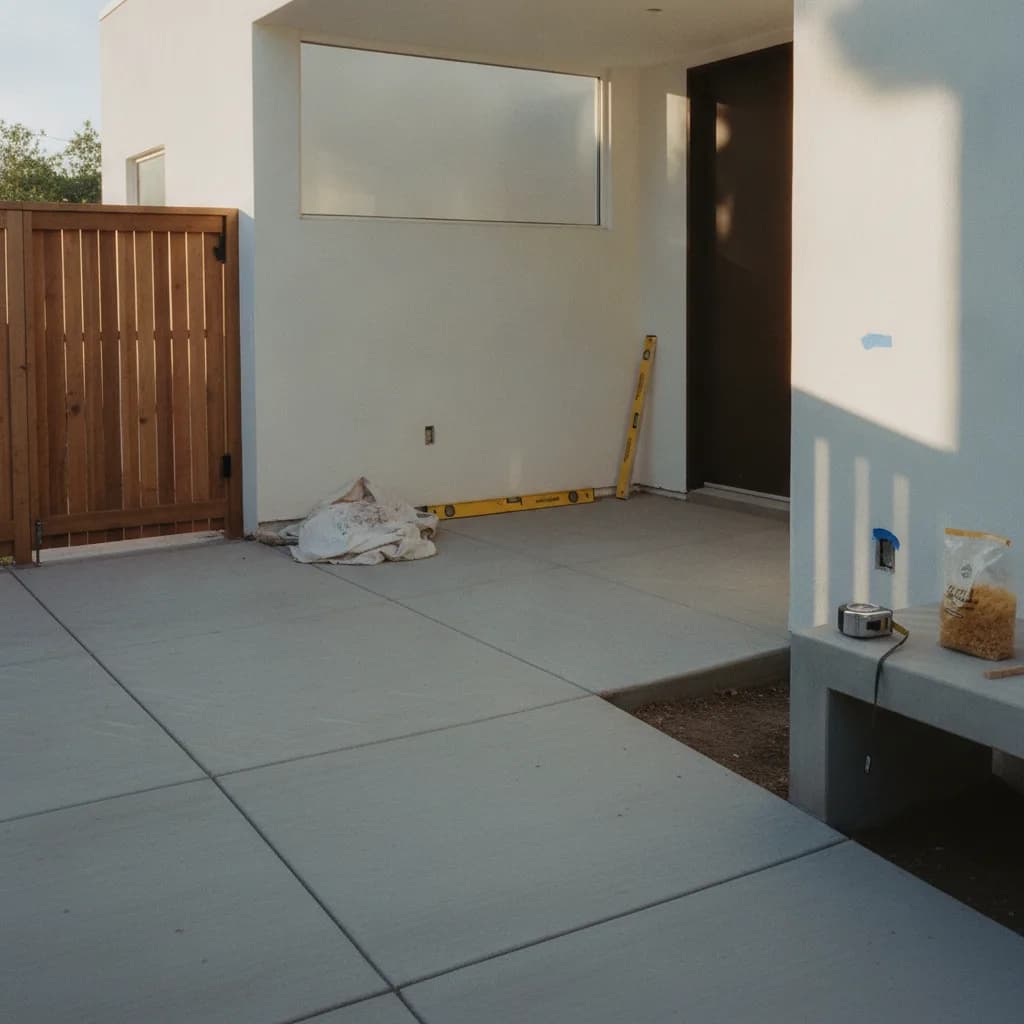
A typical 800-square-foot driveway replacement in Los Angeles can go over budget by $5,000 to $10,000 and add three weeks to the timeline. The reason is almost never the surface material you see; it’s the structural preparation you don't. While a simple resurfacing project on a small townhouse driveway can start lower, most full replacements that go wrong fail because of mistakes made before a single paver is laid or a yard of concrete is poured.
In a Nutshell: The Los Angeles Driveway Budget Busters
The average driveway project in Los Angeles goes sideways when homeowners focus on the finish and contractors cut corners on the foundation. The most common mistakes are ignoring expansive clay soil, using an inadequate base, and failing to plan for drainage. The counter-move you should make this week: verify the license of any potential driveway contractor Los Angeles offers on the California State License Board (CSLB) website. No license, no conversation.
Mistake #1: Ignoring Your Subgrade
Many homeowners approve a quote based on the top layer, assuming the ground underneath is a simple matter of scraping it flat. This is a critical error in Los Angeles, where expansive clay soils, especially prevalent in the San Fernando Valley, can swell and shrink dramatically, cracking a brand-new concrete slab in two years. Instead, insist your contract specifies subgrade compaction to 95 percent of its maximum dry density, as determined by a Modified Proctor test, to create a stable, unmoving foundation.
Mistake #2: Skimping on the Base Material
A contractor might propose using three inches of recycled concrete as a base to lower the initial price. This saves a few hundred dollars upfront but costs thousands in repairs when the driveway heaves and settles, because that material won't drain or compact uniformly. The correct specification is a minimum four to six-inch layer of open-graded, clean-crushed stone, like Caltrans Class 2 aggregate base or #57 stone, placed over a geotextile separation fabric to prevent it from mixing with the subgrade soil.
Mistake #3: Treating Drainage as an Afterthought
Ready to compare vetted project options?
Use Project Match privately when your scope is clear enough for contractor conversations.
Start Project MatchHomeowners often don't think about water until the first winter storm floods their garage. An improperly sloped driveway channels water toward your home’s foundation, causing saturation and structural risk, especially on hillside properties in neighborhoods like Eagle Rock or Silver Lake. A professional plan mandates a minimum one-quarter inch of fall per linear foot, directing water to a street, storm drain, or an installed channel drain system tied into your property's drainage.
Mistake #4: Using the Wrong Material for the Microclimate
You might love the look of dark basalt pavers, but they will become a heat island in a Sherman Oaks summer, raising the ambient temperature around your home. This leads to higher cooling costs and premature sealant failure. Match the material to the location: in coastal Santa Monica or Mar Vista, use epoxy-coated #5 rebar in concrete to prevent spalling from salt air corrosion; inland, choose lighter-colored pavers or concrete with a high Solar Reflectance Index (SRI) to mitigate heat.
Mistake #5: Fumbling the Permit Process
Assuming a driveway replacement doesn't need a permit is a fast way to get a stop-work order from the Los Angeles Department of Building and Safety (LADBS). Any work on the driveway apron, the portion that connects to the public street, requires a public works permit because it's in the city's right-of-way. Your contractor must handle this. For a comprehensive overview, see our guide at the Los Angeles driveway permit playbook for 2026.
Mistake #6: Hiring an Unvetted Contractor
Accepting the lowest bid without rigorous vetting often means hiring an unlicensed, uninsured crew that lacks the technical knowledge for LA's specific geological and climate challenges. The resulting failure from improper compaction or poor concrete finishing will not be covered, and you'll pay a qualified contractor to tear it out and start over, doubling the project cost. Get three quotes. Check three references. Visit one finished California job before signing.
Mistake #7: Relying on a Vague Scope of Work
A one-page estimate that just says "New Concrete Driveway - $35,000" is a recipe for budget-busting change orders. This ambiguity allows contractors to charge extra for things that should have been included, like demolition hauling, soil export, or a specific concrete finish. A proper scope of work is a detailed document specifying demolition methods, subgrade compaction standards, base material type and depth, concrete PSI strength (e.g., 4,000 PSI), rebar schedule, and finish type. The National Association of Home Builders recommends a ten to fifteen percent contingency on renovations in homes over thirty years old; a vague scope will consume that before the first pour.
Why is a driveway in Los Angeles so expensive?
The driveway los angeles cost is driven by high labor rates, stringent regulations, and complex site conditions. According to the California Department of Industrial Relations, prevailing wage data for Los Angeles County sets a high baseline for skilled labor like concrete finishers and equipment operators. disposal fees for old concrete and asphalt are substantial, and the need for solid engineering to handle expansive soils or steep slopes adds significant expense compared to other regions.
Three Representative Los Angeles Driveway Projects for 2026
Three representative projects from 2026, scoped similarly, reconstructed from Golden Yards Magazine's Project of the Day network and used here in aggregate form:
- Echo Park Hillside: A 600-square-foot paver driveway on a sloped lot requiring a small retaining wall and extensive drainage work. The project involved significant grading and soil export. Total Cost: $38,500.
- Studio City Ranch: A 1,200-square-foot brushed concrete driveway replacement. The scope included breaking and hauling away the old slab, re-compacting the expansive clay subgrade, and pouring a new 4-inch slab with #4 rebar. Total Cost: $46,000.
- Culver City Modern: An 850-square-foot driveway with two concrete strips and permeable grass pavers in the center. The project required LADBS permits for the apron and coordination with LADWP for a nearby water line. Total Cost: $41,200.
Sources & Methodology
See the Golden Yards Methodology for how sources are reviewed, ranges are normalized, and planning-data limits are handled.
Cost ranges in this guide draw on the following named industry sources, public agency datasets, and Golden Yards Magazine editorial research.
- Interlocking Concrete Pavement Institute (ICPI) Tech Specs (2026)
- American Concrete Institute (ACI) 332-R-06 Guide to Residential Concrete (2024)
- California State License Board (CSLB) (2026)
- Los Angeles Department of Building and Safety (LADBS) Building Code (2026)
- California Department of Industrial Relations, Prevailing Wage Determinations (2026)
- National Association of Home Builders (NAHB) Construction Cost Survey (2025)
Golden Yards Magazine Take
The meta-mistake behind nearly every blown driveway budget in Los Angeles is treating it like a cosmetic update rather than the structural engineering project it is. Homeowners fixate on paver color or stamp patterns, but the long-term success and value of the investment are determined by unseen factors: the percentage of subgrade compaction, the thickness of the aggregate base, and the gauge of the steel reinforcement. A driveway is infrastructure for your property. It must support thousands of pounds of vehicle weight daily while resisting soil movement and water intrusion for decades. Allocate your budget and your attention to the foundation first. The surface is just the finish line.
Frequently Asked Questions
What's the most expensive mistake when building a driveway in Los Angeles?
The most expensive mistake is improper subgrade and base preparation. A driveway built on poorly compacted, expansive soil will inevitably crack, heave, and fail, often within a few years. The only remedy is complete demolition and replacement, forcing you to pay for the entire project twice. This single error dwarfs the cost of any surface material upgrade.
Unlike a poor finish that can be corrected, a failed foundation is a total loss. In Los Angeles, with its varied clay soils, skimping on compaction testing or using an insufficient aggregate base to save $1,000 upfront can lead to a $40,000 replacement project down the road. It is the single most critical element for driveway longevity.
How do I know if my driveway contractor is padding the quote?
A padded quote often hides in vague line items and lump-sum figures rather than itemized costs. If a quote for a driveway in Los Angeles just says "Prep and Pour" without specifying the depth of the base rock, the concrete's PSI strength, or the rebar spacing, it's a red flag. This ambiguity allows them to use cheaper materials while charging a premium.
Ask for a detailed scope of work. A trustworthy contractor will specify materials (e.g., "6 inches of compacted Caltrans Class 2 base," "4,000 PSI concrete," "#4 rebar at 18 inches on center"). Also, compare the material and labor costs against at least two other detailed quotes. Unusually high allowances or undefined "site management" fees are signs of padding.
When should I walk away from a driveway quote?
Walk away immediately if the contractor is not licensed with the CSLB, cannot provide proof of liability and workers' compensation insurance, or pressures you to sign a contract on the spot. Also, be wary of any quote that is dramatically lower than all others, as this often indicates they plan to cut critical corners on the unseen base and subgrade work.
Other major warning signs include an unwillingness to provide a detailed, written scope of work, a refusal to provide local references, or a request for a large upfront deposit exceeding the legal limit (in California, 10% of the contract price or $1,000, whichever is less). Your driveway's success depends on the contractor's professionalism and adherence to standards.
What's the fastest way to blow a driveway budget in Los Angeles?
The fastest way to blow your budget is through change orders resulting from an incomplete initial plan. Deciding to add a walkway, change the paver style, or install lighting after the work has begun will trigger costly revisions. Each change disrupts the workflow, requires new material orders, and adds labor hours at a premium rate.
To prevent this, finalize every single detail before signing the contract. Lock in the exact paver model, the concrete color and finish, the path of any conduits for future lighting, and the precise footprint of the driveway. A well-defined plan, documented in the scope of work, is the best defense against the budget creep that plagues many Los Angeles driveway projects.
Ready to start your driveway project?
Find My ProsFrequently Asked Questions
What's the most expensive mistake when building a driveway in Los Angeles?
The most expensive mistake is improper subgrade and base preparation. A driveway built on poorly compacted, expansive soil will inevitably crack, heave, and fail, often within a few years. The only remedy is complete demolition and replacement, forcing you to pay for the entire project twice. This single error dwarfs the cost of any surface material upgrade. Unlike a poor finish that can be corrected, a failed foundation is a total loss. In Los Angeles, with its varied clay soils, skimping on compaction testing or using an insufficient aggregate base to save $1,000 upfront can lead to a $40,000 replacement project down the road. It is the single most critical element for driveway longevity.
How do I know if my driveway contractor is padding the quote?
A padded quote often hides in vague line items and lump-sum figures rather than itemized costs. If a quote for a driveway in Los Angeles just says "Prep and Pour" without specifying the depth of the base rock, the concrete's PSI strength, or the rebar spacing, it's a red flag. This ambiguity allows them to use cheaper materials while charging a premium. A trustworthy contractor will specify materials (e.g., "6 inches of compacted Caltrans Class 2 base," "4,000 PSI concrete," "#4 rebar at 18 inches on center"). Also, compare the material and labor costs against at least two other detailed quotes. Unusually high allowances or undefined "site management" fees are signs of padding.
When should I walk away from a driveway quote?
Walk away immediately if the contractor is not licensed with the CSLB, cannot provide proof of liability and workers' compensation insurance, or pressures you to sign a contract on the spot. Also, be wary of any quote that is dramatically lower than all others, as this often indicates they plan to cut critical corners on the unseen base and subgrade work. Other major warning signs include an unwillingness to provide a detailed, written scope of work, a refusal to provide local references, or a request for a large upfront deposit exceeding the legal limit (in California, 10% of the contract price or $1,000, whichever is less). Your driveway's success depends on the contractor's professionalism and adherence to standards.
What's the fastest way to blow a driveway budget in Los Angeles?
The fastest way to blow your budget is through change orders resulting from an incomplete initial plan. Deciding to add a walkway, change the paver style, or install lighting after the work has begun will trigger costly revisions. Each change disrupts the workflow, requires new material orders, and adds labor hours at a premium rate. To prevent this, finalize every single detail before signing the contract. Lock in the exact paver model, the concrete color and finish, the path of any conduits for future lighting, and the precise footprint of the driveway. A well-defined plan, documented in the scope of work, is the best defense against the budget creep that plagues many Los Angeles driveway projects.