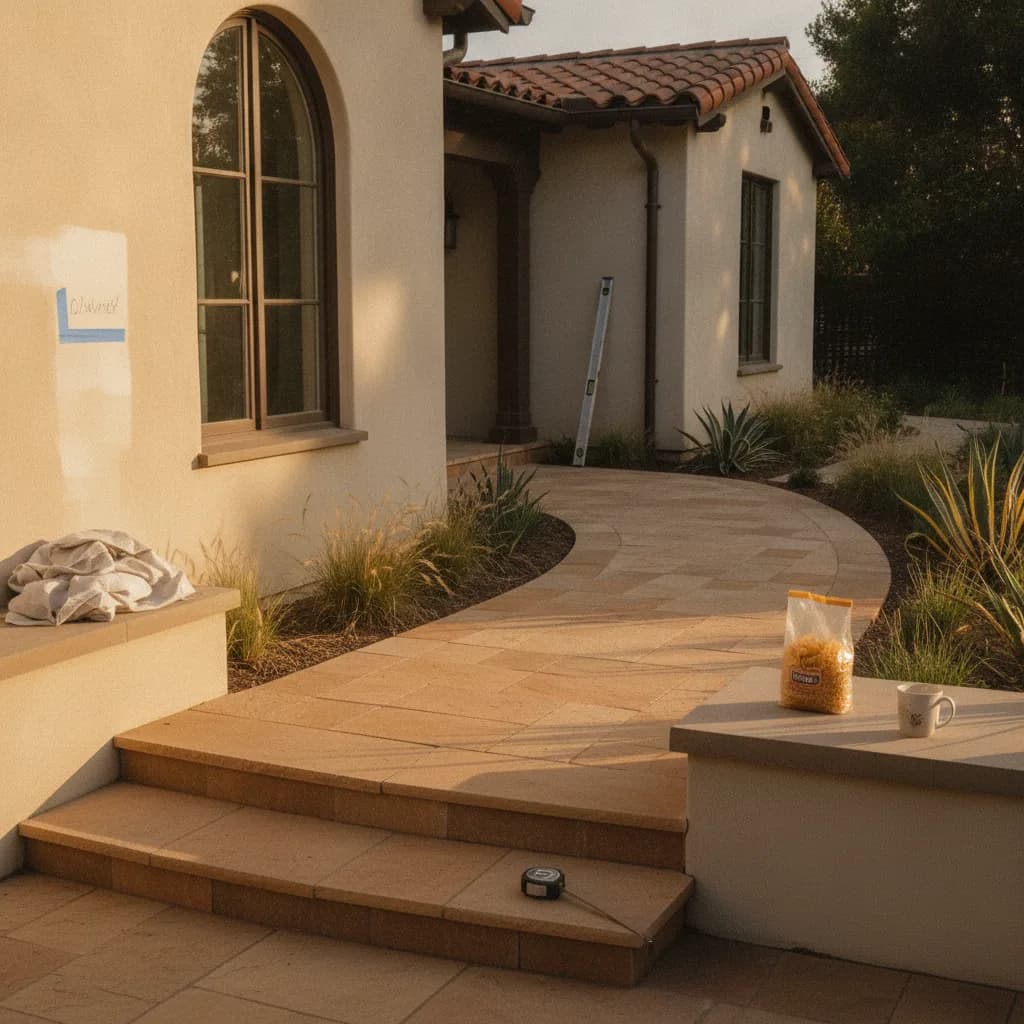
A simple paver walkway in Orange County should be a one-time investment. But skimping on the base preparation can turn a $12,000 project into a $25,000 problem within three years when you pay to rip it out and do it right. The biggest cost isn't the pavers you see; it's the compacted base you don't. Getting that wrong means you pay for the whole job twice, a common and expensive lesson for local homeowners.
In a Nutshell
The difference between an Orange County walkway that lasts five years and one that lasts twenty-five isn't the paver you choose. It's the subgrade prep, the base material, and the edge restraint. Getting these wrong means sunken pavers, wide joints, and a complete tear-out. The fix is never a patch job.
- Three Most Common Mistakes: Ignoring expansive clay soil, using the wrong base material, and skipping proper compaction.
- Your Counter-Move This Week: Dig a small test pit, six inches deep, at the edge of your proposed walkway path. Is the soil sticky clay or sandy loam? This one piece of information changes the entire sub-base specification and informs every quote you get from a walkway contractor in Orange County.
Understanding Walkway Orange County Cost
A professionally installed paver walkway in Orange County typically costs between $18 and $35 per square foot. The final price for a new walkway orange county 2026 project depends on site access, soil conditions, material choice, and complexity. This range can start lower for simple overlay projects on existing concrete or for small condo patios, but a full excavation and installation for a single-family home will fall squarely in this bracket. The key is ensuring the price reflects a properly engineered base, not just surface-level aesthetics.
Mistake #1: Ignoring Orange County's Expansive Clay Soil
Many homeowners assume any patch of dirt is a stable foundation for a walkway. This is a critical error in this region. Much of inland Orange County, from Anaheim Hills to Irvine, sits on expansive clay that swells when wet and shrinks when dry, heaving a poorly prepared walkway into an uneven mess within two seasons. This failure leads to trip hazards and a full replacement, costing upwards of $20 per square foot. Instead, you must insist your contractor excavates an extra four inches and installs a geotextile separation layer between the native subgrade and the aggregate base.
Mistake #2: Skimping on Subgrade and Base Compaction
Ready to compare vetted project options?
Use Project Match privately when your scope is clear enough for contractor conversations.
Start Project MatchHomeowners often watch a contractor lay a few inches of gravel and assume the base is complete. An uncompacted or poorly compacted base is the number one cause of paver settlement and failure. Without compaction to 95 percent Modified Proctor density, that base will settle under load and rain, creating dips and valleys. The callback to fix this is a full tear-out, not a simple lift and relay. You must specify in the contract that the subgrade and aggregate base will be compacted in two-inch lifts with a mechanical plate compactor and tested for density.
Mistake #3: Choosing Aesthetics Over Engineering for Materials
It's easy to pick a paver based on color and a joint sand based on convenience. This prioritizes the wrong things. The material specification determines longevity; using decorative gravel instead of ASTM C33 concrete sand for the bedding course allows pavers to shift, while using basic silica sand in the joints washes out, allowing weeds and paver creep. This can cut the life of a walkway in half. Demand a written spec: a four to six-inch open-graded base of #57 stone, a one-inch bedding course of ASTM C33 sand, and polymeric joint sand (ASTM C144) to lock it all together.
Mistake #4: Underestimating Coastal Salt Air Corrosion
Homeowners in coastal cities like Newport Beach or Dana Point often approve standard concrete specs with untreated rebar for steps or landings. Salt-laden marine air accelerates rebar corrosion, causing the concrete to spall and crack prematurely, a failure mode known as spalling. The repair involves chipping out the failed concrete and replacing the steel, a fix that often costs more than the original installation. For any reinforced concrete elements within a mile of the coast, you must specify epoxy-coated or galvanized #4 rebar and ensure it has at least two inches of concrete cover.
Mistake #5: Accepting a Vague, One-Line Quote
Many people accept a quote that says "Install 400 sq. ft. paver walkway - $14,000." This quote is an escape hatch for the contractor. It fails to specify base depth, compaction standards, material types, or edge restraint, leaving you with no recourse when the work fails. The "walkway orange county cost" you thought was locked in becomes a starting point for change orders. Get three quotes. Check three references. Visit one finished California job before signing. Your contract must detail every step: excavation depth, subgrade compaction standard, geotextile fabric model, base material and depth, bedding sand spec, paver type, edge restraint product, and joint sand type.
Mistake #6: Forgetting Permits and Inspections
Homeowners frequently assume a simple walkway doesn't need a permit, so they hire a contractor to do it quickly. While many simple walkways are exempt, adding retaining walls over a certain height, significant grading, or complex drainage often triggers permit requirements. Building without one can result in stop-work orders, fines, and orders to demolish the work. A good walkway contractor orange county will know exactly when a permit is needed. Clarify the scope with your contractor and confirm permit requirements with your local jurisdiction, whether it's the City of Irvine or unincorporated Orange County, and document this in your contract.
Sources & Methodology
See the Golden Yards Methodology for how sources are reviewed, ranges are normalized, and planning-data limits are handled.
Cost ranges in this guide draw on the following named industry sources, public agency datasets, and Golden Yards Magazine editorial research.
- ICPI Tech Spec 2: Construction of Interlocking Concrete Pavements (2023)
- ASTM C33/C33M - 18: Standard Specification for Concrete Aggregates (2018)
- California Department of Industrial Relations, Prevailing Wage Determinations (2026)
- National Association of Home Builders, Construction Cost Survey (2025)
- Building Industry Association of Southern California, Orange County Chapter (2026)
- County of Orange, OC Public Works, Standard Plans (2024)
Golden Yards Magazine Take
The fundamental mistake is treating a walkway like furniture. Homeowners shop for pavers, focusing on color and texture, when they should be shopping for a system. A walkway isn't a collection of pretty stones; it's an engineered structure designed to manage water, support loads, and resist soil movement. The pavers are just the wearing surface, the last five percent of the job. The other ninety-five percent, the part that determines if it lasts, is buried. Stop asking contractors what pavers they recommend. Start asking them for their subgrade prep and compaction protocol. The contractor who geeks out on base density is the one you hire. The one who just wants to show you a catalog is the one who will generate a callback.
Frequently Asked Questions
What's the most expensive mistake when building a walkway in Orange County?
The most expensive mistake is improper subgrade and base preparation. Skimping here guarantees premature failure like sinking or heaving pavers. The fix isn't a repair; it's a complete demolition and reconstruction, meaning you pay for the excavation, materials, and labor twice, effectively doubling the original project cost.
In Orange County, this is often tied to ignoring our expansive clay soils. Without proper excavation, soil amendment, or a geotextile fabric layer, the clay will move the walkway. A standard four-inch base might be fine in sandy soil, but in the clay soils of Irvine or Yorba Linda, you need a six to eight-inch engineered base. The extra $2-$3 per square foot for proper base prep saves you from a $20+ per square foot replacement cost down the line.
How can I tell if a walkway contractor's quote is too high?
A quote isn't "too high" if it accurately reflects the cost of durable materials and skilled labor. Suspect a quote is padded if it's a single lump sum without a detailed breakdown of materials, labor, and equipment. A professional quote will itemize excavation, base materials, pavers, edge restraints, and sand, justifying the total cost.
Get at least three detailed quotes to establish a baseline. According to the California Department of Industrial Relations wage data for Orange County, skilled hardscape labor commands a premium. A cheap quote often signals shortcuts: an insufficient base, no compaction, or use of substandard materials. Ask a bidder to walk you through their line items. A contractor who can defend their numbers with material specs and labor hours is transparent; one who can't is likely hiding something.
When should I walk away from a walkway quote?
Walk away from any quote that lacks detail or from a contractor who resists putting specifications in writing. Vague promises of a "good base" are red flags. Also, reject any contractor who suggests skipping permits for work that clearly requires them or who can't provide a license and proof of insurance.
A contractor's refusal to specify materials (e.g., "#57 stone base," "ASTM C33 sand") or methods ("compaction in 2-inch lifts to 95% Proctor") means they intend to use whatever is cheapest and easiest. The National Association of Home Builders recommends a ten to fifteen percent contingency on renovations in homes over thirty years old; a contractor who doesn't discuss potential unknowns isn't being realistic. If they pressure you for a quick decision or a large upfront cash deposit, find someone else.
What's the fastest way to blow a walkway budget in 2026?
The fastest way to blow your budget is through change orders. This happens when the initial scope of work is poorly defined. Deciding to add landscape lighting, a small retaining wall, or a different, more expensive paver after the contract is signed will inflate costs with material markups and additional labor charges.
Lock in every single decision before signing the contract. The price for adding a feature mid-project is always higher than planning for it from the start. A simple walkway can become complex quickly. Three representative projects from 2026, scoped similarly, reconstructed from Golden Yards Magazine's Project of the Day network and used here in aggregate form: show that well-planned projects finish on budget, while those with mid-stream changes run 20-30% over.
Ready to start your hardscaping project?
Find My ProsFrequently Asked Questions
What's the most expensive mistake when building a walkway in Orange County?
The most expensive mistake is improper subgrade and base preparation. Skimping here guarantees premature failure like sinking or heaving pavers. The fix isn't a repair; it's a complete demolition and reconstruction, meaning you pay for the excavation, materials, and labor twice, effectively doubling the original project cost. In Orange County, this is often tied to ignoring our expansive clay soils. Without proper excavation, soil amendment, or a geotextile fabric layer, the clay will move the walkway. A standard four-inch base might be fine in sandy soil, but in the clay soils of Irvine or Yorba Linda, you need a six to eight-inch engineered base. The extra $2-$3 per square foot for proper base prep saves you from a $20+ per square foot replacement cost down the line.
How can I tell if a walkway contractor's quote is too high?
A quote isn't "too high" if it accurately reflects the cost of durable materials and skilled labor. Suspect a quote is padded if it's a single lump sum without a detailed breakdown of materials, labor, and equipment. A professional quote will itemize excavation, base materials, pavers, edge restraints, and sand, justifying the total cost. Get at least three detailed quotes to establish a baseline. According to the California Department of Industrial Relations wage data for Orange County, skilled hardscape labor commands a premium. A cheap quote often signals shortcuts: an insufficient base, no compaction, or use of substandard materials. Ask a bidder to walk you through their line items. A contractor who can defend their numbers with material specs and labor hours is transparent; one who can't is likely hiding something.
When should I walk away from a walkway quote?
Walk away from any quote that lacks detail or from a contractor who resists putting specifications in writing. Vague promises of a "good base" are red flags. Also, reject any contractor who suggests skipping permits for work that clearly requires them or who can't provide a license and proof of insurance. A contractor's refusal to specify materials (e.g., "#57 stone base," "ASTM C33 sand") or methods ("compaction in 2-inch lifts to 95% Proctor") means they intend to use whatever is cheapest and easiest. The National Association of Home Builders recommends a ten to fifteen percent contingency on renovations in homes over thirty years old; a contractor who doesn't discuss potential unknowns isn't being realistic. If they pressure you for a quick decision or a large upfront cash deposit, find someone else.
What's the fastest way to blow a walkway budget in 2026?
The fastest way to blow your budget is through change orders. This happens when the initial scope of work is poorly defined. Deciding to add landscape lighting, a small retaining wall, or a different, more expensive paver after the contract is signed will inflate costs with material markups and additional labor charges. Lock in every single decision before signing the contract. The price for adding a feature mid-project is always higher than planning for it from the start. A simple walkway can become complex quickly. Three representative projects from 2026, scoped similarly, reconstructed from Golden Yards Magazine's Project of the Day network and used here in aggregate form: show that well-planned projects finish on budget, while those with mid-stream changes run 20-30% over.