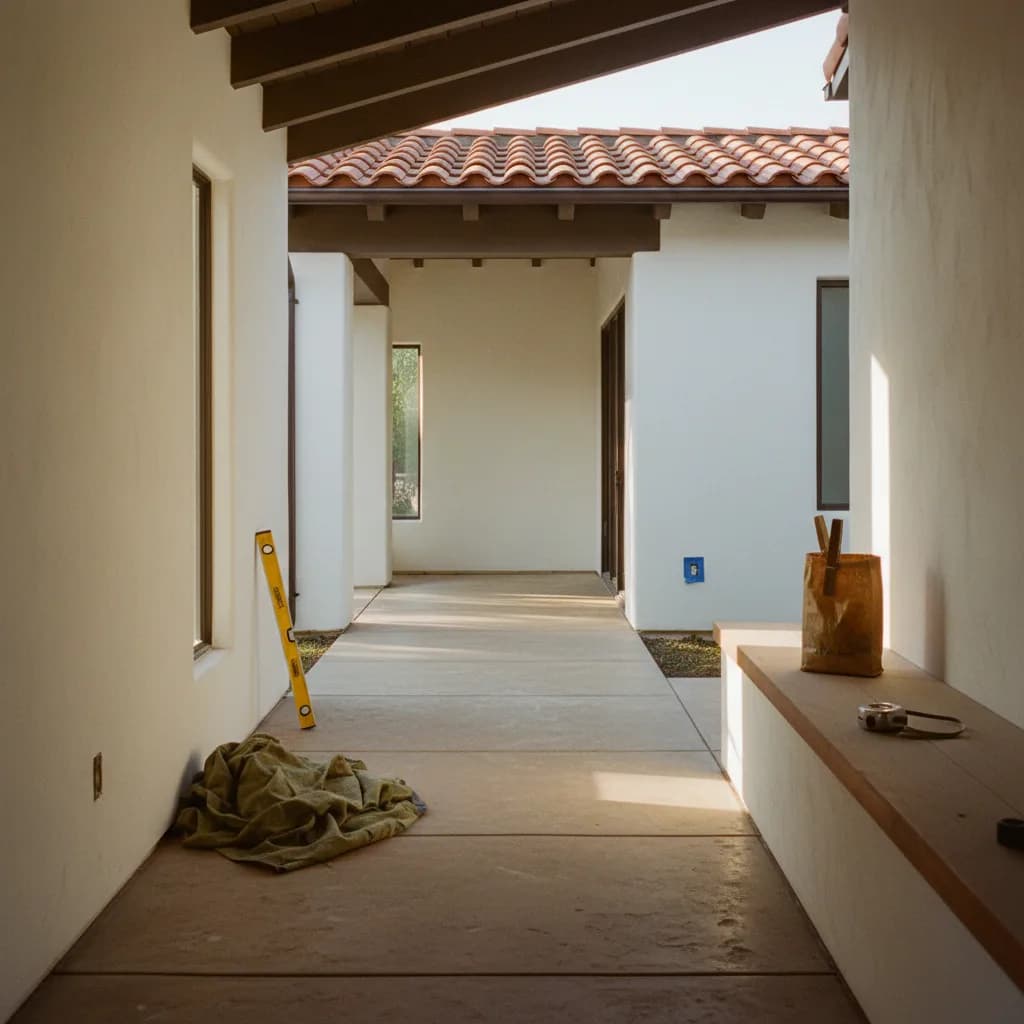
A professionally installed walkway in Riverside for 2026 will cost between $18,000 and $50,000 for a typical 400 to 600 square foot project. The final invoice for a quality walkway lands squarely between $40 and $60 per square foot. This price can start lower, around $25 per square foot, for a simple, straight-run concrete path on a perfectly flat lot, but that is not the typical project we see. The real price of a durable, well-built Riverside walkway is baked into the unseen work: subgrade engineering for expansive clay soil and a solid, open-graded base.
In a Nutshell
- Total Cost Range: $15,000 to $65,000+
- Mid-Range Project Average: $28,000 to $45,000 for a 500-square-foot paver walkway with proper base preparation.
- Typical Timeline: Three to five weeks from demolition to final joint sand sweep.
- Biggest Surprise Line Item: Subgrade remediation and soil export, which can add $3,000 to $7,000 when dealing with Riverside’s notorious expansive clay.
What does a walkway actually cost in Riverside in 2026?
The material you see on the surface is only a fraction of the total cost. The real investment is in the earthwork, base, and drainage that ensures your walkway survives Riverside's punishing summer heat and reactive soils. Below are three tiers of investment for a typical 500-square-foot walkway.
| Tier | Cost per Sq. Ft. | Total (500 sq. ft.) | What You Get |
|---|---|---|---|
| Basic | $25 - $40 | $12,500 - $20,000 | 4-inch broom-finish concrete slab (ACI 332 spec), minimal grading, straight layout, wire mesh reinforcement. Assumes stable, non-expansive soil. |
| Mid-Range | $45 - $65 | $22,500 - $32,500 | Interlocking concrete pavers, 6-inch open-graded #57 stone base over a geotextile fabric, standard edge restraints, polymeric sand joints, gentle curves. |
| Premium | $70 - $110+ | $35,000 - $55,000+ | Natural stone (flagstone or travertine), complex patterns, integrated low-voltage lighting, 8-10 inch engineered base for expansive soil, concrete bond beam edging, steps, and sub-surface drainage. |
For a typical mid-range paver walkway, here’s how the costs break down:
- Labor: 40%
- Pavers & Surface Materials: 25%
- Base/Bedding Aggregate & Geotextile: 15%
- Demolition & Soil Off-Haul: 10%
- Overhead, Permits, & Profit: 10%
The bottom-of-range projects, those under $30 per square foot, are almost always simple concrete pours on lots with ideal soil conditions or paver overlays on existing, stable concrete. They are not representative of a new walkway installation that requires significant earthwork.
Why is a walkway in Riverside more expensive than in other regions?
Three factors drive the walkway riverside cost above the national average: specialized labor, soil conditions, and material logistics. Ignore them, and you’re planning for a callback, not a permanent installation.
1. Skilled Labor Rates: The biggest single factor is the cost of qualified labor. A crew that knows how to properly prep a subgrade for expansive soil commands a premium. According to the California Department of Industrial Relations prevailing wage data for Riverside County, skilled construction labor rates are significantly higher than in neighboring states. This isn't just about laying pavers; it's about operating compaction equipment correctly, understanding soil reports, and installing drainage that works. Expect to pay for that expertise.
2. Expansive Clay Soil: Much of Riverside, from Canyon Crest to Orangecrest, is built on highly expansive clay soil. This soil swells when wet and shrinks when dry, a cycle that destroys improperly installed hardscapes. A standard 4-inch base is a recipe for failure. A proper Riverside walkway requires an engineered subgrade, often over-excavated, and a thicker, open-graded base (minimum six to eight inches of #57 stone) separated by a geotextile fabric. This adds significant cost in labor, materials, and soil disposal.
3. Material & Neighborhood Premiums: The Inland Empire isn't next door to major stone quarries. That means aggregates, pavers, and natural stone carry a transportation premium. Fuel costs and logistics add up., projects in higher-end neighborhoods like Hawarden Hills or Victoria Woods often come with higher expectations for finish quality, site cleanliness, and logistical coordination, which contractors price into their bids. Access can be tighter, and homeowners associations may have stricter rules, all of which adds to the bottom line.
What do real Riverside homeowners spend in 2026?
Ready to compare vetted project options?
Use Project Match privately when your scope is clear enough for contractor conversations.
Start Project MatchThree representative projects from 2026, scoped similarly, reconstructed from Golden Yards Magazine's Project of the Day network and used here in aggregate form:
- Canyon Crest ($31,500): A 550-square-foot meandering paver walkway connecting a driveway to a backyard patio. The project required over-excavating twelve inches of expansive clay, installing a new sub-drain tied into the property's main line, and laying an 8-inch compacted base. The crew used Belgard pavers and a high-performance polymeric sand to resist ant intrusion.
- Woodcrest ($24,000): A 400-square-foot straight-run stamped concrete walkway. While seemingly simpler, the soil required chemical stabilization and the slab was poured at five inches thick with #4 rebar at 18-inch on-center to mitigate cracking. The cost included a premium color hardener and sealer to protect against UV degradation from the intense sun.
- Downtown Historic District ($46,000): A 600-square-foot walkway using reclaimed brick to match the home's historic character. The high cost was driven by the labor-intensive process of cleaning and laying the irregular bricks on a modern, engineered base with a concrete bond beam for edge restraint. Permitting with the historic preservation office added two weeks to the timeline.
Where does the money actually go?
The surface material is the obvious cost, but the majority of the budget is consumed by what's underneath and around it. A professional walkway contractor riverside will account for these items, which are often missing from low-ball estimates.
- Demolition and Haul-Away: Tearing out an old concrete path or clearing vegetation. ($1,500 - $3,500)
- Geotechnical Soil Report: For sites with known soil issues or steep slopes, this is non-negotiable. ($2,000 - $5,000)
- Subgrade Remediation: Over-excavating and replacing expansive clay with engineered fill. ($3 - $7 per square foot)
- Permitting and Inspection Fees: City of Riverside plan check, permit issuance, and inspector site visits. ($750 - $1,800)
- Geotextile Separation Fabric: Prevents the base stone from sinking into the clay subgrade. A critical and often-skipped step. ($1 - $2 per square foot)
- Sub-surface Drainage System: Perforated pipes, catch basins, and trenching to manage water. ($2,500 - $6,000)
- Low-Voltage Lighting Conduit: Installing sleeves under the walkway for future landscape lighting. ($500 - $1,500)
- Site Protection and Cleanup: Protecting existing landscape, structures, and daily site cleaning. ($1,000 - $2,500)
What stops a Riverside walkway from running over budget?
Budget overruns in hardscaping are almost always a failure of planning. Three issues account for the majority of surprise costs.
1. Undiagnosed Soil Conditions: The estimate assumes stable ground, but demolition reveals highly expansive clay or undocumented fill. The fix is expensive: over-excavation and a much deeper base. A soil test upfront can prevent this, but many skip it to save a few hundred dollars, risking thousands in change orders.
2. Water Mismanagement: The project plan doesn't account for a high water table or runoff from a neighboring property. Once the ground is open, the problem becomes obvious. Installing a French drain or tying into the storm sewer is a significant unbudgeted expense. A proper site assessment should catch this.
3. Mid-Project Design Changes: The homeowner decides to widen the path, change the paver style, or add steps after work has begun. This not only adds material and labor costs but also creates timeline delays that have a cascading effect. Lock in the design before the first shovel hits the dirt. The National Association of Home Builders recommends a ten to fifteen percent contingency on renovations in homes over thirty years old.
How can I estimate my walkway cost?
To get a preliminary idea of material and base aggregate quantities for your project, you can use an online tool. While no substitute for a professional bid, a hardscape calculator can help you understand the scale of the material orders required. For a detailed breakdown, use our driveway and hardscape cost calculator to model different material choices and sizes.
What should your Riverside contractor include in the quote?
A legitimate bid is a detailed scope of work, not a one-page price. If your quote is missing these items, the contractor is either inexperienced or leaving room for change orders. Your contract for a riverside walkway should specify:
- Excavation depth for subgrade preparation.
- Subgrade compaction standard (e.g., 95% Modified Proctor).
- Geotextile fabric type and specification.
- Base material type and gradation (e.g., Caltrans Class 2 or #57 stone).
- Compacted base thickness (minimum 6 inches for pavers in Riverside).
- Bedding course material (ASTM C33 concrete sand) and screeded thickness (1 inch).
- Paver or stone manufacturer, style, and color.
- Concrete specification (e.g., 3,500 PSI, 4-inch slump) and reinforcement type (rebar or mesh).
- Edge restraint type and installation method (e.g., plastic edging with 10-inch spikes or a concrete toe).
- Joint sand type (polymeric or silica) and installation process.
- Detailed drainage plan, including slope percentages and discharge points.
- Permit acquisition responsibility and cost. You can learn more in our Riverside walkway permit playbook.
- Project timeline, payment schedule, and warranty terms.
- Lien release procedures.
Golden Yards Take
Homeowners fixate on the surface: the color of the paver, the texture of the stone. Contractors know the project is won or lost in the subgrade. The single biggest mistake we see in Riverside is treating a walkway like a decorative element instead of a structural one. In this region's expansive soil, a walkway is a small building. It needs a foundation. Skimping on the base to afford a premium paver is a fool's bargain. The premium paver will heave, shift, and fail within five years. A standard paver on an over-engineered, 8-inch open-graded base will last for thirty. Focus your budget on the part you can't see. Test the soil. Prep the base. Build it to last.
Sources & Methodology
See the Golden Yards Methodology for how sources are reviewed, ranges are normalized, and planning-data limits are handled.
Cost ranges in this guide draw on the following named industry sources, public agency datasets, and Golden Yards Magazine editorial research.
- California Department of Industrial Relations, Prevailing Wage Determinations for Riverside County (2026)
- City of Riverside, Planning and Building Department, Permit Guidelines (2026)
- Interlocking Concrete Pavement Institute (ICPI), Tech Spec 2: Construction of Interlocking Concrete Pavements (2025)
- National Association of Home Builders (NAHB), Remodeling Market Index (Q1 2026)
- California Contractors State License Board (CSLB), Contractor Bid Survey (2025)
- American Concrete Institute (ACI), ACI 332-R-06: Guide to Residential Concrete (2024)
Ready to start your hardscaping project?
Find My ProsFrequently Asked Questions
How much does a basic concrete walkway cost in Riverside?
<p>A basic, broom-finished concrete walkway in Riverside typically costs between $25 and $40 per square foot. This price assumes a straightforward installation on a flat, stable lot with good access for a concrete truck. The cost covers a standard 4-inch slab with wire mesh reinforcement and proper control joints.</p> <p>Several factors can increase this price. A thicker slab (5 inches) with rebar reinforcement, necessary for areas with poorer soil, will cost more. Stamped or colored concrete can add another $5 to $15 per square foot. Difficult site access that requires pumping the concrete instead of pouring directly from the truck also adds a significant premium. Without proper subgrade compaction to 95% Modified Proctor, even a basic slab will crack under the stress of Riverside's soil and climate.</p>
Do I need a permit for a walkway in Riverside?
<p>You generally need a permit for a new walkway in Riverside if it covers more than 200 square feet of impermeable surface or involves significant grading. Permits are almost always required if the walkway includes steps or retaining walls over 30 inches high, as these have structural and safety implications.</p> <p>The City of Riverside's Planning and Building Department has specific thresholds that trigger a permit. It's best to assume you need one and have your contractor verify. Proceeding without a required permit can result in stop-work orders, fines, and problems when you eventually sell your home. A professional contractor will handle the permit application process as part of their scope of work, ensuring all work is inspected and compliant with local codes.</p>
How long does a paver walkway last in the Inland Empire heat?
<p>A paver walkway built to Interlocking Concrete Pavement Institute (ICPI) standards can easily last 25 to 50 years, even in the extreme heat of the Inland Empire. The longevity depends entirely on the quality of the base preparation and the jointing material used, not just the pavers themselves.</p> <p>The intense UV radiation in Riverside can fade lower-quality pavers over time and degrade standard polymeric sand, causing it to fail prematurely. High-quality pavers with integrated color and a premium, UV-stable polymeric sand are essential. Most importantly, a deep, open-graded base allows for drainage and accommodates minor soil movement without causing the surface to heave or separate, which is the primary failure mode in this climate.</p>
What's better for Riverside soil: concrete or pavers?
<p>For Riverside's expansive clay soils, pavers offer a distinct structural advantage over a solid concrete slab. The flexible, interlocking nature of a paver system allows it to accommodate minor soil expansion and contraction without catastrophic failure. A small amount of settling can be easily repaired by lifting, re-leveling, and reinstalling the affected pavers.</p> <p>A rigid concrete slab, by contrast, cannot flex. When expansive soil swells unevenly beneath it, the slab is put under immense tension, leading to uncontrolled, structural cracks that are difficult and expensive to repair. While a concrete slab can be heavily reinforced with rebar to resist this, a paver system is inherently better suited to handle the soil movement common throughout Riverside County.</p>
How can I save money on my walkway cost in 2026?
<p>The most effective way to reduce your walkway cost is by simplifying the design and material choices. Opt for a straight or gently curving layout instead of complex, tight radiuses. Choose a standard, high-quality concrete paver from a local manufacturer over an imported natural stone, which can cut material costs by half.</p> <p>Other strategies include scheduling your project for the off-season (late fall or winter) when contractors may be more competitive. If you are capable, handling the demolition of an old path yourself can save on labor costs. However, never cut corners on base preparation. Reducing the depth of the base or skipping the geotextile fabric is false economy that guarantees you will pay to have the entire walkway redone in a few years.</p>