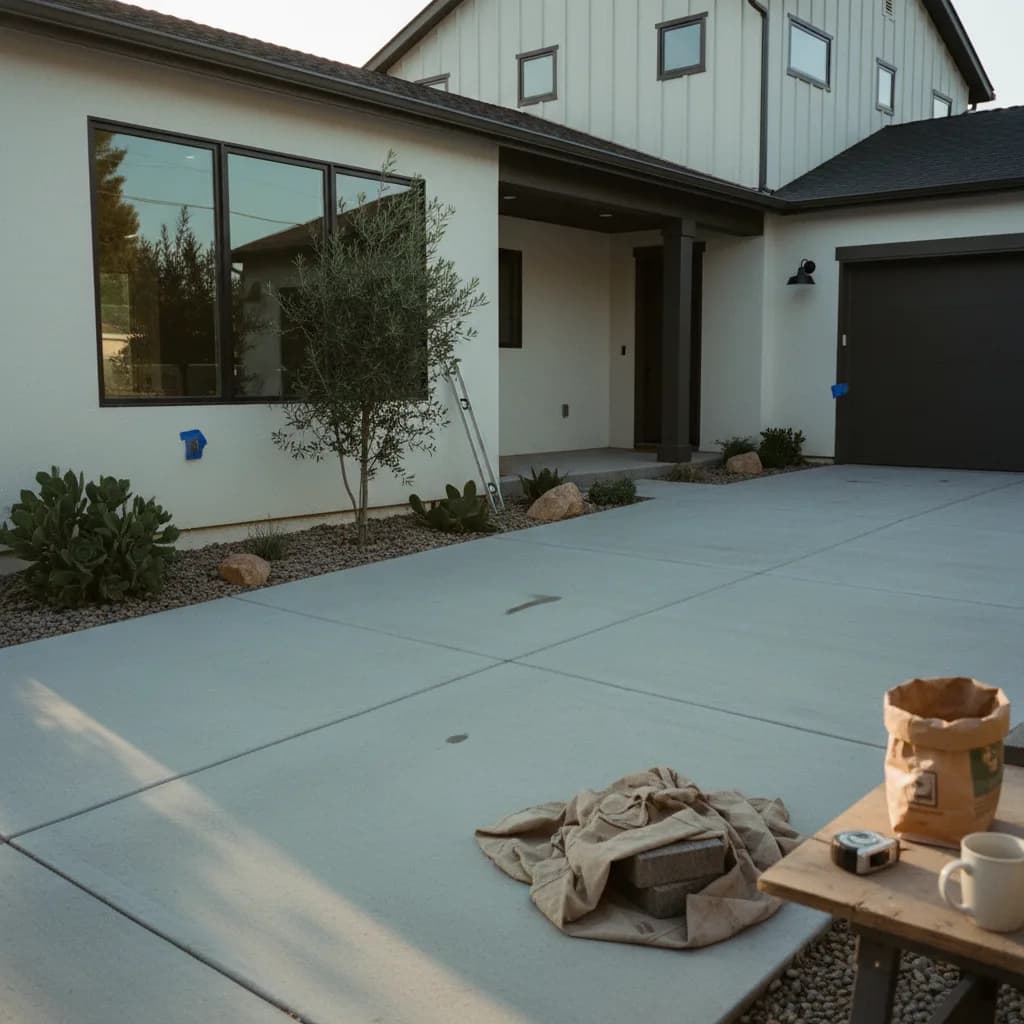
For a Sacramento driveway, compare three distinct options: poured concrete, conventional interlocking concrete pavers, and a designed permeable paver system. Concrete offers a continuous surface with planned joints. Interlocking pavers offer individual units that can be removed for repairs. Permeable paving adds a water-management function, but only when the entire assembly is designed for it and for vehicle loads.
The useful question is what an upgrade buys on your property: a different finish, easier future access, a drainage solution, or additional site work. “Premium” is not a construction specification. This September 2026 review compares those decisions and the local approval questions; it does not establish verified Sacramento installed-price averages or a guaranteed service life.
Concrete vs. pavers: compare the whole driveway system
| System | Reason to consider it | What the proposal should explain |
|---|---|---|
| Poured concrete | A continuous surface with your chosen finish and an agreed joint layout. | Support conditions, slab design, joint construction, curing and vehicle reopening. |
| Conventional interlocking pavers | A modular surface with a plan for replacing units or accessing utilities. | Vehicle-rated units, base, bedding, edges, joints and drainage as a compatible assembly. |
| Permeable interlocking pavers | A pavement that also manages water through its joints and supporting layers. | Vehicle loading, reservoir design, soil infiltration, any underdrain and ongoing maintenance. |
Keep surface selection separate from the pavement underneath it. Ask for samples and a drawing of the proposed layers. A more expensive unit does not identify the required base, and a decorative pattern does not explain how a driveway will drain. Our California driveway and paver guide provides broader planning context; the City and County checks below concern the Sacramento area.
How to compare Sacramento driveway costs
Obtain proposals for the same measured area and vehicle use. Identify the private driveway, any apron or inlet, adjacent sidewalk work and optional widening separately. State whether the surface must support ordinary cars, an RV or other heavier vehicles. Otherwise, two per-square-foot prices may describe substantially different projects.
Have each contractor separate demolition and disposal, preparation of the existing ground, pavement construction, drainage changes, approval costs and finish options. Ask what happens if demolition exposes unsuitable material: who evaluates it, how an alternative is priced, and how you approve additional work. A stated allowance is different from a completed design with a fixed price.
Use this comparison formula: quoted total + identified exclusions needed for the agreed scope = comparable project total. Then divide by the same paved area if you want an effective unit price. Keep unpriced items marked “unresolved”; do not insert a guessed allowance just to make a proposal appear complete.
For example, compare a simple finish and a decorative finish on the same concrete design, or compare two paver selections on the same approved supporting system. Obtain a separate price for a permeable design if its drainage works differ. This review has no verified basis for a fixed material premium, local price band or resale-return percentage. Ask for the date and validity period of each actual quote.
Choose a detail intended for vehicles
CMHA’s conventional paver construction guidance treats the soil, base, bedding, restraints and units as parts of the pavement. Ask which detail applies to your vehicle loads and ground conditions, and what checks document proper preparation. Do not assume every Sacramento property has identical soil or that one base thickness is suitable everywhere.
Do not copy a pedestrian-only hybrid into a driveway. CMHA’s October 2025 guidance on standard sand-jointed pavers over open-graded aggregate limits that hybrid method to residential pedestrian projects, excluding vehicular and commercial uses. It also explains the risk of joint sand migrating into the aggregate below. This is a restriction on that described hybrid, not a claim that all open-graded driveway designs are prohibited.
For poured concrete, request a slab and joint plan suited to the site. NRMCA’s joint guidance explains the role of planned joints in managing movement-related cracking. A universal slab thickness, strength, reinforcement pattern or joint-spacing claim cannot substitute for the applicable design and local requirements.
Illustration of concrete paving and joint lines beside a planted border.
What makes a paver driveway permeable?
Ready to compare vetted project options?
Use Project Match privately when your scope is clear enough for contractor conversations.
Start Project MatchCMHA’s permeable pavement guidance describes a system with permeable joints, open-graded bedding and aggregate storage layers. The design needs to address both water and structural loading. Depending on conditions, water may infiltrate into the soil or leave through an underdrain. The visible paver alone does not establish either performance.
Ask the designer to show the drainage destination, the assumptions about the underlying soil, the supporting section and the maintenance plan. If the proposed joints use sand, ask how that material is compatible with the selected system. Do not accept a conventional detail relabeled “permeable” without an explanation of how water passes through and is managed below.
Permeability also does not eliminate local paving and drainage requirements. Sacramento City Code §17.612.020 addresses permitted paving materials and requires surfaced areas to comply with applicable stormwater rules. It includes asphalt among the materials, so this comparison does not treat concrete as the only code-recognized driveway option.
City of Sacramento: driveway permit or encroachment permit?
Start with the street connection and the property line. The City’s driveway application FAQ distinguishes the following cases. Use the table to identify the review question, then confirm the scope with Development Engineering.
| Proposed work | City FAQ guidance |
|---|---|
| New or modified driveway needing an inlet or curb cut | The FAQ identifies a Driveway Permit. |
| Rebuilding an existing inlet without changing its width | The FAQ identifies an Encroachment Permit. |
| Driveway abutting rolled curb or an alleyway | The FAQ lists no permit for that driveway condition, while retaining code requirements. Confirm any other work or approvals separately. |
The City’s Minor Permits page provides the broader process for work in the public right-of-way and links the applications. Do not read a general driveway replacement quote as proof that the public apron, sidewalk or curb work is included. For paving entirely on private property, ask which planning, drainage or other requirements apply to the actual scope.
Show the existing and proposed driveway widths, nearby trees, utility equipment, sidewalk and property boundaries on the drawing. Request a written list of approval responsibilities and costs. Do not schedule demolition around an assumed permit turnaround.
Check front-yard paving limits and the correct jurisdiction
The City’s planning FAQ says a maximum of 50% of each required front-yard and street side-yard setback may be paved for the listed hardscape uses. It identifies an exception for the street side-yard portion behind a fence meeting the applicable requirements. This is not a rule allowing half of any entire lot to become a driveway. Have Planning check the relevant setback area before widening.
For an unincorporated Sacramento County property, use the County’s encroachment process. The County specifically includes new driveway work and driveway repairs in the public right-of-way. Its Site Improvement & Permits Section can identify the applicable submittal. City instructions are not a substitute for County approval.
Folsom, Elk Grove and Roseville projects need their own jurisdiction checks. Confirm the property location rather than relying on the contractor’s service-area name. Keep the street-connection approval and the private paving plan together when you compare proposals.
When can you park, and what will maintenance involve?
Ask for a reopening instruction matched to your vehicles. NRMCA explains that curing maintains suitable moisture and temperature so newly placed concrete can develop its intended properties. The date of placement alone does not establish permission for cars, RVs or delivery trucks to use the driveway. Record the contractor’s protection and reopening requirements in the handover information.
Pavers are manufactured units, but a finished-looking surface is not the same as a completed installation. Confirm that the supporting work, restraints, joints and any treatments are complete before use. Ask separately about any concrete components or applied products that need curing or drying.
CMHA’s maintenance guidance covers inspection, joint loss, stains, settlement and removal and reinstatement of conventional interlocking pavers. Keep spare matching units and the product details. A repairable surface is useful, but fixing a unit does not resolve an underlying drainage or support problem. Obtain maintenance instructions for the actual system rather than a blanket lifespan or resealing promise.
What to resolve before hiring a driveway contractor
Match the license classification to the work. CSLB’s C-8 classification covers specified concrete work; its D-6 classification includes interlocking precast pavers and other listed concrete-related services. Those scopes are not identical. Confirm that the proposed contractor and any subcontractors are appropriately licensed for the complete job, including additional drainage or utility work.
- Approve a measured plan identifying private paving and public right-of-way work.
- Record the intended vehicles and the compatible pavement detail.
- Compare itemized proposals with exclusions and unresolved amounts visible.
- Identify who obtains approvals and how changes to the work are agreed.
- Plan temporary parking and access to the home.
- Get written reopening instructions, maintenance information and warranty terms.
Use the material comparison to narrow the options, then make the final choice from complete proposals for the same property. The lowest number and the most expensive finish each need the same scrutiny of what is actually included.
Sources and methodology
Reviewed September 14, 2026. This article uses the City and County approval resources, CSLB classification descriptions, and CMHA and NRMCA guidance linked alongside the relevant claims. The October 2025 CMHA hybrid-system note is specifically limited to pedestrian applications. These sources are not a survey of Sacramento installation prices.
The revision removes unsupported local project invoices, price and lifespan bands, and universal soil or construction specifications. The original illustration remains; it does not prove a particular installation system, location or completed project. See our methodology and editorial standards for how source limits and corrections are handled.
Ready to start your driveway project?
Find My ProsFrequently Asked Questions
Is concrete or a paver driveway cheaper in Sacramento?
This review does not establish a verified Sacramento installed-price difference. Compare proposals for the same area, vehicle use, preparation, drainage and public apron work. Separate finish options from changes to the pavement system. A fixed material premium or per-square-foot price can hide differences in the included work.
Can standard pavers with sand joints use an open-graded base for a driveway?
The hybrid described in CMHA’s October 2025 note is limited to residential pedestrian projects and excludes vehicular applications. Do not transfer that detail to a driveway. A designed permeable driveway is a different system; ask for the compatible joints, supporting layers, drainage and vehicle-load design.
Do I need a permit to replace a driveway in the City of Sacramento?
The City’s driveway FAQ distinguishes a new or modified inlet from reconstruction of an existing inlet at the same width. The first is identified with a Driveway Permit and the second with an Encroachment Permit. Rolled-curb and alleyway conditions are treated separately. Confirm the actual work with Development Engineering.
Can I pave my whole front yard for parking in Sacramento?
The City’s planning FAQ limits listed hardscape uses to 50% of each required front-yard and street side-yard setback, with a stated fenced street-side exception. It is not a blanket allowance for half of the entire lot. Ask Planning to confirm the setback area and rules before widening a driveway.
Are City of Sacramento driveway rules the same as Sacramento County rules?
No. Confirm whether the property is in the City, an unincorporated County area or another municipality. The County has its own encroachment process for driveway work in the public right-of-way. A Sacramento mailing address or a contractor’s service area does not identify every applicable approval.
Does a permeable driveway automatically solve drainage problems?
No. Its design must explain where water enters, how it moves through the supporting layers and where excess water goes. Soil conditions and underdrains may affect the solution. The visible paver or a gap between units does not establish a complete permeable system or compliance with local drainage requirements.
When can I park on a new concrete or paver driveway?
Follow reopening instructions for the completed assembly and your vehicles. Concrete needs appropriate curing and protection. Pavers require completion of the base, edges, joints and any treatments; associated concrete or applied products may also need time. This review does not prescribe one parking deadline for every driveway.
Is asphalt prohibited for a Sacramento driveway?
Sacramento City Code §17.612.020 includes asphalt among the paving materials and also addresses vehicle performance and drainage. This article compares concrete and paver systems; it does not establish a universal climate-based winner over asphalt. Ask the applicable authority and designer about your proposed use.
Which contractor license should I check for driveway work?
Check the classification against the actual scope. CSLB describes C-8 concrete work separately from D-6 services, which include interlocking precast pavers. Those classifications do not have identical scopes. Confirm the appropriate licensing for the complete proposal and any additional work or subcontractors.