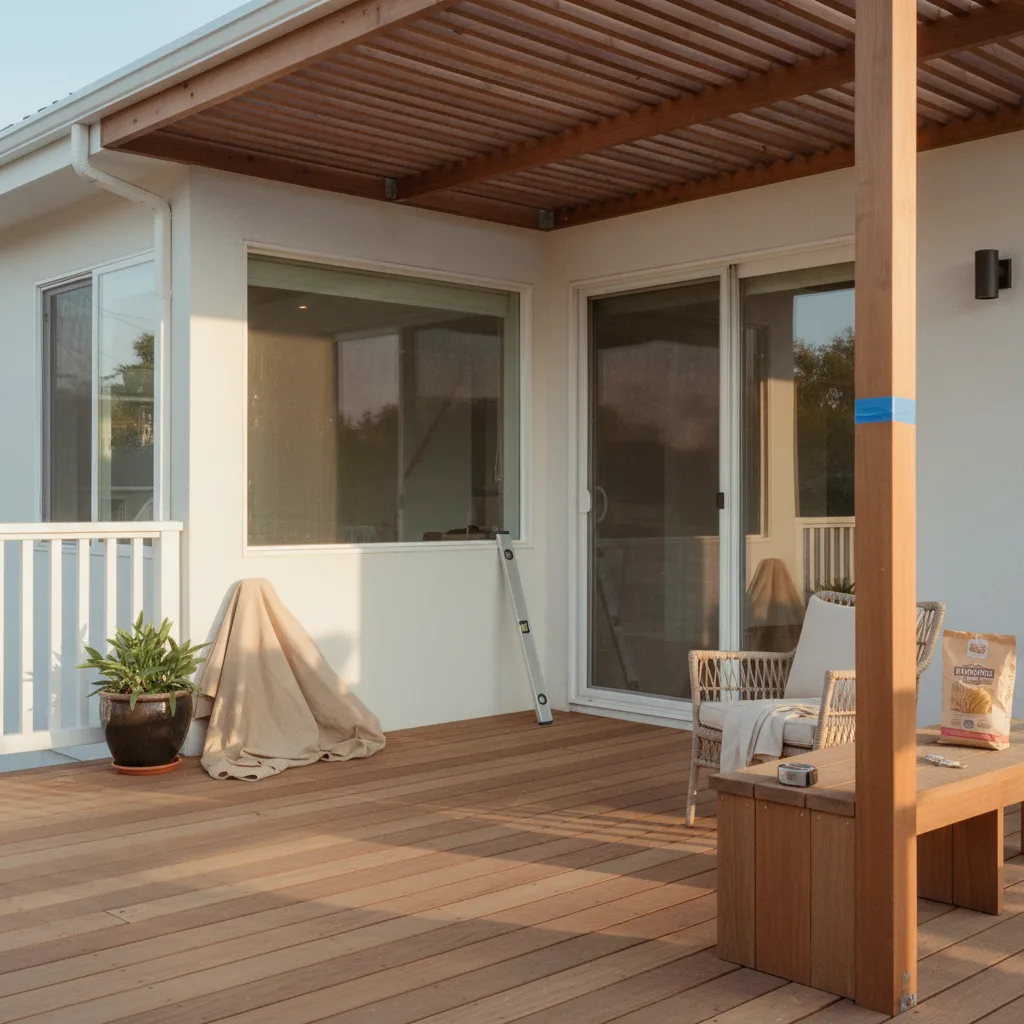
A new deck in Newport Beach in 2026 typically costs between $45,000 and $98,000 for a professionally installed, fully permitted 400-square-foot project using quality composite materials. The final invoice often settles in the $65,000 range for a mid-tier build. While costs can start lower, around $18,000, this usually applies to a simple ground-level deck refresh, replacing boards on an existing structurally sound frame, not a new build. The premium for coastal living is real, driven by materials, engineering, and labor.
In a Nutshell: Newport Beach Deck Costs
- Total Cost Range: $18,000 (basic refresh) to $160,000+ (premium hillside Ipe deck with features).
- Mid-Range Average: $55,000 to $75,000 for a 400 sq. ft. composite deck with standard railings and minimal site complexity.
- Project Timeline: 7 to 12 weeks, including two weeks for design, four for permitting with the City of Newport Beach, and three to six for construction.
- Biggest Surprise Line Item: Structural engineering and soils reports, particularly for properties in Newport Coast or on the bayfront, can add an unexpected $5,000 to $12,000 before a single board is laid.
What Does a Deck Actually Cost in Newport Beach in 2026?
The price per square foot is a common starting point, but the total project cost is a more accurate measure. In Newport Beach, that figure is shaped by materials, site access, structural requirements, and desired features. Below is a breakdown of what homeowners can expect for a typical 400-square-foot deck.
| Tier | Materials & Features | Price Per Sq. Ft. (Installed) | Total Project Cost (400 Sq. Ft.) |
|---|---|---|---|
| Basic | Pressure-Treated Pine, Simple Rectangular Design, Wood Railings, Standard Concrete Footings | $75 - $110 | $30,000 - $44,000 |
| Mid-Range | Trex Enhance or TimberTech PRO Composite, Aluminum or Cable Railings, Integrated LED Stair Lighting | $110 - $160 | $44,000 - $64,000 |
| Premium | Ipe Hardwood or TimberTech AZEK PVC, Glass Panel Railings, Outdoor Kitchen Cutouts, Pergola Integration | $180 - $250+ | $72,000 - $100,000+ |
For a representative mid-range project costing $58,000, the budget allocation typically breaks down as follows:
- Materials (Decking, Framing, Railings, Hardware): 45% ($26,100)
- Labor (Carpentry, Site Prep, Finishing): 35% ($20,300)
- Permits, Engineering & Design: 10% ($5,800)
- Demolition, Haul-Away & Site Prep: 5% ($2,900)
- Contractor Overhead & Profit: 5% ($2,900)
The bottom of the range, such as a $25,000 project, almost always involves leveraging an existing, permitted foundation and frame, focusing the budget purely on new decking boards and railings over a small area.

Why Is a Deck More Expensive in Newport Beach?
Building a deck in Newport Beach carries a premium compared to inland Orange County cities like Anaheim or Santa Ana. Three primary factors drive this cost differential: coastal material requirements, high-cost labor, and a complex regulatory environment.
1. Coastal Material & Hardware Specifications
The marine environment is relentless. Salt-laden air accelerates corrosion, meaning standard galvanized hardware is insufficient. A deck contractor in Newport Beach must use 316-grade stainless steel for all fasteners, joist hangers, and connectors, such as those from Simpson Strong-Tie's Stainless-Steel line. This hardware can cost three to four times more than the galvanized equivalent, adding $2,000 to $4,000 to a typical project. Decking materials themselves also need to be resilient to moisture and UV exposure, pushing homeowners toward higher-end composites or dense hardwoods like Ipe.
2. Skilled Labor Rates & Insurance Costs
The cost of living and operating a business in coastal Orange County directly impacts labor prices. According to the California Department of Industrial Relations prevailing wage data for Orange County, skilled carpenters and related trades command hourly rates 15 to 25 percent higher than in inland counties., contractors working on high-value homes in neighborhoods like Newport Coast or Balboa Island carry higher insurance premiums, a cost passed on to the client.
3. Stringent Permitting and Engineering
The City of Newport Beach Building Division has rigorous requirements, especially for properties within the coastal zone. Most new decks require a full plan review, structural engineering calculations to account for soil conditions and seismic activity, and potentially a soils report. This upfront administrative and engineering work costs significantly more than in jurisdictions with simpler processes. For hillside properties or lots with questionable soil stability, the costs for caissons or deepened footings can escalate quickly.
What Do Real Newport Beach Homeowners Spend in 2026?
Ready to compare vetted project options?
Use Project Match privately when your scope is clear enough for contractor conversations.
Start Project MatchThree representative projects from 2026, scoped similarly, reconstructed from Golden Yards Magazine's Project of the Day network and used here in aggregate form:
- Corona del Mar ($72,000): A 450-square-foot, second-story deck replacement. The project used TimberTech AZEK decking in a light gray to reduce heat absorption. The scope included a new waterproof membrane over the living space below, glass panel railings to preserve the ocean view, and structural upgrades to the ledger board connection. The cost was driven by the complex waterproofing and railing system.
- Lido Isle ($59,000): This project involved a 380-square-foot ground-level Ipe deck to replace a crumbling concrete patio. The three-beat budget framing was simple: the Ipe and substructure materials were $26k. The skilled labor for the intricate installation was $21k. The demolition, site prep, and drainage system added another $12k. The homeowner chose the durable hardwood for its resistance to moisture and classic nautical look.
- Newport Coast ($125,000): A 600-square-foot multi-level deck on a canyon-side property. The high cost was due to extensive structural work, including four 18-foot-deep concrete caissons for stability. The decking was a premium composite, Trex Transcend Lineage, with a built-in outdoor kitchen frame, a gas line for a fire pit, and a complex low-voltage lighting scheme. Engineering alone accounted for over $15,000 of the budget.
Where Does the Money Actually Go? The Hidden Costs
The decking boards are what you see, but they are often less than a third of the total project cost. A deck contractor in Newport Beach has to account for several line items that rarely make it into initial ballpark estimates. Budget for these.
- Structural Engineering & Plans: $3,800 - $8,000. Non-negotiable for most new decks in Newport Beach.
- City Plan Review & Permit Fees: $2,500 - $5,000. This is purely for the city's approval process.
- Demolition and Debris Removal: $2,000 - $4,500. Removing an old concrete patio or wood deck is labor-intensive.
- 316 Stainless Steel Hardware Package: $1,800 - $3,500. This is the upcharge over standard galvanized hardware and is essential for longevity near the coast.
- Ledger Board Waterproofing & Flashing: $1,200 - $2,500. Improper flashing where the deck meets the house is a primary cause of water intrusion and structural failure.
- Drainage and Site Grading: $1,500 - $6,000. Ensuring water flows away from the foundation is critical and sometimes requires French drains or regrading the yard.
- Electrical Subpanel for Lighting/Outlets: $2,200 - $4,000. If your main panel is full, a new subpanel is needed to support deck lighting, heaters, or an outdoor kitchen.
- Final Inspection & Deputy Inspector Fees: $800 - $1,500. Some structural elements require a third-party deputy inspector to be on-site, a separate cost from the city permit.
What Stops a Newport Beach Deck from Running Over Budget?
Staying on budget is about anticipating problems. In our experience, three issues cause the most financial pain for homeowners building a deck in Newport Beach.
1. Unforeseen Structural or Geotechnical Issues. Discovering that the home's existing ledger board is rotted or that the soil is less stable than assumed can require costly change orders. This is where a contingency fund is vital. The National Association of Home Builders recommends a ten to fifteen percent contingency on renovations in homes over thirty years old.
2. Mid-Project Upgrades (Scope Creep). It is tempting to add features once construction begins. Deciding to add a built-in bench, a pergola, or upgrading from cable to glass railings mid-stream will inflate costs for both materials and labor. Lock in your design and material choices before the contract is signed to hold a firm price.
3. Inadequate Plans Leading to Inspection Failure. If the submitted plans are not detailed enough or miss a local code requirement, a city inspector can halt work until revised, re-engineered plans are submitted and approved. These delays and revision fees add thousands to the final cost. Working with a designer or contractor who has extensive experience with the City of Newport Beach is your best defense. Review material and project considerations in our California deck planning guide, then request a written Newport Beach quote for your dimensions and site conditions.
What Should Your Newport Beach Contractor Include in the Quote?
A vague quote is a red flag. A professional proposal for a deck in Newport Beach should be highly detailed and include these twelve items at a minimum. A detailed plan helps you and your contractor stay aligned, which is a key step in our Newport Beach Deck Permit Playbook for 2026.
- Scope of Work: A detailed narrative of the project, including square footage and features.
- Demolition: Explicit mention of what is being removed and how debris will be handled.
- Foundation/Footings: Specifics on depth, diameter, and concrete PSI.
- Framing Materials: Lumber grade (e.g., Pressure-Treated No. 2 Douglas Fir) and joist spacing (e.g., 16 inches on center).
- Decking Material: Exact brand, product line, and color (e.g., Trex Transcend Lineage in 'Jasper').
- Fastening System: Type of fasteners specified (e.g., hidden clips or face screws) and material (e.g., Grade 316 Stainless Steel).
- Railing System: Brand, material, and style (e.g., Fortress AL13 Pro aluminum panel railing in Black Sand).
- Stairs: Number of treads, riser height, and stringer material.
- Waterproofing: Details on ledger flashing and any required membranes.
- Permit Acquisition: A statement that the contractor will pull the permit and manage inspections.
- Payment Schedule: Clear breakdown of payments tied to project milestones.
- Warranty: Separate warranties for materials (from the manufacturer) and labor (from the contractor).
Sources & Methodology
See the Golden Yards Methodology for how sources are reviewed, ranges are normalized, and planning-data limits are handled.
Cost ranges in this guide draw on the following named industry sources, public agency datasets, and Golden Yards Magazine editorial research.
- California Department of Industrial Relations (DIR) - Orange County Prevailing Wage Data (2026)
- City of Newport Beach Building Division - Permit Fee Schedule (2026)
- National Association of Home Builders (NAHB) Remodeling Market Index (Q1 2026)
- California Contractors State License Board (CSLB) - Licensee Data (2026)
- Trex Company, LLC - Professional Pricing & Installation Guide (2026)
- North American Deck and Railing Association (NADRA) - Best Practices Manual (2025)
Golden Yards Magazine Take
The single biggest mistake Newport Beach homeowners make is focusing on the cost per square foot of the decking boards. This is a misdirection. The real cost drivers are invisible: the engineering, the concrete footings, the grade of stainless steel in the screws, and the labor expertise required to build a structure that will withstand decades of coastal exposure. A $10-per-square-foot difference in decking material is a rounding error compared to a $15,000 foundation surprise. Our advice: vet your contractor based on their experience with local soil conditions and the Newport Beach permitting office. The best contractors build from the ground up, and that is where your budget focus should be, too. The deck isn't the budget surprise; the rest is.
Ready to start your deck project?
Find My ProsFrequently Asked Questions
How much does a composite deck cost vs. a wood deck in Newport Beach?
In Newport Beach, a composite deck from brands like Trex costs $110 to $160 per square foot installed. This compares to pressure-treated wood at $75 to $110 or premium Ipe hardwood at $180 to $250. Wood's lower initial cost is often offset by annual maintenance costing $800 to $1,500.
The initial savings on wood are countered by long-term upkeep, a critical factor in Newport Beach's salty air. Wood decks require annual sealing and staining, a recurring expense of $800 to $1,500, while composite decking only needs periodic cleaning.
Furthermore, the corrosive coastal climate demands 316-grade stainless steel fasteners for any deck. This requirement slightly narrows the initial price gap between basic wood and composite materials, making the total investment more comparable over time.
Do I need a permit for a deck in Newport Beach?
Yes, a building permit from the City of Newport Beach Building Division is almost always required for a new deck. City code mandates permits for any deck more than 30 inches above the ground, attached to the house, or covering more than 120 square feet. A reputable contractor can manage this process.
The permitting process ensures your deck is built to current safety and structural codes, which is crucial for insurance and the future sale of your home. Failing to get a permit from the City of Newport Beach Building Division can result in stop-work orders, fines, and the potential need to demolish the structure. These rules apply to nearly all functional decks, including those over 30 inches high or 120 square feet.
What are the best deck materials for the Newport Beach climate?
For Newport Beach's marine environment, the best deck materials are high-performance composites, PVC, and dense hardwoods like Ipe. Brands such as Trex, TimberTech, and Fiberon offer durable composite options. For any material, it is critical to use 316-grade stainless steel fasteners to prevent corrosion from the salt air.
Capped composite boards from Trex, TimberTech, and Fiberon come with strong warranties against fading and moisture damage. For even greater performance in a coastal setting, PVC decking like TimberTech's AZEK line is highly resistant to moisture and stays cooler to the touch. If you prefer natural wood, Ipe is the premier choice due to its extreme density and natural resistance to rot and insects, though it requires regular oiling to maintain its color.
How long does it take to build a deck in Newport Beach?
Building a deck in Newport Beach typically takes seven to twelve weeks. This timeline includes one to two weeks for design and material selection, three to five weeks for creating plans and securing a city permit, and three to six weeks for construction. The permitting phase is often the most variable part of the schedule.
The total seven to twelve week timeline consists of three phases. Design and material selection is one to two weeks. Plan creation and permitting with the City of Newport Beach takes three to five weeks, though this is the most unpredictable stage due to meticulous plan reviews and potential revision requests. Actual construction requires three to six weeks and can be influenced by the project's size, complexity, weather, material availability, and the inspector's schedule.
Can I build a deck myself to save on cost?
No, building a deck yourself in Newport Beach is not recommended for most projects. While a skilled person might build a simple, ground-level deck, the city has significant structural and safety requirements. The permitting process demands detailed plans and engineering, making professional involvement necessary to ensure the project is safe, compliant, and durable.
The potential savings on labor for a DIY deck can be quickly erased by costly mistakes. In Newport Beach, the city's permitting process is stringent, and failed inspections often lead to wasted materials and project delays. Improper construction can also result in expensive future repairs, a significant risk given the area's high property values.
Hiring a licensed and insured deck contractor is the most prudent investment. A professional ensures the project meets all building codes and safety standards from the start, protecting your property and preventing dangerous structural failures. This approach guarantees a compliant and long-lasting addition to your home.