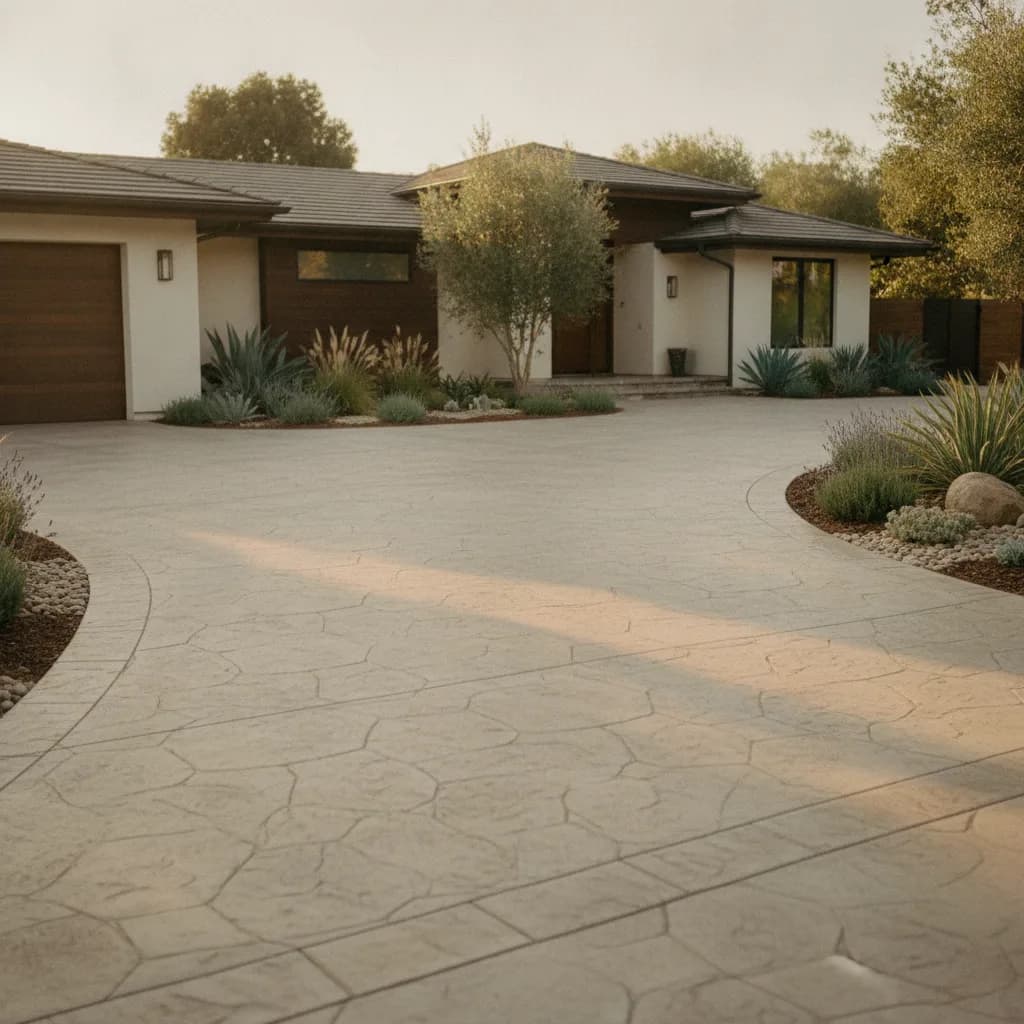
A new concrete driveway is a significant investment in your home's curb appeal and functionality. Planning the budget, however, involves more than multiplying a square footage by a generic unit price. The true concrete driveway cost depends on site-specific conditions, demolition requirements, material choices, and the thoroughness of the preparation work. This guide provides a framework for understanding these variables and planning your project in California.
A planning guide offers a starting point for budgeting, but it is not a substitute for a written quote from a qualified contractor who has assessed your property. Use these scenarios to ask informed questions and ensure the bids you receive cover the same complete scope of work. Before diving into costs, understanding the fundamentals of proper installation is key, as covered in our comprehensive guide to driveways and pavers.
In a Nutshell: California Concrete Driveway Cost Scenario
This article uses a hypothetical 24x24 foot (576 sq ft) two-car driveway as a planning example. The figures presented are for budget estimation and do not represent a formal quote or reflect prices for any specific location in California.
- Scenario Scope: Installation of a new 576 sq ft concrete driveway.
- Assumed Unit Costs: Based on sourced data, we use a range of $6 to $26 per square foot, depending on the finish and complexity. Demolition is assumed to cost an additional $2 to $6 per square foot.
- Explicit Assumptions: Prices assume a level site with clear access for heavy equipment and material delivery. Soil conditions are assumed to be stable and not require extensive amendment.
- Excluded Work: This analysis excludes costs for extensive grading, retaining walls, complex drainage systems (like French drains), landscaping, lighting, or permit fees, which vary by municipality.
- The Biggest Question to Resolve: What level of site preparation does your property require? The condition of the subgrade, which is the native soil compacted and prepared to support the driveway structure, and the plan for drainage, the system for moving rainwater away from the driveway and your home's foundation, are the most significant variables affecting both the final cost and the long-term durability of the installation.
Hypothetical Concrete Driveway Cost Scenarios
To illustrate how project scope affects the total concrete driveway cost, we've created three hypothetical planning scenarios for a 576-square-foot driveway in California. These are not documented projects but are examples based on transparent assumptions and sourced cost ranges. Your actual costs will vary based on your contractor's assessment, material choices, and local labor rates.
Basic Driveway: Plain Concrete Replacement
This scenario assumes the removal of an existing, damaged driveway and replacement with a standard, broom-finished concrete slab.
- Scope: Demolish and haul away 576 sq ft of old concrete. Prepare base and pour a 4-inch slab of plain concrete with a light broom finish.
- Assumed Demolition Cost: 576 sq ft @ $4/sq ft (hypothetical rate within the $2-$6 range) = $2,304
- Assumed Installation Cost: 576 sq ft @ $9/sq ft (hypothetical rate within the $6-$15 range) = $5,184
- Hypothetical Total: $7,488
- Exclusions: Does not include costs for correcting underlying subgrade issues, adding reinforcement beyond basic wire mesh, or installing new drainage solutions.
Mid-Range Driveway: New Driveway with Enhanced Durability
This scenario is for installing a new driveway where none existed before, requiring more extensive site preparation and including common upgrades for better longevity.
- Scope: Excavate 576 sq ft of lawn and soil. Install and compact an aggregate base. Pour a 4-inch slab with rebar reinforcement and control joints.
- Assumed Excavation & Base Prep Cost: Priced as a lump sum, assumed here at $2,500 for this example.
- Assumed Installation Cost: 576 sq ft @ $12/sq ft (hypothetical rate within the $6-$15 range, accounting for rebar) = $6,912
- Hypothetical Total: $9,412
- Exclusions: Does not include costs for significant grading, decorative finishes, or sealing.
Expanded Driveway: Stamped and Colored Concrete
This high-end scenario involves decorative options for a premium look, along with solid preparation for a challenging site.
- Scope: Demolish an old driveway. Correct subgrade issues and install a new compacted base with a drainage channel. Pour a reinforced slab with integral color and a stamped pattern (e.g., stone or brick). Includes cleanup and sealing.
- Assumed Demolition & Site Prep Cost: Assumed lump sum of $4,500 for this complex example.
- Assumed Stamped Concrete Cost: 576 sq ft @ $18/sq ft (hypothetical rate within the $8-$26 range) = $10,368
- Hypothetical Total: $14,868
- Exclusions: Does not include costs for custom color matching, multiple patterns, or landscape integration.
Key Site Questions That Change Your Quote
A contractor's quote is a response to the specific conditions of your property. The price of a concrete driveway is not just about square footage. Ask any potential installer how their proposal addresses these critical site-specific factors. A low bid that ignores them may lead to costly change orders or a failed driveway.
Access: Can a full-size concrete mixer truck reach the installation area? If not, the contractor may need to use a smaller truck, a concrete pump, or wheelbarrows, all of which add significant labor costs. Tight access through narrow side yards or on steep slopes will increase the price.
Demolition and Removal: What needs to be removed? Tearing out old, thin asphalt is easier and cheaper than breaking up a six-inch thick, rebar-reinforced concrete slab. The cost, which HomeGuide notes can be $2 to $6 per square foot, depends on thickness, reinforcement, and disposal fees. Removing soil, rocks, or large tree roots also adds to the cost.
Subgrade and Soil Conditions: California has diverse soil types, including expansive clays that swell when wet and shrink when dry. This movement can crack a poorly supported driveway. Ask the installer how the base design accounts for your specific soil. A proper base involves excavating weak soil, laying down a layer of aggregate (crushed rock), and compacting it to create a stable platform. The thickness and type of base material are critical decisions that affect cost and performance.
Drainage: Where will rainwater go? A driveway should be sloped (typically a minimum of one-quarter inch per foot) to direct water away from your home's foundation and into a safe area like a street or drainage system. In some cases, a simple slope is not enough. Your site might require channel drains, French drains, or a dry well to manage water effectively, especially on sloped properties or in areas with heavy rainfall. Put the proposed drainage work in the quote so competing bids cover the same job.
Utilities: Are there underground utility lines? Gas, water, sewer, and electrical lines must be located before any excavation begins. The contractor is responsible for contacting 811 (the "Call Before You Dig" service), but rerouting a utility line that is unexpectedly in the way can be a major additional expense.
Hypothetical Planning Examples, Not Documented Projects
Ready to compare vetted project options?
Use Project Match privately when your scope is clear enough for contractor conversations.
Start Project MatchTo further clarify how scope drives cost, let's compare three distinct hypothetical driveway projects. These examples use transparent arithmetic based on our assumed rates. They are planning tools, not representations of actual invoices.
Example 1: Small Driveway Extension (200 sq ft)
A homeowner wants to add a small parking pad next to their existing driveway.
- Scope: Excavate 200 sq ft of lawn. Install a compacted aggregate base. Pour a 4-inch plain concrete slab to match the existing elevation.
- Assumptions: Easy site access. No demolition required. Standard broom finish.
- Hypothetical Cost Calculation:
- Mobilization & Site Prep (minimum charge for small job): $1,000 (assumed)
- Installation: 200 sq ft @ $15/sq ft (higher unit cost assumed for small scale) = $3,000
- Estimated Total: $4,000
Example 2: Large Replacement on a Slope (1,200 sq ft)
A property on a hillside needs a long, sloping driveway replaced. The old one is badly cracked due to poor water management.
- Scope: Demolish and remove 1,200 sq ft of old concrete. Re-grade the subgrade for improved stability. Install a 6-inch aggregate base. Install a channel drain across the driveway at the garage entrance. Pour a 5-inch thick, air-entrained concrete slab with rebar reinforcement for extra strength on the slope.
- Assumptions: The slope requires thicker concrete and solid reinforcement. A drainage system is essential.
- Hypothetical Cost Calculation:
- Demolition: 1,200 sq ft @ $5/sq ft = $6,000
- Excavation, Grading, & Base: $4,000 (assumed lump sum)
- Drainage System: $1,500 (assumed)
- Installation (thicker, reinforced): 1,200 sq ft @ $14/sq ft = $16,800
- Estimated Total: $28,300
Example 3: Decorative Circular Driveway (900 sq ft)
A homeowner is installing a new circular driveway as part of a major landscape renovation. They want a high-end look.
- Scope: Major excavation and grading to create the circular shape. Install a compacted base. Pour a reinforced slab with an integral 'sandstone' color. Apply a smooth slate texture stamp. Include a contrasting stamped border. Clean, cure, and apply two coats of high-gloss sealer.
- Assumptions: Complex formwork for the circular shape. Two-step decorative process (color and stamp). Premium materials.
- Hypothetical Cost Calculation:
- Excavation & Base Prep: $5,000 (assumed for complex shape)
- Installation (stamped, colored, sealed): 900 sq ft @ $22/sq ft (within the $8-$26 range) = $19,800
- Estimated Total: $24,800
What a Detailed Driveway Quote Includes
A professional quote is more than a single number; it is a statement of work. A detailed bid protects both you and the contractor by creating a clear set of expectations. Vague quotes make it impossible to compare bids accurately. Your quote should explicitly list the following:
- Demolition and Disposal: The scope of removal (e.g., concrete, asphalt, soil), the thickness of the material being removed, and confirmation that all debris will be legally disposed of.
- Site Preparation: The depth of excavation for the subgrade and the type and compacted thickness of the aggregate base material. Insist that these dimensions are included.
- Formwork: Setting the forms that will contain the wet concrete and define the shape and edges of the driveway.
- Reinforcement: The type, size, and spacing of the reinforcement material. This could be welded wire mesh or steel rebar. Ask the contractor to specify the plan for supporting the reinforcement in the middle of the slab, not on the ground.
- Concrete Specifications: The specified compressive strength of the concrete mix, measured in pounds per square inch (PSI). A typical residential driveway uses 3,000 to 4,000 PSI concrete. The quote should also specify the slab thickness.
- Finishing: The type of finish (e.g., broom finish, trowel finish, stamped pattern, exposed aggregate) and any coloring agents or hardeners to be used.
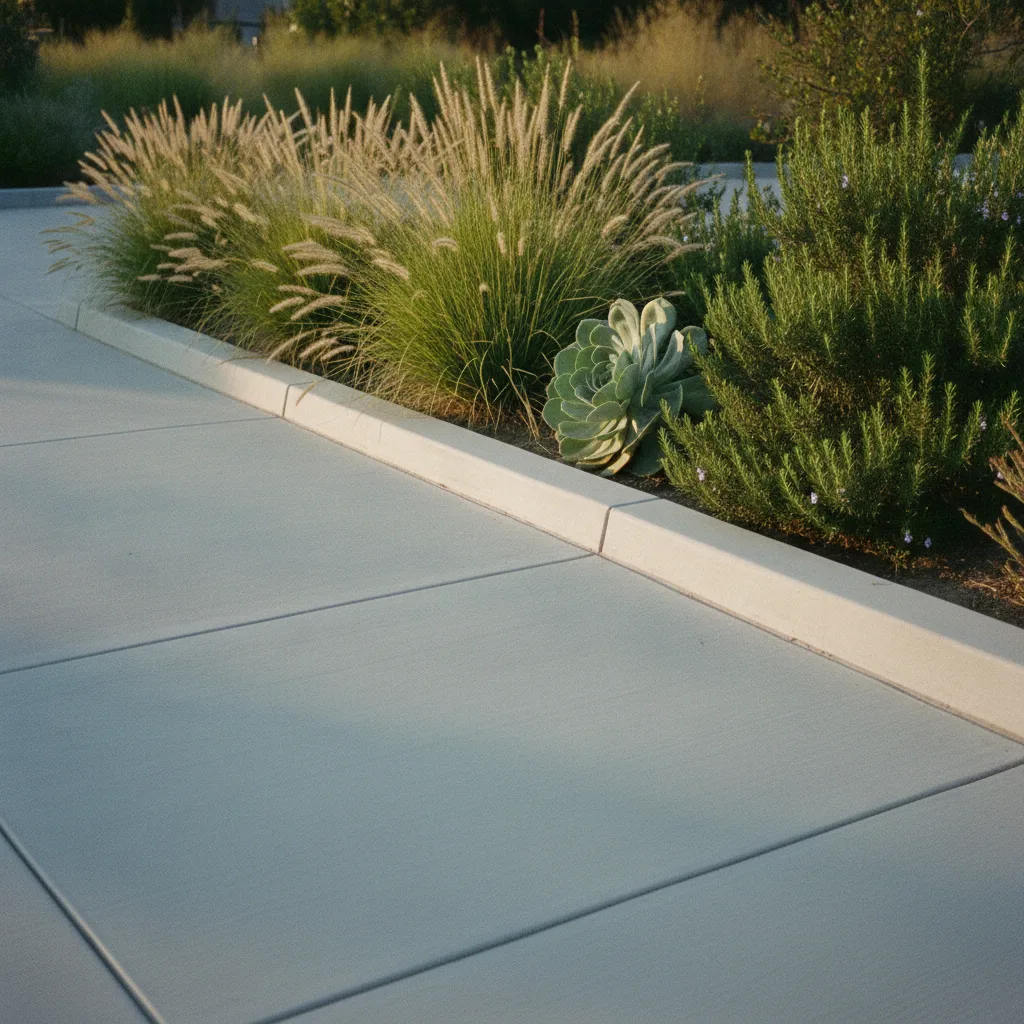
- Control Joints: The plan for cutting or placing joints to control where the concrete will inevitably crack as it cures and settles. The layout and depth of these joints are critical.
- Curing and Sealing: The method for curing the concrete to ensure it reaches its full strength. It should also specify if a protective sealer will be applied, including the type of sealer and number of coats.
- Site Cleanup: A commitment to remove all construction debris, clean adjacent surfaces, and repair any minor landscape damage.
- Permits: A statement of who is responsible for securing and paying for any required local building permits.
- Warranty: A clear description of the warranty on both materials and workmanship, including what is covered and for how long.
Planning for a Financial Reserve
For any major construction project, it is practical to include a financial reserve or contingency fund in your budget. This is not an industry rule but an optional planning assumption you can make to prepare for unforeseen issues. A reserve is a portion of your total budget, perhaps five to fifteen percent, set aside for surprises.
What could this cover? During excavation, the contractor might discover unstable soil that requires extra work to stabilize. They might uncover an old, abandoned utility line or a septic tank that needs to be removed. Or, you might decide to make a scope change mid-project, such as upgrading the finish or adding a walkway. Having a reserve planned means these discoveries or decisions do not derail the project or create financial stress. The amount you choose to reserve depends on the age of your home and the uncertainty of the site conditions. For a simple replacement on a known, stable site, a smaller reserve may be sufficient. For a complex project on a property with known soil or drainage issues, a larger reserve provides more peace of mind.
Contractor Quote Checklist
When you meet with potential contractors, use this checklist to guide your conversation. A professional installer should be able to answer these questions clearly and incorporate the details into their written proposal. Their willingness to discuss these points is a good indicator of their expertise.
- Are you licensed and insured in California? Can you provide proof of your license and general liability and workers' compensation insurance?
- How many years have you been installing concrete driveways in this area? Can you provide references or a portfolio of local work?
- Based on your site assessment, what is the planned thickness of the compacted base and the concrete slab itself?
- What type of soil do you see on my property, and how will your base preparation method account for it?
- What reinforcement (wire mesh or rebar) do you recommend for my project, and why? How will it be positioned within the slab?
- What concrete strength (PSI) and mix will you be using? Will it include any special additives for durability?
- What is your plan for drainage? How will you ensure water flows away from my house's foundation?
- How and when will you place control joints to manage cracking?
- What is your process for curing the concrete after it's poured? This is critical for long-term strength.
- Does your price include obtaining necessary permits from my city or county?
- How will you protect my house, existing landscaping, and sidewalks during construction?
- What is the total project timeline, from start to finish? When can we use the driveway?
- What does your warranty cover, and for what duration? Please provide this in writing.
- What are the payment terms? What is the deposit amount and schedule for subsequent payments?
How to Compare Driveway Bids
When you receive multiple bids, the lowest price is not automatically the best value. A cheap bid often signals that corners are being cut, usually in the unseen but critical preparation work. To compare bids effectively, create a simple spreadsheet and list the key specifications from each proposal side-by-side.
Check for consistency in the base thickness, concrete thickness, reinforcement type, and concrete PSI. If one bid specifies a two-inch base and another specifies a six-inch base, they are not for the same job. The six-inch base will cost more but will provide far superior support. Call the contractors and ask them to clarify any missing information or discrepancies. For example, if one quote omits any mention of reinforcement, ask why they believe it is not necessary for your project.
Pay close attention to exclusions. Does the price include demolition, hauling away debris, and permit fees? A bid that seems low might be excluding these essential items, which you will have to pay for later. Once you have normalized the bids to ensure they all cover the same scope of work, you can make an informed decision based on price, contractor experience, and your confidence in their approach. For more help estimating your specific project, you can use a tool like this concrete driveway cost calculator to organize your assumptions.
Frequently Asked Questions
What is the average cost of a concrete driveway in California?
Based on sourced data, a plain concrete driveway in California can cost between $6 and $15 per square foot. For a typical two-car driveway of 576 square feet, this suggests a hypothetical project range of $3,500 to $8,600. Decorative options like stamped concrete can increase the cost to $8 to $26 per square foot.
These figures are for planning purposes only and are not an average for a specific metro area. The final concrete driveway cost depends heavily on site-specific factors like demolition needs ($2 to $6 per square foot extra), soil conditions, site access, and the level of reinforcement and base preparation required for a durable installation.
How long does a concrete driveway last?
A properly installed concrete driveway should last 25 to 50 years. Longevity depends almost entirely on the quality of the installation, particularly the preparation of the subgrade and base, the use of appropriate reinforcement, and proper drainage. A thin slab on poorly compacted soil can fail in less than a decade.
Other factors influencing lifespan include the local climate, the amount and weight of vehicle traffic, and maintenance. Regular cleaning and sealing the concrete every few years can protect it from water penetration, stains, and surface degradation, helping it reach or exceed its expected service life.
Do I need a permit for a new driveway in California?
Most cities and counties in California require a permit for installing a new driveway or significantly altering an existing one. Permits ensure the project complies with local regulations regarding setbacks from property lines, driveway width, curb cuts, and drainage. They also trigger inspections to verify proper construction.
Never assume a permit is not needed. Ask your contractor or check directly with your local building or public works department. The contractor should typically handle the permit process, but you should confirm who is responsible. Working without a required permit can result in fines and orders to remove the work.
Is stamped concrete more expensive than pavers?
The cost of stamped concrete and pavers can overlap significantly. Generally, basic stamped concrete is often less expensive than high-end interlocking pavers. However, complex stamped concrete with multiple colors and patterns can cost as much as or more than a standard paver installation.
Stamped concrete costs are estimated between $8 and $26 per square foot. Paver costs have a similarly wide range. The choice between them often comes down to aesthetic preference and maintenance considerations. Stamped concrete requires periodic sealing to maintain its appearance, while pavers may need occasional re-leveling or joint sand replacement.
Is rebar necessary in a concrete driveway?
While not always required by code for every situation, including steel reinforcement like rebar is a best practice for ensuring a driveway's long-term durability. Rebar adds tensile strength, helping the concrete slab resist cracking from soil movement, heavy loads, and thermal expansion and contraction. It is especially important in California's varied soil conditions.
Some contractors may propose using welded wire mesh instead of rebar. While mesh can help control the width of shrinkage cracks, it does not provide the same structural strength as a grid of rebar. Ask your contractor to explain their reinforcement choice and how it is appropriate for your specific site conditions and vehicle loads.
Sources & Methodology
See the Golden Yards Methodology for how sources are reviewed, ranges are normalized, and planning-data limits are handled.
The cost ranges in this article are based on publicly available data for planning purposes. They are not a substitute for a professional quote. We used the following sources for our hypothetical scenarios:
- HomeGuide provided installation cost ranges for plain concrete ($6 to $15 per sq. ft.), stamped concrete ($8 to $26 per sq. ft.), and driveway removal ($2 to $6 per sq. ft.).
The scenarios and examples presented are hypothetical and include assumed values for labor and materials to demonstrate how costs are calculated. All project costs should be verified with qualified local contractors who have assessed your specific property.
Golden Yards Magazine Take
The durability of a concrete driveway is determined long before the truck arrives to pour. It is defined by the quality of the unseen preparation work: the excavation, the subgrade compaction, and the aggregate base. A lower bid that saves money by skimping on this foundation is no bargain; it is a down payment on a replacement. Your primary task is to ensure that every quote you receive is for the same solid, site-appropriate preparation. Insist that proposals specify the compacted base thickness, the concrete slab thickness, the concrete's strength rating (PSI), and the type and placement of steel reinforcement. A contractor who is hesitant to commit these details in writing may not be the right partner for your project.
Ready to start your driveway project?
Find My ProsFrequently Asked Questions
What is the average cost of a concrete driveway in California?
Based on sourced data, a plain concrete driveway in California can cost between $6 and $15 per square foot. For a typical two-car driveway of 576 square feet, this suggests a hypothetical project range of $3,500 to $8,600. Decorative options like stamped concrete can increase the cost to $8 to $26 per square foot.
These figures are for planning purposes only and are not an average for a specific metro area. The final concrete driveway cost depends heavily on site-specific factors like demolition needs ($2 to $6 per square foot extra), soil conditions, site access, and the level of reinforcement and base preparation required for a durable installation.
How long does a concrete driveway last?
A properly installed concrete driveway should last 25 to 50 years. Longevity depends almost entirely on the quality of the installation, particularly the preparation of the subgrade and base, the use of appropriate reinforcement, and proper drainage. A thin slab on poorly compacted soil can fail in less than a decade.
Other factors influencing lifespan include the local climate, the amount and weight of vehicle traffic, and maintenance. Regular cleaning and sealing the concrete every few years can protect it from water penetration, stains, and surface degradation, helping it reach or exceed its expected service life.
Do I need a permit for a new driveway in California?
Most cities and counties in California require a permit for installing a new driveway or significantly altering an existing one. Permits ensure the project complies with local regulations regarding setbacks from property lines, driveway width, curb cuts, and drainage. They also trigger inspections to verify proper construction.
Never assume a permit is not needed. Ask your contractor or check directly with your local building or public works department. The contractor should typically handle the permit process, but you should confirm who is responsible. Working without a required permit can result in fines and orders to remove the work.
Is stamped concrete more expensive than pavers?
The cost of stamped concrete and pavers can overlap significantly. Generally, basic stamped concrete is often less expensive than high-end interlocking pavers. However, complex stamped concrete with multiple colors and patterns can cost as much as or more than a standard paver installation.
Stamped concrete costs are estimated between $8 and $26 per square foot. Paver costs have a similarly wide range. The choice between them often comes down to aesthetic preference and maintenance considerations. Stamped concrete requires periodic sealing to maintain its appearance, while pavers may need occasional re-leveling or joint sand replacement.
Is rebar necessary in a concrete driveway?
While not always required by code for every situation, including steel reinforcement like rebar is a best practice for ensuring a driveway's long-term durability. Rebar adds tensile strength, helping the concrete slab resist cracking from soil movement, heavy loads, and thermal expansion and contraction. It is especially important in California's varied soil conditions.
Some contractors may propose using welded wire mesh instead of rebar. While mesh can help control the width of shrinkage cracks, it does not provide the same structural strength as a grid of rebar. Ask your contractor to explain their reinforcement choice and how it is appropriate for your specific site conditions and vehicle loads.