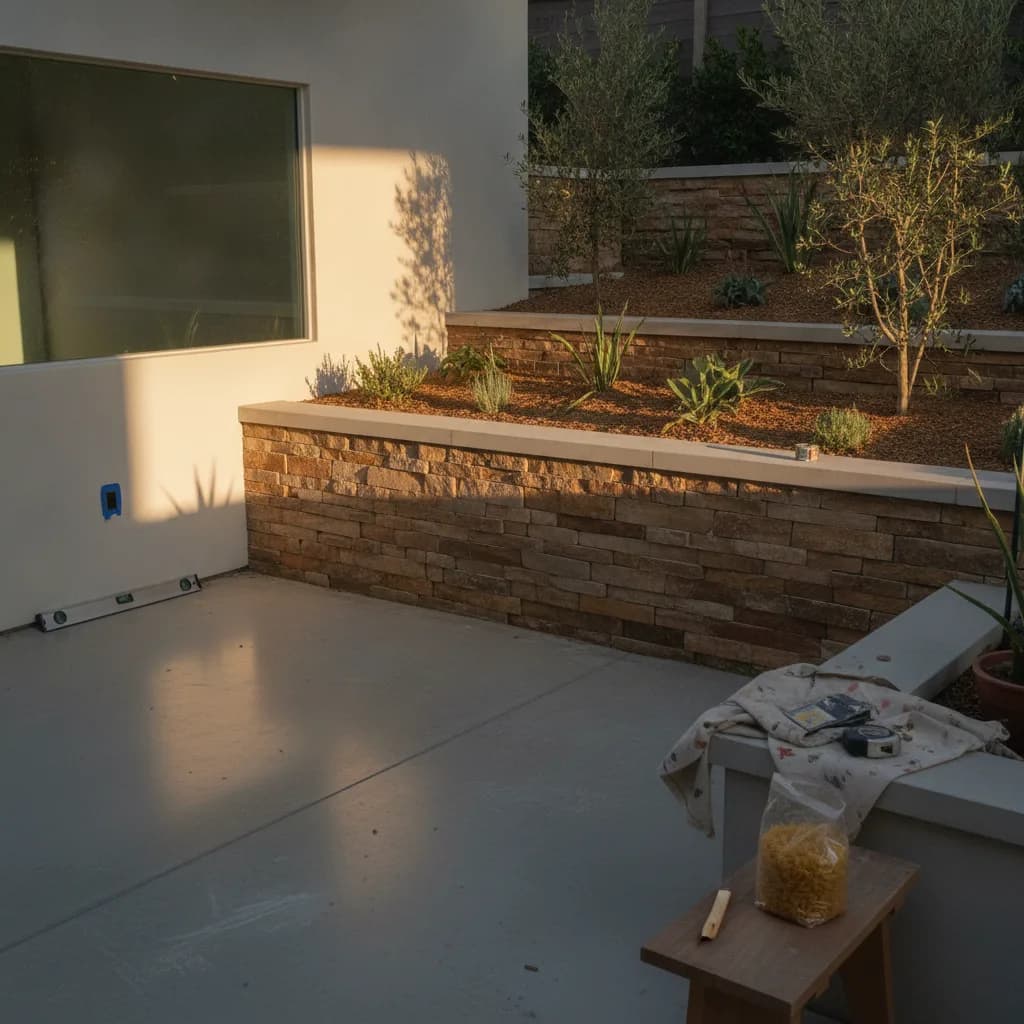
A properly engineered retaining wall in Newport Beach will cost between $45,000 and $120,000 in 2026, with many projects landing in the $60,000 to $90,000 range for a standard 50-foot wall. The final price tag for a retaining wall contractor in Newport Beach is driven by soil conditions, height, and site access. While costs can start lower, around $25,000, this typically applies to non-structural, low-height garden walls on flat lots, not the engineered systems required for hillside stabilization or significant grade changes common in the area.
In a Nutshell
- Total Cost Range: $25,000 (simple, low-height block) to $200,000+ (complex, engineered concrete on a hillside).
- Mid-Range Project Average: $75,000 for a 50-foot long, 5-foot high engineered CMU wall with a stucco finish and proper drainage.
- Typical Timeline: Six to ten weeks from signed contract to final inspection. Three to four of those weeks are for engineering, plans, and city permits before a single shovel hits the dirt.
- Biggest Surprise Line Item: The Geotechnical Soils Report. It can add $3,500 to $7,000 to the budget before any construction begins, and it's non-negotiable for most permitted walls.
What does a Retaining Wall actually cost in Newport Beach in 2026?
The cost is a direct function of the forces the wall must resist. A garden planter wall is a simple material bill; a wall holding up a driveway or a hillside home is an engineered system where the visible block or concrete is the last, and sometimes least expensive, component. Below are three tiers of investment for a typical 50-foot long retaining wall.
| Tier | Description | Estimated Cost Range |
|---|---|---|
| Basic | Low-height (under 4 feet) segmental block wall on a flat lot with easy access. Pre-engineered system, minimal excavation, no special inspections. | $25,000, $40,000 |
| Mid-Range | 4 to 6-foot high Concrete Masonry Unit (CMU) wall requiring full structural engineering and city permits. Includes deep footings, epoxy-coated rebar, waterproofing, and a complete back-drain system. | $60,000, $95,000 |
| Premium | Tall (over 6 feet) or tiered cast-in-place concrete wall on a sloped or difficult-access site. Requires extensive geotechnical analysis, shoring, deputy inspections, and a premium finish like stone veneer or architectural concrete. | $120,000, $250,000+ |
For a representative mid-range $75,000 project, the budget allocation is heavily weighted toward the non-visible components:
- Engineering & Permitting (15%): $11,250
- Excavation, Haul-Off & Site Prep (18%): $13,500
- Materials (Footings, Rebar, Block, Drainage) (22%): $16,500
- Labor & Equipment (35%): $26,250
- Contractor Overhead & Profit (10%): $7,500
The bottom-of-the-range case, a simple block garden wall, involves none of the engineering, inspection, or heavy excavation costs that define a structural retaining wall project in Newport Beach.

Why is a retaining wall more expensive in Newport Beach than inland?
Three factors drive up the retaining wall newport beach cost: coastal geology, specialized labor, and material specifications designed to fight saltwater corrosion.
1. Geotechnical and Permitting Complexity
The soils in coastal Orange County, particularly in hillside areas like Corona del Mar and Newport Coast, are often expansive clays or unstable sandy loams. Any wall over four feet in height (measured from the bottom of the footing, per the California Building Code) requires a permit from the Newport Beach Building Division, which in turn triggers the need for a geotechnical soils report and stamped structural engineering plans. This front-loads thousands of dollars into the project before construction even starts, a cost often absent in areas with more stable soil.
2. Skilled Labor Rates and Neighborhood Premiums
Finding a qualified retaining wall contractor in Newport Beach means competing for a limited pool of experienced masons and equipment operators. According to the California Department of Industrial Relations prevailing wage data for Orange County, skilled construction labor rates are among the highest in Southern California., contractors add a premium for working in neighborhoods like Balboa Island or Lido Isle, where tight access, limited staging areas, and strict work hours add significant logistical costs and time to the project.
3. Salt Air Corrosion Mitigation
A standard steel rebar cage will begin to corrode from ambient salt air, leading to concrete spalling and structural failure within ten to fifteen years. The local standard of care demands corrosion-resistant materials. The spec calls for epoxy-coated #5 rebar, hot-dip galvanized connectors, and comprehensive waterproofing membranes applied to the back of the wall. These materials add 15 to 20 percent to the raw material cost compared to an identical wall built 20 miles inland.
What do real Newport Beach homeowners spend in 2026?
Ready to compare vetted project options?
Use Project Match privately when your scope is clear enough for contractor conversations.
Start Project MatchThree representative projects from 2026, scoped similarly, reconstructed from Golden Yards Magazine's Project of the Day network and used here in aggregate form:
- Corona del Mar Hillside ($88,000): A 60-foot long, 6-foot high CMU wall was required to create a level patio area. The project involved significant excavation into a slope, shoring to protect the uphill property, and a comprehensive drainage system tied into the main storm drain. The geotechnical report and engineering plans alone were nearly $12,000.
- Eastbluff Property Line ($62,500): This project replaced a failing railroad tie wall between two properties. The 70-foot long, 4.5-foot high wall was straightforward but required careful coordination with the neighbor. The final cost included a stacked stone veneer finish to match the home's facade and a new vinyl fence on top.
- Back Bay View Terrace ($115,000): A tiered wall system with two 4-foot high walls was built to create a larger, usable outdoor space with a view. The project used cast-in-place concrete with a board-form finish. Costs were improved by difficult access for the concrete pump truck and the need for a deputy inspector to be on-site during the pour to verify rebar placement and concrete slump.
Where does the money actually go?
The contractor's bid focuses on the big items, but a significant portion of the budget for a Newport Beach retaining wall goes to services and materials you never see in the finished product.
- Geotechnical Soils Report: $3,500 - $7,000. This is the foundational document that dictates the engineering design.
- Structural Engineering & Plans: $4,000 - $9,000. A licensed civil engineer must design the wall's footings, rebar schedule, and drainage to comply with the soils report and city code.
- City Plan Check & Permit Fees: $2,500 - $6,000. These fees are calculated based on project valuation by the City of Newport Beach.
- Deputy Inspections: $1,200 - $3,000. For engineered walls, the city requires a third-party special inspector to verify critical structural elements like rebar placement and concrete strength.
- Excavation & Spoil Haul-Off: $4,000 - $10,000+. The cost to dig the footing and remove the dirt from the site. This is highly variable based on soil volume and site access.
- Subsurface Drainage System: $25 - $40 per linear foot. This includes the perforated pipe, #57 clean crushed rock, and non-woven geotextile separation layer that prevents hydrostatic pressure buildup, the number one cause of wall failure.
- Waterproofing Membrane: $15 - $25 per square foot. A commercial-grade membrane is applied to the entire backside of the wall to protect the structure from moisture intrusion.
What stops a Newport Beach retaining wall from running over budget?
Three issues typically derail a retaining wall budget: surprises below grade, mid-project design changes, and permit revisions.
1. Unforeseen Subsurface Conditions: The soils report provides a snapshot, but it's not exhaustive. Hitting a massive rock ledge, an old foundation, or a pocket of saturated, unstable soil during excavation can require different equipment and techniques, leading to change orders and delays.
2. Scope Creep: The initial plan for a simple stucco finish evolves into a desire for a custom stone veneer. Or, the homeowner decides to add integrated lighting, seating, or a water feature after the contract is signed. Each change adds material and labor costs that were not in the original bid.
3. Plan Check Corrections: The city's plan reviewer may require revisions to the engineering, such as a deeper footing or an altered drainage plan. This adds redesign fees from the engineer and can delay the permit issuance by weeks, impacting the contractor's schedule and potentially adding mobilization costs. The National Association of Home Builders recommends a ten to fifteen percent contingency on renovations in homes over thirty years old.
How can I estimate my retaining wall cost?
A precise estimate requires a site visit from a qualified contractor and, for larger walls, a preliminary geotechnical report. To understand the general cost drivers for hardscape projects in our area, you can model some scenarios. While we don't have a dedicated retaining wall tool, our Newport Beach driveway cost calculator can help you model the labor and material costs for a related hardscape project.
What should your Newport Beach contractor include in the quote?
A legitimate bid is not a one-page summary. It's a detailed scope of work that protects both you and the contractor. Insist on a line-item proposal that includes:
- A clear statement on who is responsible for pulling the city permit.
- Scope of demolition and site clearing.
- Excavation depth and width for the footing and drainage zone.
- Specification for subgrade compaction (e.g., to 95 percent Modified Proctor).
- Footing dimensions, concrete PSI (e.g., 3,500 PSI), and rebar schedule (e.g., #5 epoxy-coated rebar at 16 inches on center).
- Wall material specification (e.g., 8x8x16 CMU blocks, fully grouted).
- Waterproofing/dampproofing product name and application method.
- Detailed description of the drainage system: pipe type, gravel spec (e.g., 12 inches of #57 stone), and geotextile fabric type.
- Backfill material type and compaction requirements (e.g., compacted in 8-inch lifts).
- Finish material details (stucco color/texture, stone veneer type and mortar).
- Provision for special inspections and testing.
- A plan for site cleanup and haul-away of all construction debris.
- Warranty information for both materials and labor.
- For more on the city's requirements, you can review our Newport Beach retaining wall permit playbook.
Golden Yards Take
The most common point of failure for a Newport Beach retaining wall project is underestimating the cost and importance of everything that happens behind and below the wall. Homeowners get fixated on the stone veneer or the stucco color, but that's just the aesthetic skin. The real work, the part that determines if the wall lasts five years or fifty, is the engineering, the footing, and the drainage. Hydrostatic pressure is a relentless force. If your contractor's proposal is light on the details for water management, from the waterproofing membrane to the geotextile-wrapped drain rock, it's the wrong proposal. A callback for a failing retaining wall is not a simple fix; it's a complete teardown and rebuild. Get the subgrade and drainage right. The rest is just finish work.
Sources & Methodology
Golden Yards reviews public permit and code signals, material pricing, climate and site constraints, contractor quote patterns, comparable projects, the Golden Yards Cost Index, and the Golden Yards Methodology. Cost references are planning ranges, not fixed bids.
- National Association of Home Builders (NAHB) Construction Cost Survey
- California Department of Industrial Relations, Orange County Prevailing Wage Data
- City of Newport Beach Building Division, Permit Fee Schedule
- California Contractors State License Board (CSLB), Contractor Bid Guidelines
- American Concrete Institute (ACI), ACI 318 Building Code Requirements for Structural Concrete
- Interlocking Concrete Pavement Institute (ICPI), Tech Spec for Segmental Retaining Walls
- Golden Yards Magazine Editorial Methodology, 2026 Project Data
Ready to start your hardscaping project?
Find My ProsFrequently Asked Questions
How much does a simple retaining wall cost per linear foot in Newport Beach?
In Newport Beach, a simple block retaining wall under four feet tall costs $300 to $500 per linear foot. For engineered walls requiring permits and extensive drainage, the price increases to $900 to $1,800 per linear foot or more. The primary cost differentiator is whether the wall is a structural system or a simple garden feature.
The lower $300 to $500 price point assumes easy site access and no complex soil issues for a non-structural garden wall. The significant jump to $900 to $1,800 per foot for an engineered wall is due to its function as a structural system, for instance, holding back a slope or supporting a driveway. This higher cost includes upfront expenses for geotechnical reports and structural plans. It also accounts for more expensive materials, such as epoxy-coated rebar and heavy-duty drainage composites, which are necessary for permitted, structural projects.
Do I need a permit for a retaining wall in Newport Beach?
Yes, a permit from the Newport Beach Building Division is required for retaining walls over four feet high, measured from the footing's bottom to the wall's top. Any wall supporting a surcharge, such as a driveway or slope, also needs a permit regardless of its height. Building without one is a significant risk.
The four-foot height measurement is crucial, as it includes the entire structure from the bottom of the footing, not just the exposed portion. The permitting process ensures a licensed engineer designs the wall to safely handle your property's specific soil pressures and loads, which is essential for long-term stability. Proceeding without a permit can result in stop-work orders, fines, and an order to tear down the unpermitted structure.
What is the biggest hidden cost in a retaining wall project?
The biggest hidden cost is the combination of a geotechnical soils report and structural engineering plans, which can total $7,500 to $16,000 before construction begins. For any significant retaining wall in Newport Beach, this upfront investment in professional services is not optional and forms the foundation for a safe, durable wall.
Homeowners are often surprised by this significant cost. The geotechnical engineer determines the soil's properties, which is critical information. A structural engineer then uses that data to design the footing size, the amount and grade of steel reinforcement, and the specific drainage requirements for the project. Attempting to reduce costs during this phase is the most direct path to premature wall failure.
How long does a properly built retaining wall last?
A properly engineered concrete retaining wall should last 50 to 100 years. Its longevity depends on controlling hydrostatic pressure with effective drainage and waterproofing. In contrast, timber or railroad tie walls have a much shorter lifespan of 15 to 20 years, especially in damp, salt-laden coastal air like Newport Beach.
The key to a concrete masonry unit or cast-in-place wall's long life is not the material itself, but the performance of the system behind it. If drainage and waterproofing control water pressure, the structure will endure. Timber walls are susceptible to rot and insect damage, a significant issue in the coastal environment of Newport Beach. Although less expensive initially, their need for replacement within 15 to 20 years makes them a more costly choice over the long term.
Can I save money by using a segmental block wall instead of poured concrete?
Yes, for walls under four feet, a segmental retaining wall (SRW) system can be more cost-effective than poured concrete. SRWs may not require the same level of engineering and use dry-stacked blocks, avoiding formwork and concrete trucks. For taller, structural walls, however, the cost savings can diminish significantly.
Taller SRW systems still require extensive excavation, geogrid reinforcement layered into the backfill, and the same solid drainage system as a concrete wall. While material costs might be slightly lower for a segmental wall, the labor for excavation and the precise installation of the geogrid can be intensive. These additional labor costs can offset the initial material savings. It is best to have a contractor price both options based on the specific engineering requirements for your site to determine the most economical solution.